Zeller Maximilian, Held Martina, Bender Julia, Berz Annuska, Heinloth Tanja, Hellfritz Timm, Pfeiffer Keram
Department of Biology - Animal Physiology, Philipps-University Marburg, Marburg, Germany.
PLoS One. 2015 Dec 2;10(12):e0143244. doi: 10.1371/journal.pone.0143244. eCollection 2015.
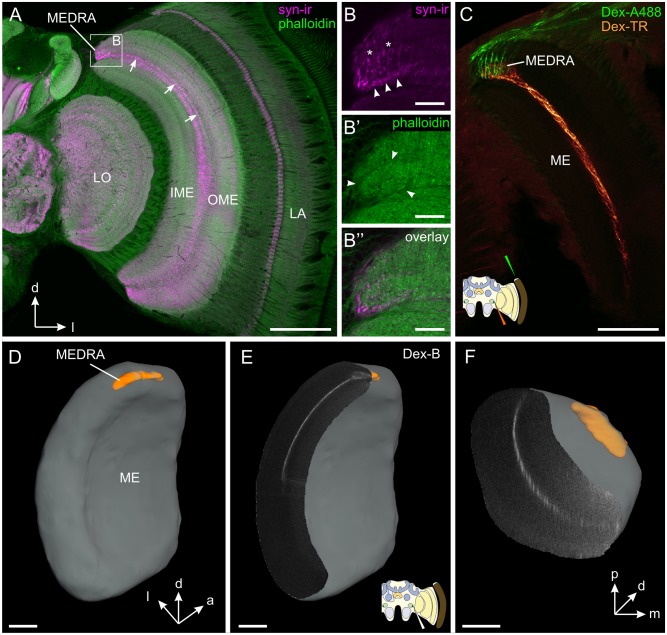
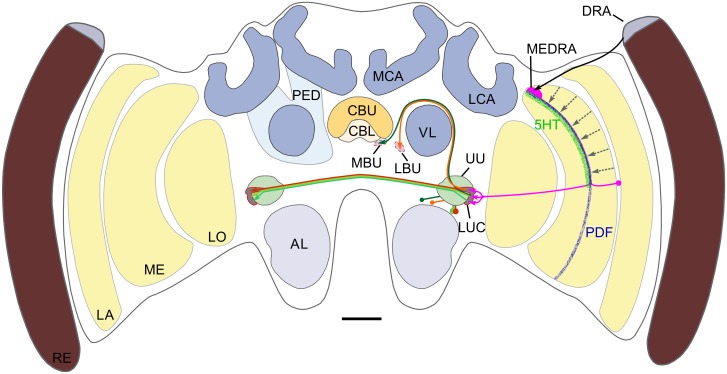
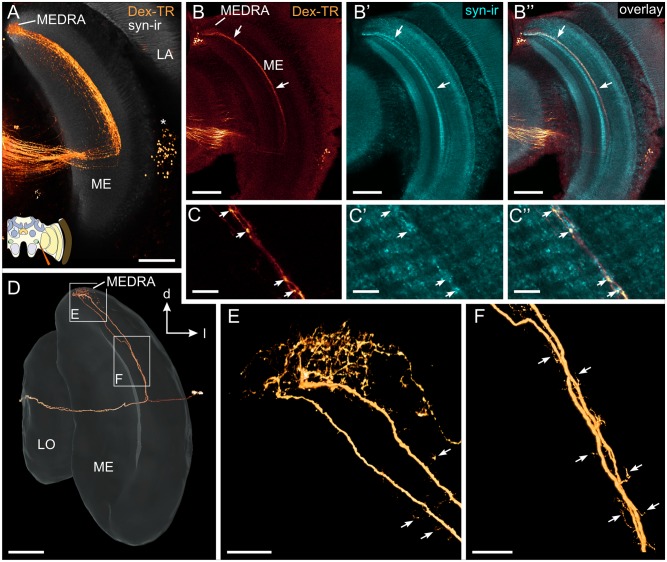
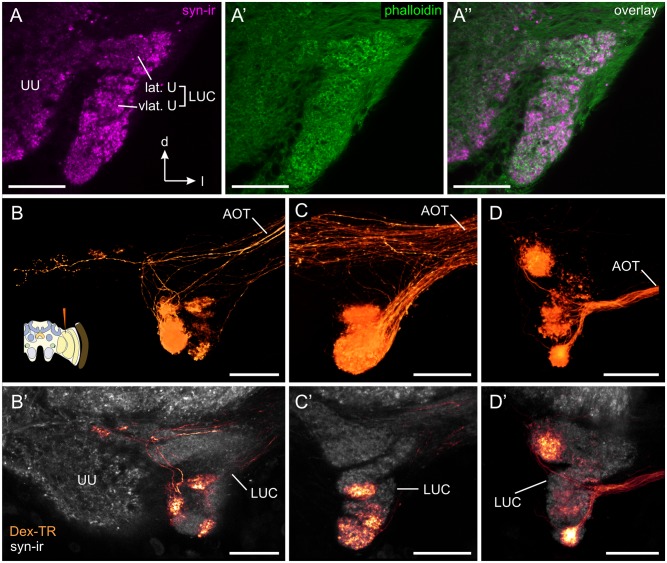
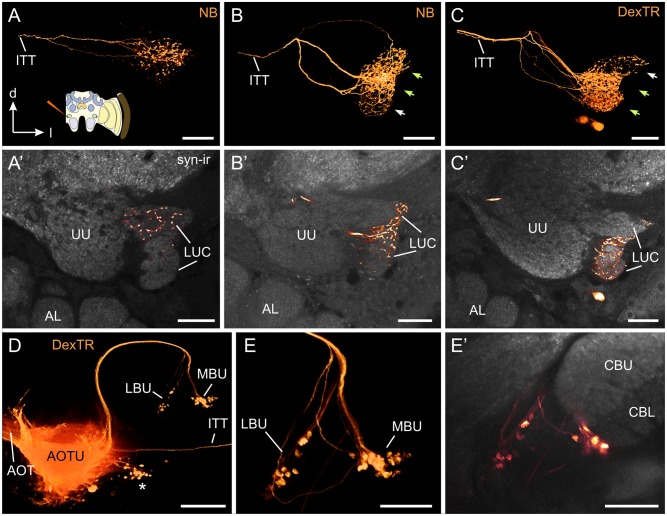
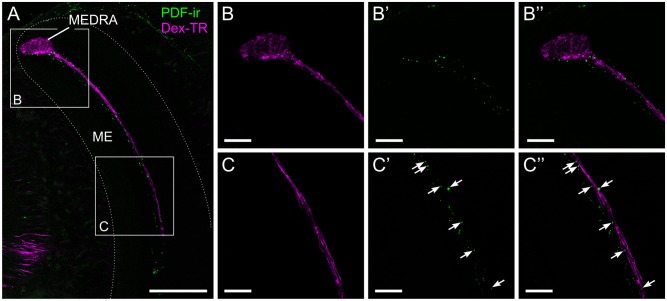
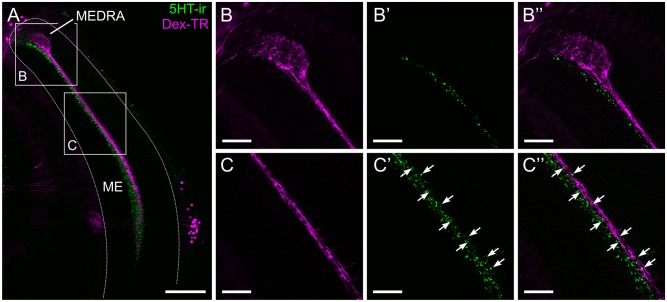
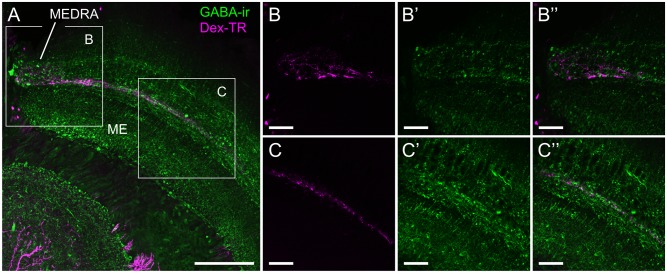
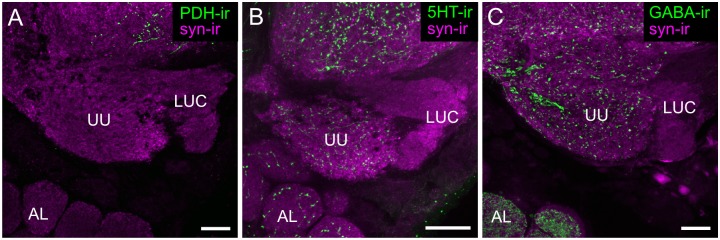
Honeybees are known for their ability to use the sun's azimuth and the sky's polarization pattern for spatial orientation. Sky compass orientation in bees has been extensively studied at the behavioral level but our knowledge about the underlying neuronal systems and mechanisms is very limited. Electrophysiological studies in other insect species suggest that neurons of the sky compass system integrate information about the polarization pattern of the sky, its chromatic gradient, and the azimuth of the sun. In order to obtain a stable directional signal throughout the day, circadian changes between the sky polarization pattern and the solar azimuth must be compensated. Likewise, the system must be modulated in a context specific way to compensate for changes in intensity, polarization and chromatic properties of light caused by clouds, vegetation and landscape. The goal of this study was to identify neurons of the sky compass pathway in the honeybee brain and to find potential sites of circadian and neuromodulatory input into this pathway. To this end we first traced the sky compass pathway from the polarization-sensitive dorsal rim area of the compound eye via the medulla and the anterior optic tubercle to the lateral complex using dye injections. Neurons forming this pathway strongly resembled neurons of the sky compass pathway in other insect species. Next we combined tracer injections with immunocytochemistry against the circadian neuropeptide pigment dispersing factor and the neuromodulators serotonin, and γ-aminobutyric acid. We identified neurons, connecting the dorsal rim area of the medulla to the anterior optic tubercle, as a possible site of neuromodulation and interaction with the circadian system. These neurons have conspicuous spines in close proximity to pigment dispersing factor-, serotonin-, and GABA-immunoreactive neurons. Our data therefore show for the first time a potential interaction site between the sky compass pathway and the circadian clock.
蜜蜂以其利用太阳方位角和天空偏振模式进行空间定向的能力而闻名。蜜蜂的天空罗盘定向在行为层面上已得到广泛研究,但我们对其潜在的神经元系统和机制的了解非常有限。对其他昆虫物种的电生理研究表明,天空罗盘系统的神经元整合了有关天空偏振模式、其颜色梯度和太阳方位角的信息。为了在一整天中获得稳定的方向信号,必须补偿天空偏振模式和太阳方位角之间的昼夜变化。同样,该系统必须以特定情境的方式进行调节,以补偿由云层、植被和地形引起的光强度、偏振和颜色特性的变化。本研究的目的是识别蜜蜂大脑中天空罗盘通路的神经元,并找到该通路中昼夜节律和神经调节输入的潜在位点。为此,我们首先通过染料注射追踪从复眼的偏振敏感背缘区域经髓质和前视结节到外侧复合体的天空罗盘通路。形成这条通路的神经元与其他昆虫物种的天空罗盘通路的神经元非常相似。接下来,我们将示踪剂注射与针对昼夜节律神经肽色素分散因子以及神经调节剂血清素和γ-氨基丁酸的免疫细胞化学相结合。我们确定连接髓质背缘区域和前视结节的神经元是神经调节以及与昼夜节律系统相互作用的一个可能位点。这些神经元在靠近色素分散因子、血清素和γ-氨基丁酸免疫反应性神经元的位置有明显的棘突。因此,我们的数据首次展示了天空罗盘通路与昼夜节律钟之间的一个潜在相互作用位点。