Palacios-Gimenez Octavio M, Carvalho Carlos Roberto, Ferrari Soares Fernanda Aparecida, Cabral-de-Mello Diogo C
UNESP-Univ. Estadual Paulista, Instituto de Biociências/IB, Departamento de Biologia, Rio Claro, SP, Brazil.
UFV-Univ. Federal de Viçosa, Centro de Ciências Biológicas, Departamento de Biologia Geral, Viçosa, MG, Brazil.
PLoS One. 2015 Dec 2;10(12):e0143540. doi: 10.1371/journal.pone.0143540. eCollection 2015.
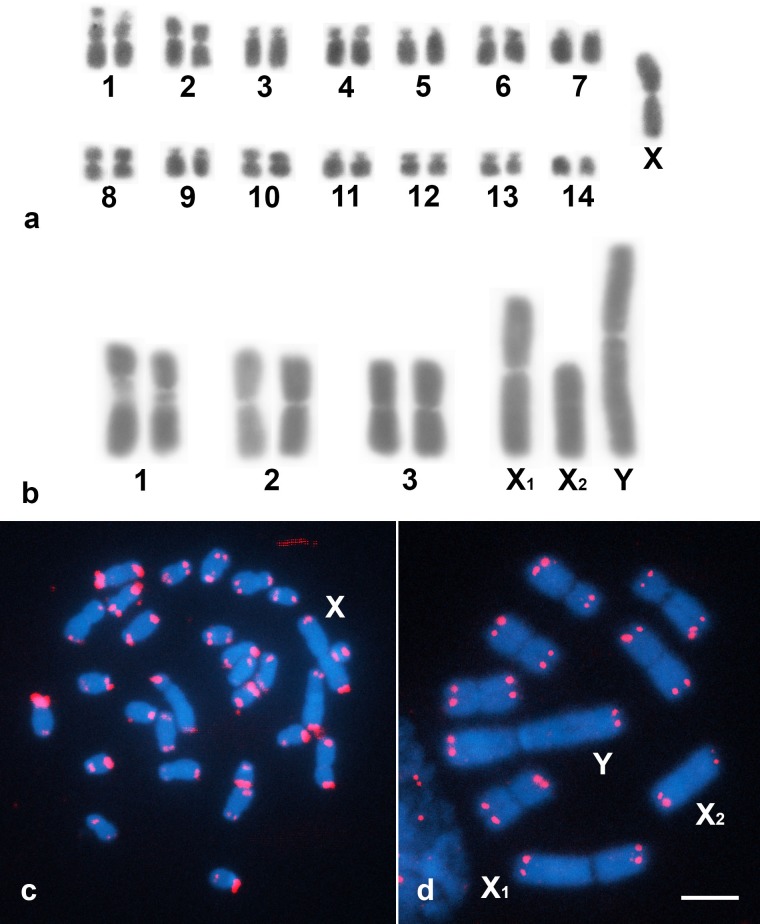
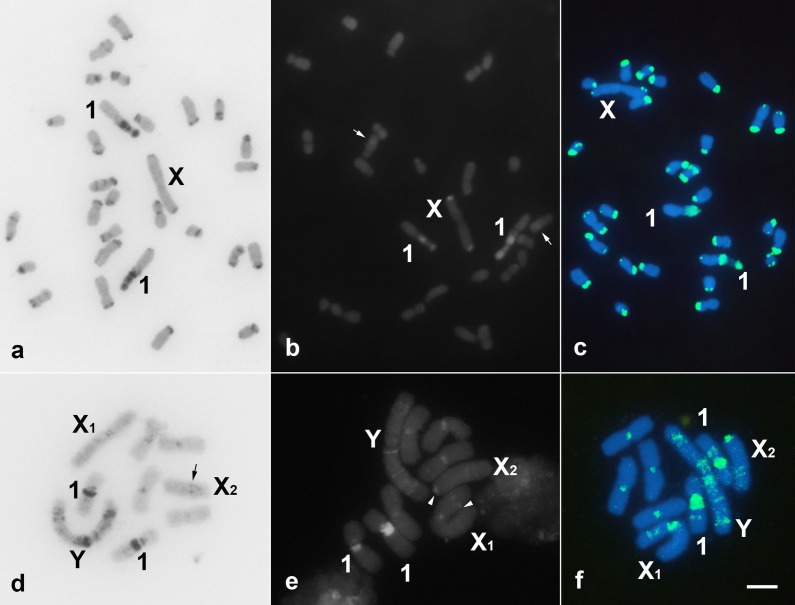
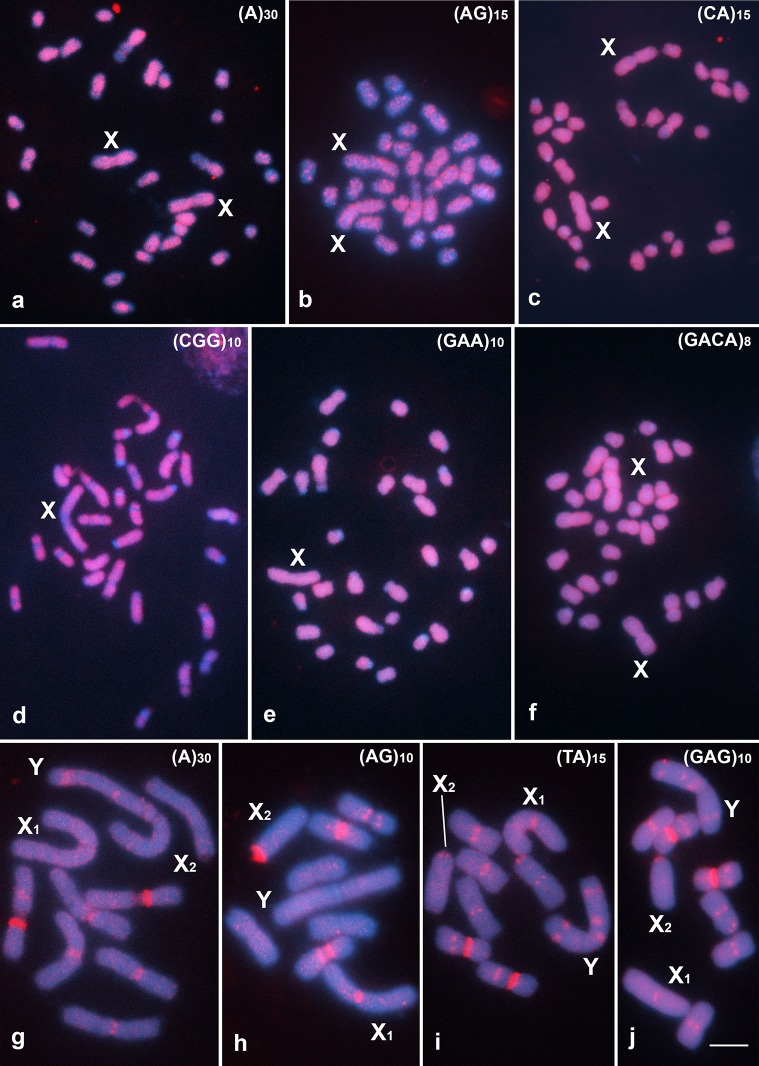
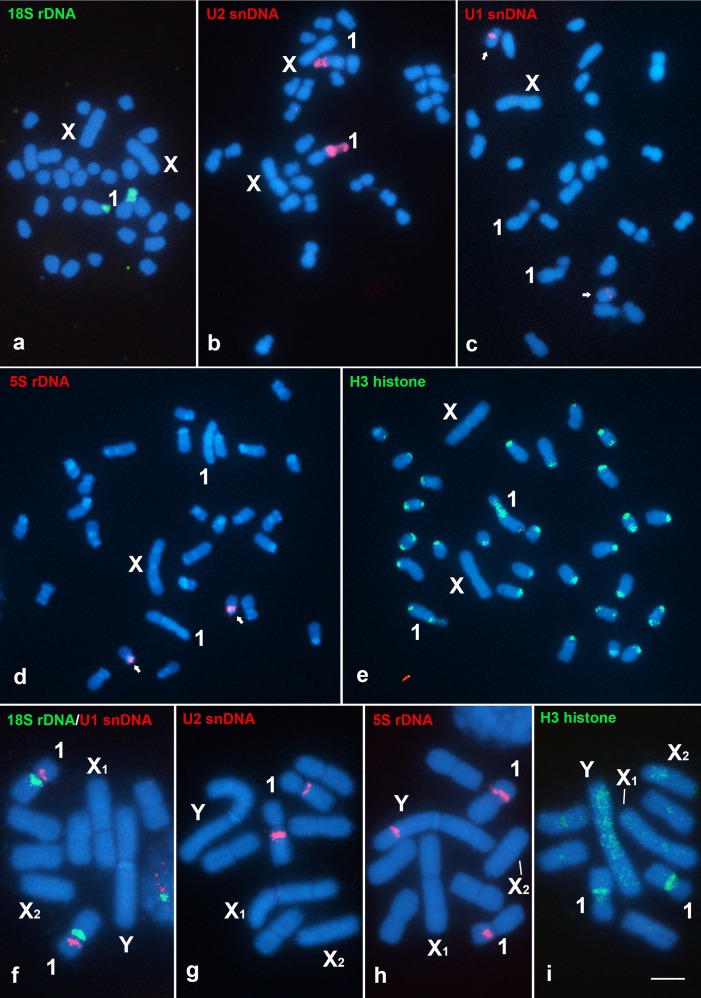
A large percentage of eukaryotic genomes consist of repetitive DNA that plays an important role in the organization, size and evolution. In the case of crickets, chromosomal variability has been found using classical cytogenetics, but almost no information concerning the organization of their repetitive DNAs is available. To better understand the chromosomal organization and diversification of repetitive DNAs in crickets, we studied the chromosomes of two Gryllidae species with highly divergent karyotypes, i.e., 2n(♂) = 29,X0 (Gryllus assimilis) and 2n = 9, neo-X1X2Y (Eneoptera surinamensis). The analyses were performed using classical cytogenetic techniques, repetitive DNA mapping and genome-size estimation. Conserved characteristics were observed, such as the occurrence of a small number of clusters of rDNAs and U snDNAs, in contrast to the multiple clusters/dispersal of the H3 histone genes. The positions of U2 snDNA and 18S rDNA are also conserved, being intermingled within the largest autosome. The distribution and base-pair composition of the heterochromatin and repetitive DNA pools of these organisms differed, suggesting reorganization. Although the microsatellite arrays had a similar distribution pattern, being dispersed along entire chromosomes, as has been observed in some grasshopper species, a band-like pattern was also observed in the E. surinamensis chromosomes, putatively due to their amplification and clustering. In addition to these differences, the genome of E. surinamensis is approximately 2.5 times larger than that of G. assimilis, which we hypothesize is due to the amplification of repetitive DNAs. Finally, we discuss the possible involvement of repetitive DNAs in the differentiation of the neo-sex chromosomes of E. surinamensis, as has been reported in other eukaryotic groups. This study provided an opportunity to explore the evolutionary dynamics of repetitive DNAs in two non-model species and will contribute to the understanding of chromosomal evolution in a group about which little chromosomal and genomic information is known.
很大比例的真核生物基因组由重复DNA组成,这些重复DNA在基因组的组织、大小和进化中发挥着重要作用。就蟋蟀而言,利用经典细胞遗传学已经发现了染色体变异性,但几乎没有关于其重复DNA组织的信息。为了更好地理解蟋蟀重复DNA的染色体组织和多样化,我们研究了两种核型高度不同的蟋蟀科物种的染色体,即2n(♂)=29,X0(黑褐油葫芦)和2n = 9, neo-X1X2Y(苏里南伊纳蟋)。使用经典细胞遗传学技术、重复DNA图谱分析和基因组大小估计进行了分析。观察到了保守特征,例如与H3组蛋白基因的多个簇/分散分布相反,rDNA和U snDNA存在少量簇。U2 snDNA和18S rDNA的位置也保守,它们在最大的常染色体中相互交织。这些生物体的异染色质和重复DNA库的分布和碱基对组成不同,表明发生了重组。尽管微卫星阵列具有相似的分布模式,即沿着整个染色体分散,这在一些蚱蜢物种中也有观察到,但在苏里南伊纳蟋染色体中也观察到了带状模式,推测这是由于它们的扩增和聚集。除了这些差异外,苏里南伊纳蟋的基因组比黑褐油葫芦的基因组大约大2.5倍,我们推测这是由于重复DNA的扩增。最后,我们讨论了重复DNA可能参与苏里南伊纳蟋新性染色体的分化,正如在其他真核生物群体中所报道的那样。这项研究为探索两种非模式物种中重复DNA的进化动态提供了机会,并将有助于理解一个染色体和基因组信息知之甚少的类群中的染色体进化。