Palacios-Gimenez Octavio M, Milani Diogo, Lemos Bernardo, Castillo Elio R, Martí Dardo A, Ramos Erica, Martins Cesar, Cabral-de-Mello Diogo C
Departamento de Biologia, UNESP - Univ Estadual Paulista, Instituto de Biociências/IB, Rio Claro, São Paulo, 13506-900, Brazil.
Program in Molecular and Integrative Physiological Sciences, Department of Environmental Health, Harvard University T. H. Chan School of Public Health, Boston, Massachusetts, 02115, USA.
BMC Evol Biol. 2018 Jan 8;18(1):2. doi: 10.1186/s12862-017-1113-x.
Neo-sex chromosome systems arose independently multiple times in evolution, presenting the remarkable characteristic of repetitive DNAs accumulation. Among grasshoppers, occurrence of neo-XY was repeatedly noticed in Melanoplinae. Here we analyzed the most abundant tandem repeats of R. bergii (2n = 22, neo-XY♂) using deep Illumina sequencing and graph-based clustering in order to address the neo-sex chromosomes evolution.
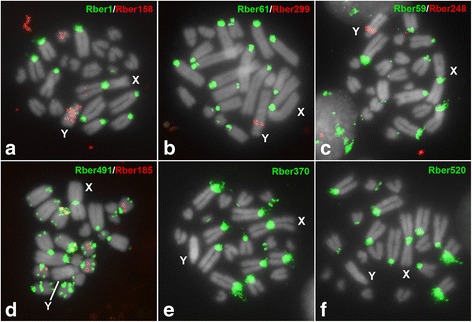
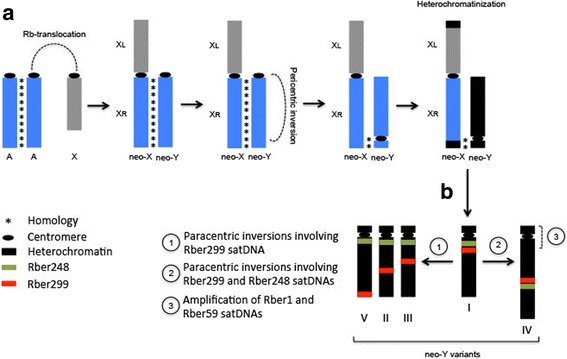
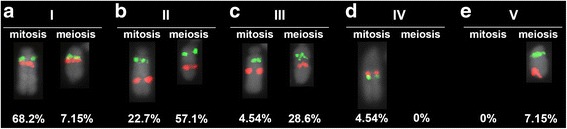
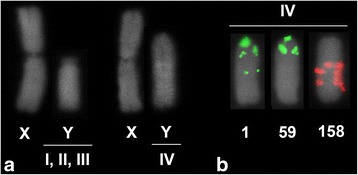
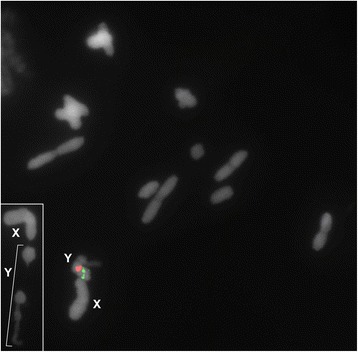
The analyses revealed ten families of satDNAs comprising about ~1% of the male genome, which occupied mainly C-positive regions of autosomes. Regarding the sex chromosomes, satDNAs were recorded within centromeric or interstitial regions of the neo-X chromosome and four satDNAs occurred in the neo-Y, two of them being exclusive (Rber248 and Rber299). Using a combination of probes we uncovered five well-defined cytological variants for neo-Y, originated by multiple paracentric inversions and satDNA amplification, besides fragmented neo-Y. These neo-Y variants were distinct in frequency between embryos and adult males.
The genomic data together with cytogenetic mapping enabled us to better understand the neo-sex chromosome dynamics in grasshoppers, reinforcing differentiation of neo-X and neo-Y and revealing the occurrence of multiple additional rearrangements involved in the neo-Y evolution of R. bergii. We discussed the possible causes that led to differences in frequency for the neo-Y variants between embryos and adults. Finally we hypothesize about the role of DNA satellites in R. bergii as well as putative historical events involved in the evolution of the R. bergii neo-XY.
新性染色体系统在进化过程中多次独立出现,具有重复DNA积累这一显著特征。在蚱蜢中,黑蝗亚科多次出现新XY染色体。在此,我们利用深度Illumina测序和基于图谱的聚类分析了贝氏稻蝗(2n = 22,新XY♂)中最丰富的串联重复序列,以探讨新性染色体的进化。
分析揭示了10个卫星DNA家族,约占雄性基因组的1%,主要分布在常染色体的C阳性区域。关于性染色体,卫星DNA存在于新X染色体的着丝粒或间质区域,新Y染色体中有4种卫星DNA,其中2种是特有的(Rber248和Rber299)。除了碎片化的新Y染色体外,我们使用多种探针组合发现了新Y染色体的5种明确的细胞学变体,它们由多次臂内倒位和卫星DNA扩增产生。这些新Y染色体变体在胚胎和成年雄性中的频率不同。
基因组数据与细胞遗传学图谱使我们能够更好地理解蚱蜢中新性染色体的动态变化,加强新X和新Y染色体的分化,并揭示参与贝氏稻蝗新Y染色体进化的多个其他重排事件。我们讨论了导致胚胎和成年个体中新Y染色体变体频率差异的可能原因。最后,我们推测了贝氏稻蝗中DNA卫星序列的作用以及与贝氏稻蝗新XY染色体进化相关的假定历史事件。