Akullian Adam, Ng'eno Eric, Matheson Alastair I, Cosmas Leonard, Macharia Daniel, Fields Barry, Bigogo Godfrey, Mugoh Maina, John-Stewart Grace, Walson Judd L, Wakefield Jonathan, Montgomery Joel M
University of Washington, School of Public Health and Community Medicine, Department of Epidemiology, Seattle, Washington, United States of America.
Kenya Medical Research Institute, Center for Global Health Research (KEMRI-CGHR), Kenya.
PLoS Negl Trop Dis. 2015 Dec 3;9(12):e0004212. doi: 10.1371/journal.pntd.0004212. eCollection 2015 Dec.
Enteric fever due to Salmonella Typhi (typhoid fever) occurs in urban areas with poor sanitation. While direct fecal-oral transmission is thought to be the predominant mode of transmission, recent evidence suggests that indirect environmental transmission may also contribute to disease spread.
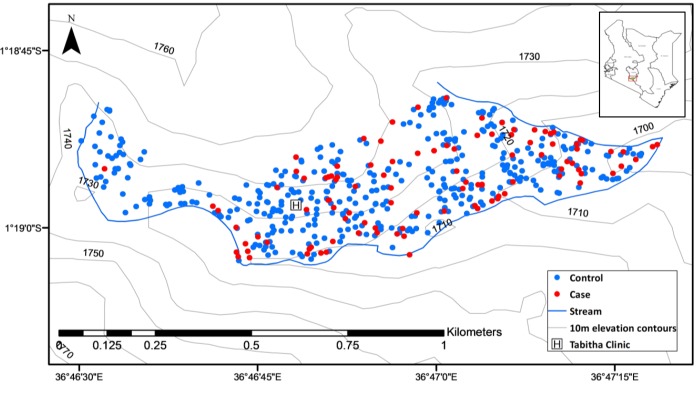
Data from a population-based infectious disease surveillance system (28,000 individuals followed biweekly) were used to map the spatial pattern of typhoid fever in Kibera, an urban informal settlement in Nairobi Kenya, between 2010-2011. Spatial modeling was used to test whether variations in topography and accumulation of surface water explain the geographic patterns of risk.
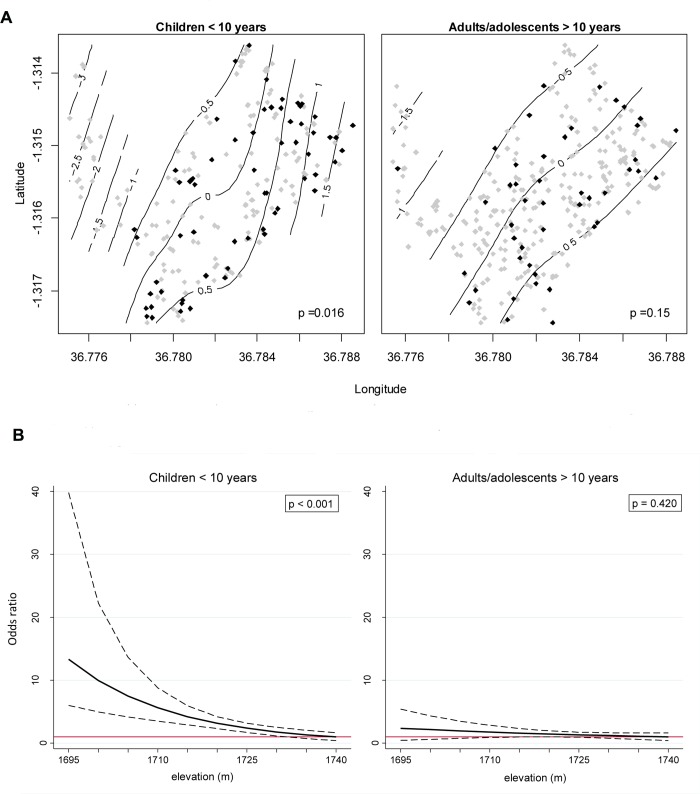
Among children less than ten years of age, risk of typhoid fever was geographically heterogeneous across the study area (p = 0.016) and was positively associated with lower elevation, OR = 1.87, 95% CI (1.36-2.57), p <0.001. In contrast, the risk of typhoid fever did not vary geographically or with elevation among individuals more than ten years of age [corrected].
Our results provide evidence of indirect, environmental transmission of typhoid fever among children, a group with high exposure to fecal pathogens in the environment. Spatially targeting sanitation interventions may decrease enteric fever transmission.
伤寒沙门氏菌引起的肠热病(伤寒热)发生在卫生条件差的城市地区。虽然粪口直接传播被认为是主要传播方式,但最近的证据表明,间接环境传播也可能导致疾病传播。
利用基于人群的传染病监测系统(每两周对28000人进行跟踪)的数据,绘制了2010年至2011年肯尼亚内罗毕城市非正规住区基贝拉伤寒热的空间分布模式。采用空间建模来检验地形变化和地表水蓄积是否能解释风险的地理模式。
在10岁以下儿童中,伤寒热风险在研究区域内存在地理异质性(p = 0.016),且与较低海拔呈正相关,比值比 = 1.87,95%置信区间(1.36 - 2.57),p < 0.001。相比之下,10岁以上人群中伤寒热风险在地理上或随海拔均无变化[校正后]。
我们的结果提供了证据,证明伤寒热在儿童中存在间接环境传播,儿童是环境中粪便病原体暴露率高的群体。在空间上针对性地开展卫生干预措施可能会减少肠热病传播。