
世界卫生组织《2010年食源性疾病负担的全球估计和区域比较》
World Health Organization Global Estimates and Regional Comparisons of the Burden of Foodborne Disease in 2010.
作者信息
Havelaar Arie H, Kirk Martyn D, Torgerson Paul R, Gibb Herman J, Hald Tine, Lake Robin J, Praet Nicolas, Bellinger David C, de Silva Nilanthi R, Gargouri Neyla, Speybroeck Niko, Cawthorne Amy, Mathers Colin, Stein Claudia, Angulo Frederick J, Devleesschauwer Brecht
机构信息
National Institute for Public Health and the Environment, Bilthoven, The Netherlands.
University of Florida, Gainesville, Florida, United States of America.
出版信息
PLoS Med. 2015 Dec 3;12(12):e1001923. doi: 10.1371/journal.pmed.1001923. eCollection 2015 Dec.
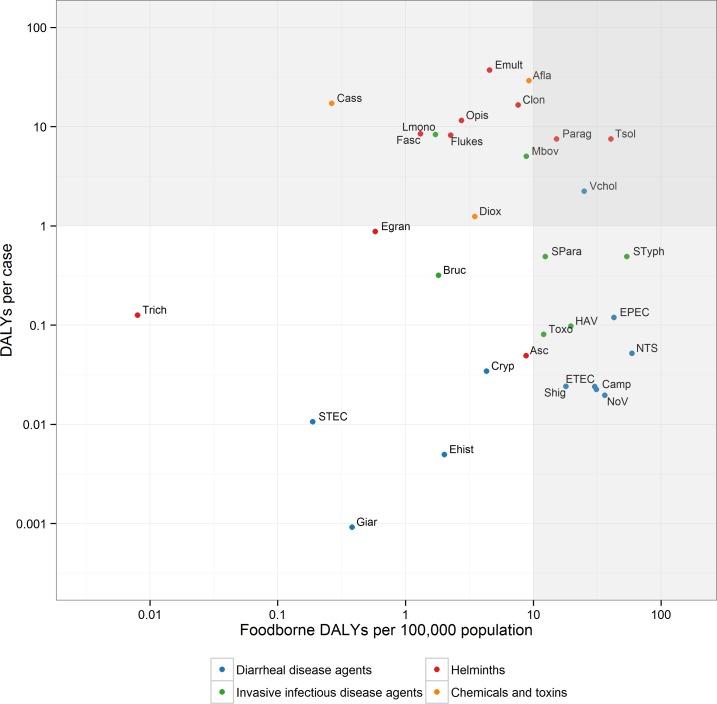
Illness and death from diseases caused by contaminated food are a constant threat to public health and a significant impediment to socio-economic development worldwide. To measure the global and regional burden of foodborne disease (FBD), the World Health Organization (WHO) established the Foodborne Disease Burden Epidemiology Reference Group (FERG), which here reports their first estimates of the incidence, mortality, and disease burden due to 31 foodborne hazards. We find that the global burden of FBD is comparable to those of the major infectious diseases, HIV/AIDS, malaria and tuberculosis. The most frequent causes of foodborne illness were diarrheal disease agents, particularly norovirus and Campylobacter spp. Diarrheal disease agents, especially non-typhoidal Salmonella enterica, were also responsible for the majority of deaths due to FBD. Other major causes of FBD deaths were Salmonella Typhi, Taenia solium and hepatitis A virus. The global burden of FBD caused by the 31 hazards in 2010 was 33 million Disability Adjusted Life Years (DALYs); children under five years old bore 40% of this burden. The 14 subregions, defined on the basis of child and adult mortality, had considerably different burdens of FBD, with the greatest falling on the subregions in Africa, followed by the subregions in South-East Asia and the Eastern Mediterranean D subregion. Some hazards, such as non-typhoidal S. enterica, were important causes of FBD in all regions of the world, whereas others, such as certain parasitic helminths, were highly localised. Thus, the burden of FBD is borne particularly by children under five years old-although they represent only 9% of the global population-and people living in low-income regions of the world. These estimates are conservative, i.e., underestimates rather than overestimates; further studies are needed to address the data gaps and limitations of the study. Nevertheless, all stakeholders can contribute to improvements in food safety throughout the food chain by incorporating these estimates into policy development at national and international levels.
由受污染食物引发的疾病导致的患病和死亡,始终威胁着公众健康,也是全球社会经济发展的重大障碍。为衡量食源性疾病(FBD)的全球和区域负担,世界卫生组织(WHO)成立了食源性疾病负担流行病学参考小组(FERG),该小组在此报告了对31种食源性危害导致的发病率、死亡率和疾病负担的首次评估。我们发现,食源性疾病的全球负担与主要传染病——艾滋病毒/艾滋病、疟疾和结核病的负担相当。食源性疾病最常见的病因是腹泻病病原体,尤其是诺如病毒和弯曲杆菌属。腹泻病病原体,特别是非伤寒型肠炎沙门氏菌,也是食源性疾病导致的大多数死亡的原因。食源性疾病死亡的其他主要原因是伤寒沙门氏菌、猪带绦虫和甲型肝炎病毒。2010年,这31种危害导致的食源性疾病全球负担为3300万伤残调整生命年(DALYs);五岁以下儿童承担了其中40%的负担。根据儿童和成人死亡率划分的14个次区域,食源性疾病负担差异很大,负担最重的是非洲次区域,其次是东南亚和东地中海D次区域。一些危害,如非伤寒型肠炎沙门氏菌,是世界所有区域食源性疾病的重要病因,而其他一些危害,如某些寄生蠕虫,则具有高度的地方性。因此,食源性疾病的负担尤其由五岁以下儿童(尽管他们仅占全球人口的9%)和生活在世界低收入地区的人们承担。这些估计是保守的,即低估而非高估;需要进一步研究以填补数据空白和解决研究的局限性。尽管如此,所有利益相关者都可以通过将这些估计纳入国家和国际层面的政策制定,为改善整个食物链的食品安全做出贡献。


 Zotero 插件