Large Edward W, Herrera Jorge A, Velasco Marc J
Department of Psychological Sciences, University of Connecticut Storrs, CT, USA ; Department of Physics, University of Connecticut Storrs, CT, USA.
Department of Music, Center for Computer Research in Music and Acoustics, Stanford University Stanford, CA, USA.
Front Syst Neurosci. 2015 Nov 25;9:159. doi: 10.3389/fnsys.2015.00159. eCollection 2015.
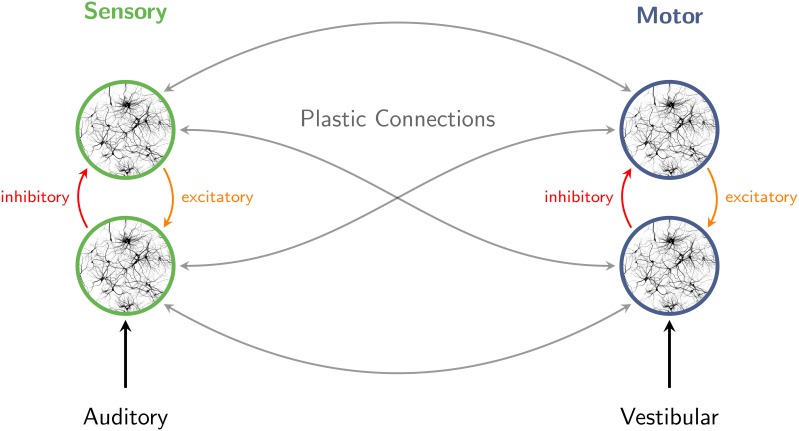
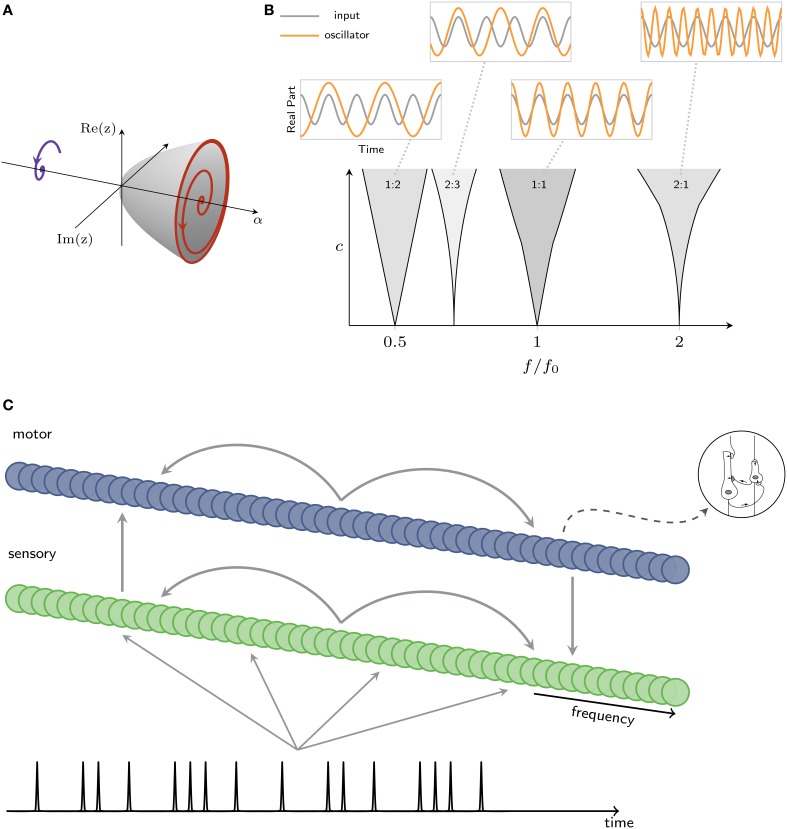
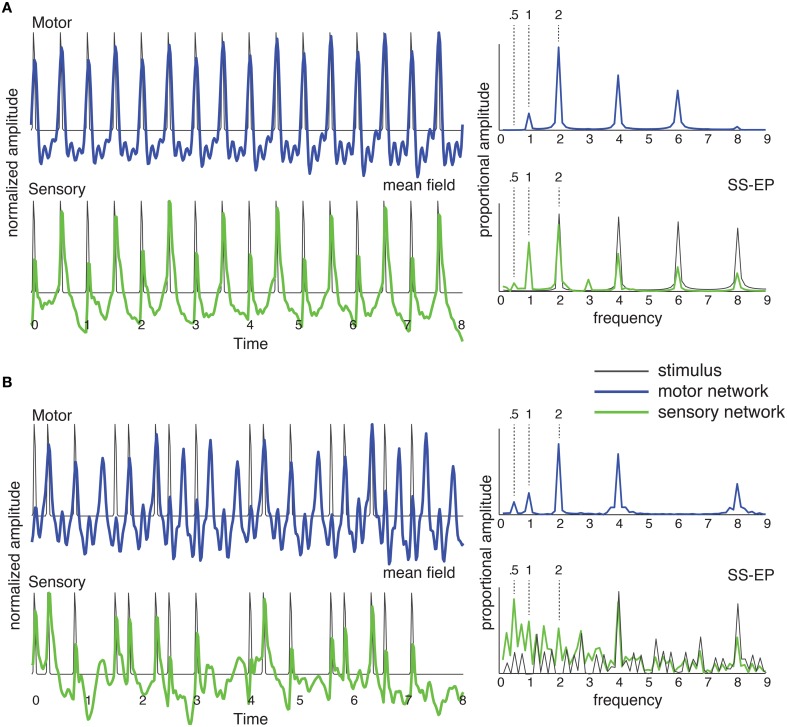
Entrainment of cortical rhythms to acoustic rhythms has been hypothesized to be the neural correlate of pulse and meter perception in music. Dynamic attending theory first proposed synchronization of endogenous perceptual rhythms nearly 40 years ago, but only recently has the pivotal role of neural synchrony been demonstrated. Significant progress has since been made in understanding the role of neural oscillations and the neural structures that support synchronized responses to musical rhythm. Synchronized neural activity has been observed in auditory and motor networks, and has been linked with attentional allocation and movement coordination. Here we describe a neurodynamic model that shows how self-organization of oscillations in interacting sensory and motor networks could be responsible for the formation of the pulse percept in complex rhythms. In a pulse synchronization study, we test the model's key prediction that pulse can be perceived at a frequency for which no spectral energy is present in the amplitude envelope of the acoustic rhythm. The result shows that participants perceive the pulse at the theoretically predicted frequency. This model is one of the few consistent with neurophysiological evidence on the role of neural oscillation, and it explains a phenomenon that other computational models fail to explain. Because it is based on a canonical model, the predictions hold for an entire family of dynamical systems, not only a specific one. Thus, this model provides a theoretical link between oscillatory neurodynamics and the induction of pulse and meter in musical rhythm.
皮层节律与听觉节律的同步被认为是音乐中节拍和韵律感知的神经关联。动态注意理论在近40年前首次提出内源性感知节律的同步,但直到最近神经同步的关键作用才得到证实。此后,在理解神经振荡的作用以及支持对音乐节奏同步反应的神经结构方面取得了重大进展。在听觉和运动网络中观察到了同步神经活动,并且它与注意力分配和运动协调有关。在这里,我们描述了一个神经动力学模型,该模型展示了相互作用的感觉和运动网络中振荡的自组织如何能够导致复杂节奏中节拍感知的形成。在一项节拍同步研究中,我们测试了该模型的关键预测,即可以在听觉节奏的幅度包络中不存在频谱能量的频率上感知到节拍。结果表明,参与者在理论预测的频率上感知到了节拍。该模型是少数几个与关于神经振荡作用的神经生理学证据一致的模型之一,并且它解释了其他计算模型无法解释的一种现象。由于它基于一个典型模型,这些预测适用于整个动力系统家族,而不仅仅是特定的一个。因此,该模型在振荡神经动力学与音乐节奏中节拍和韵律的诱导之间提供了理论联系。