Hansberg-Pastor Valeria, González-Arenas Aliesha, Piña-Medina Ana Gabriela, Camacho-Arroyo Ignacio
Departamento de Biología, Facultad de Química, Universidad Nacional Autónoma de México , Mexico City , Mexico.
Departamento de Medicina Genómica y Toxicología Ambiental, Instituto de Investigaciones Biomédicas, Universidad Nacional Autónoma de México , Mexico City , Mexico.
Front Psychiatry. 2015 Nov 20;6:165. doi: 10.3389/fpsyt.2015.00165. eCollection 2015.
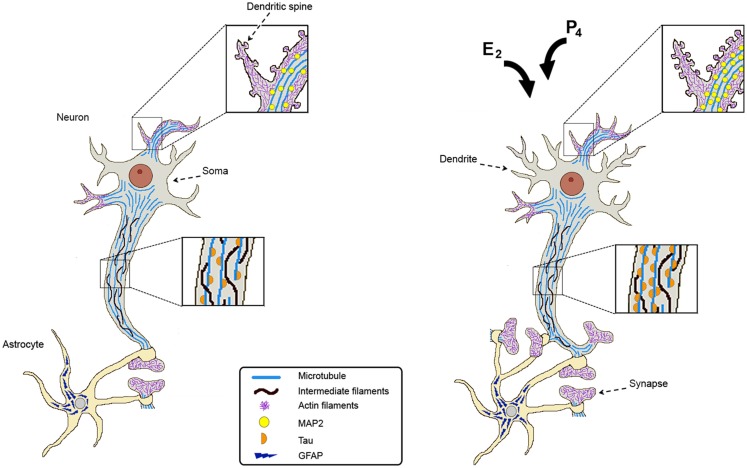
In the brain of female mammals, including humans, a number of physiological and behavioral changes occur as a result of sex hormone exposure. Estradiol and progesterone regulate several brain functions, including learning and memory. Sex hormones contribute to shape the central nervous system by modulating the formation and turnover of the interconnections between neurons as well as controlling the function of glial cells. The dynamics of neuron and glial cells morphology depends on the cytoskeleton and its associated proteins. Cytoskeletal proteins are necessary to form neuronal dendrites and dendritic spines, as well as to regulate the diverse functions in astrocytes. The expression pattern of proteins, such as actin, microtubule-associated protein 2, Tau, and glial fibrillary acidic protein, changes in a tissue-specific manner in the brain, particularly when variations in sex hormone levels occur during the estrous or menstrual cycles or pregnancy. Here, we review the changes in structure and organization of neurons and glial cells that require the participation of cytoskeletal proteins whose expression and activity are regulated by estradiol and progesterone.
在包括人类在内的雌性哺乳动物大脑中,由于接触性激素会发生一些生理和行为变化。雌二醇和孕酮调节多种大脑功能,包括学习和记忆。性激素通过调节神经元之间连接的形成和更新以及控制神经胶质细胞的功能,有助于塑造中枢神经系统。神经元和神经胶质细胞形态的动态变化取决于细胞骨架及其相关蛋白。细胞骨架蛋白对于形成神经元树突和树突棘以及调节星形胶质细胞的多种功能是必需的。诸如肌动蛋白、微管相关蛋白2、Tau蛋白和神经胶质纤维酸性蛋白等蛋白质的表达模式在大脑中以组织特异性方式发生变化,特别是在发情周期、月经周期或怀孕期间性激素水平发生变化时。在此,我们综述了神经元和神经胶质细胞的结构和组织变化,这些变化需要细胞骨架蛋白的参与,而细胞骨架蛋白的表达和活性受雌二醇和孕酮的调节。