Stewart Hannah J, Amitay Sygal
Medical Research Council Institute of Hearing Research Nottingham, UK.
Front Psychol. 2015 Nov 25;6:1826. doi: 10.3389/fpsyg.2015.01826. eCollection 2015.
To establish the modality specificity and generality of selective attention networks.
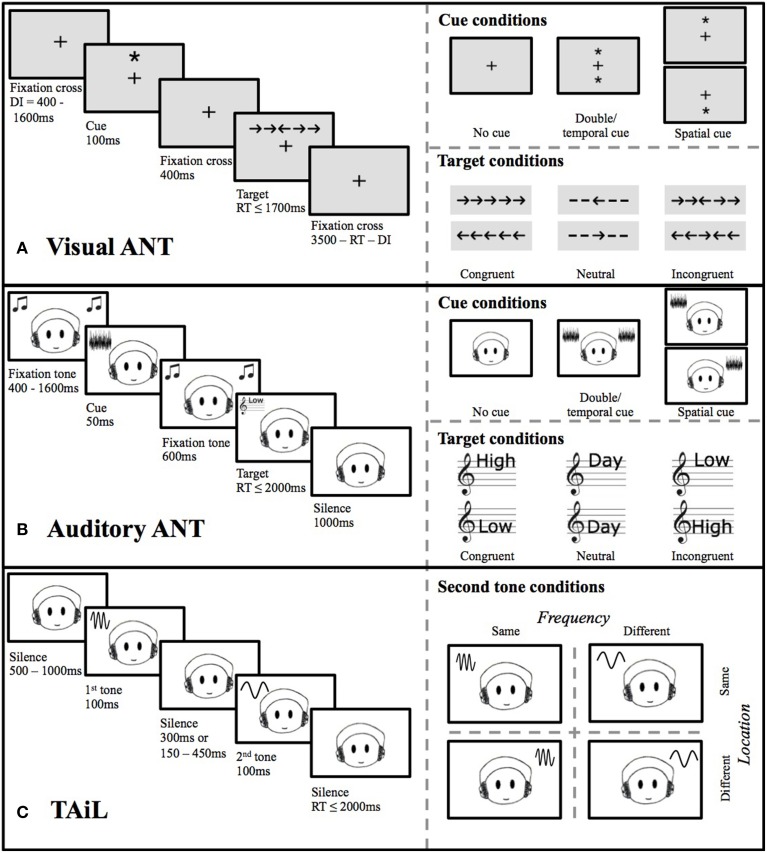
Forty-eight young adults completed a battery of four auditory and visual selective attention tests based upon the Attention Network framework: the visual and auditory Attention Network Tests (vANT, aANT), the Test of Everyday Attention (TEA), and the Test of Attention in Listening (TAiL). These provided independent measures for auditory and visual alerting, orienting, and conflict resolution networks. The measures were subjected to an exploratory factor analysis to assess underlying attention constructs.
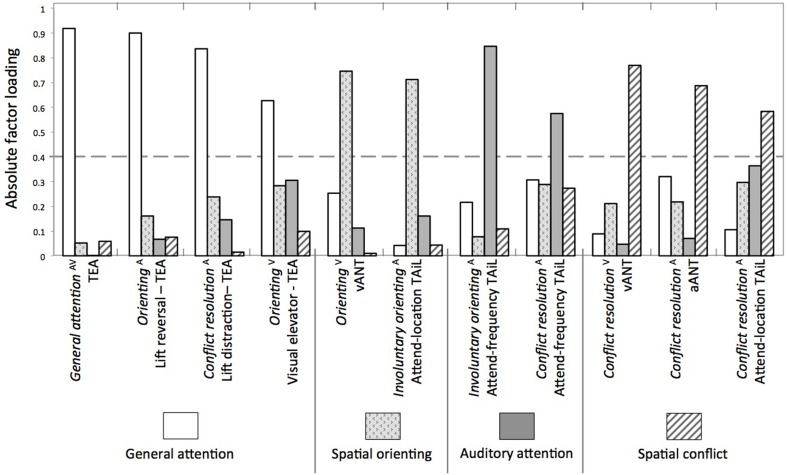
The analysis yielded a four-component solution. The first component comprised of a range of measures from the TEA and was labeled "general attention." The third component was labeled "auditory attention," as it only contained measures from the TAiL using pitch as the attended stimulus feature. The second and fourth components were labeled as "spatial orienting" and "spatial conflict," respectively-they were comprised of orienting and conflict resolution measures from the vANT, aANT, and TAiL attend-location task-all tasks based upon spatial judgments (e.g., the direction of a target arrow or sound location).
These results do not support our a-priori hypothesis that attention networks are either modality specific or supramodal. Auditory attention separated into selectively attending to spatial and non-spatial features, with the auditory spatial attention loading onto the same factor as visual spatial attention, suggesting spatial attention is supramodal. However, since our study did not include a non-spatial measure of visual attention, further research will be required to ascertain whether non-spatial attention is modality-specific.
确定选择性注意网络的模态特异性和普遍性。
48名年轻成年人完成了一系列基于注意网络框架的四项听觉和视觉选择性注意测试:视觉和听觉注意网络测试(vANT、aANT)、日常注意测试(TEA)和听力注意测试(TAiL)。这些测试为听觉和视觉警觉、定向和冲突解决网络提供了独立的测量方法。对这些测量方法进行探索性因素分析,以评估潜在的注意结构。
分析得出了一个四因素解决方案。第一个因素由TEA中的一系列测量方法组成,被标记为“一般注意”。第三个因素被标记为“听觉注意”,因为它只包含TAiL中使用音高作为被关注刺激特征的测量方法。第二个和第四个因素分别被标记为“空间定向”和“空间冲突”——它们由vANT、aANT和TAiL注意位置任务中的定向和冲突解决测量方法组成——所有任务都基于空间判断(例如,目标箭头的方向或声音位置)。
这些结果不支持我们的先验假设,即注意网络要么是模态特异性的,要么是超模态的。听觉注意分为选择性地关注空间和非空间特征,听觉空间注意与视觉空间注意加载到同一个因素上,这表明空间注意是超模态的。然而,由于我们的研究没有包括视觉注意的非空间测量方法,因此需要进一步研究以确定非空间注意是否是模态特异性的。