Athinoula A. Martinos Center for Biomedical Imaging, Massachusetts General Hospital Charlestown, MA, USA ; Department of Speech and Hearing Sciences, Institute for Learning and Brain Sciences, University of Washington Seattle, WA, USA ; Center for Computational Neuroscience and Neural Technology, Boston University Boston, MA, USA.
Front Neurosci. 2013 Jan 7;6:190. doi: 10.3389/fnins.2012.00190. eCollection 2012.
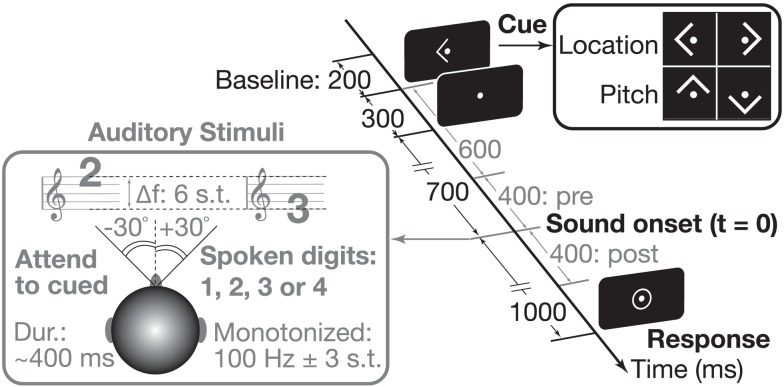
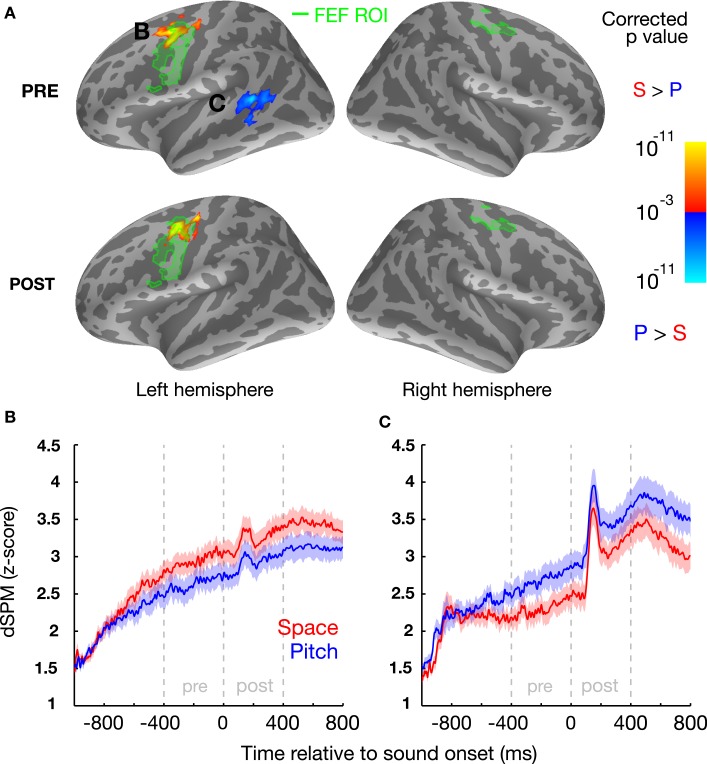
In order to extract information in a rich environment, we focus on different features that allow us to direct attention to whatever source is of interest. The cortical network deployed during spatial attention, especially in vision, is well characterized. For example, visuospatial attention engages a frontoparietal network including the frontal eye fields (FEFs), which modulate activity in visual sensory areas to enhance the representation of an attended visual object. However, relatively little is known about the neural circuitry controlling attention directed to non-spatial features, or to auditory objects or features (either spatial or non-spatial). Here, using combined magnetoencephalography (MEG) and anatomical information obtained from MRI, we contrasted cortical activity when observers attended to different auditory features given the same acoustic mixture of two simultaneous spoken digits. Leveraging the fine temporal resolution of MEG, we establish that activity in left FEF is enhanced both prior to and throughout the auditory stimulus when listeners direct auditory attention to target location compared to when they focus on target pitch. In contrast, activity in the left posterior superior temporal sulcus (STS), a region previously associated with auditory pitch categorization, is greater when listeners direct attention to target pitch rather than target location. This differential enhancement is only significant after observers are instructed which cue to attend, but before the acoustic stimuli begin. We therefore argue that left FEF participates more strongly in directing auditory spatial attention, while the left STS aids auditory object selection based on the non-spatial acoustic feature of pitch.
为了从丰富的环境中提取信息,我们专注于不同的特征,这些特征可以让我们将注意力集中到感兴趣的任何来源上。在空间注意力期间部署的皮质网络,特别是在视觉中,已经得到了很好的描述。例如,视空间注意力涉及包括额眼区(FEF)的额顶网络,其调节视觉感觉区域的活动,以增强对注意的视觉对象的表示。然而,对于控制注意力指向非空间特征的神经回路,或者指向听觉对象或特征(空间或非空间)的神经回路,我们知之甚少。在这里,我们使用结合了脑磁图(MEG)和从 MRI 获得的解剖信息,对比了当观察者在给定两个同时发出的数字的相同声音混合物时,注意到不同听觉特征时的皮质活动。利用 MEG 的精细时间分辨率,我们确定当听众将听觉注意力集中到目标位置时,与将注意力集中到目标音高相比,左额前眼区(FEF)的活动在听觉刺激之前和期间都会增强。相比之下,当听众将注意力集中到目标音高而不是目标位置时,左后上颞叶回(STS)的活动更大,该区域先前与听觉音高分类有关。这种差异增强仅在观察者被指示注意哪个线索后,但在声音刺激开始之前才显著。因此,我们认为左额前眼区(FEF)在引导听觉空间注意力方面的作用更强,而左后上颞叶回(STS)则根据音高的非空间声学特征辅助听觉对象选择。