Wei Yue-Hua, Zhou Fu-Xiang, Li Yan, Zhou Yun-Feng, Anish Krishna, Xu Li-Ying, Liao Mei-Yan
Department of Radiation and Medical Oncology, Zhongnan Hospital of Wuhan University, Wuhan, Hubei 430071, P.R. China.
Department of Radiation and Medical Oncology, Zhongnan Hospital of Wuhan University, Wuhan, Hubei 430071, P.R. China ; Hubei Key Laboratory of Tumor Biological Behaviors, Hubei Cancer Clinical Study Center, Zhongnan Hospital of Wuhan University, Wuhan, Hubei 430071, P.R. China.
Exp Ther Med. 2015 Nov;10(5):1707-1719. doi: 10.3892/etm.2015.2735. Epub 2015 Sep 8.
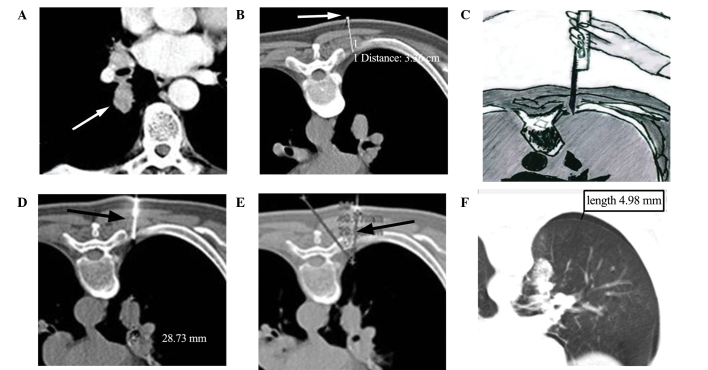
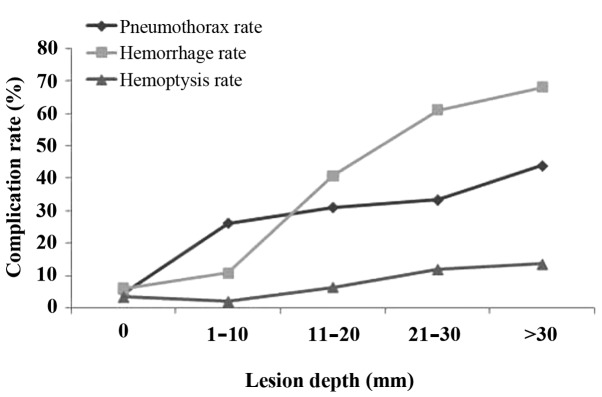
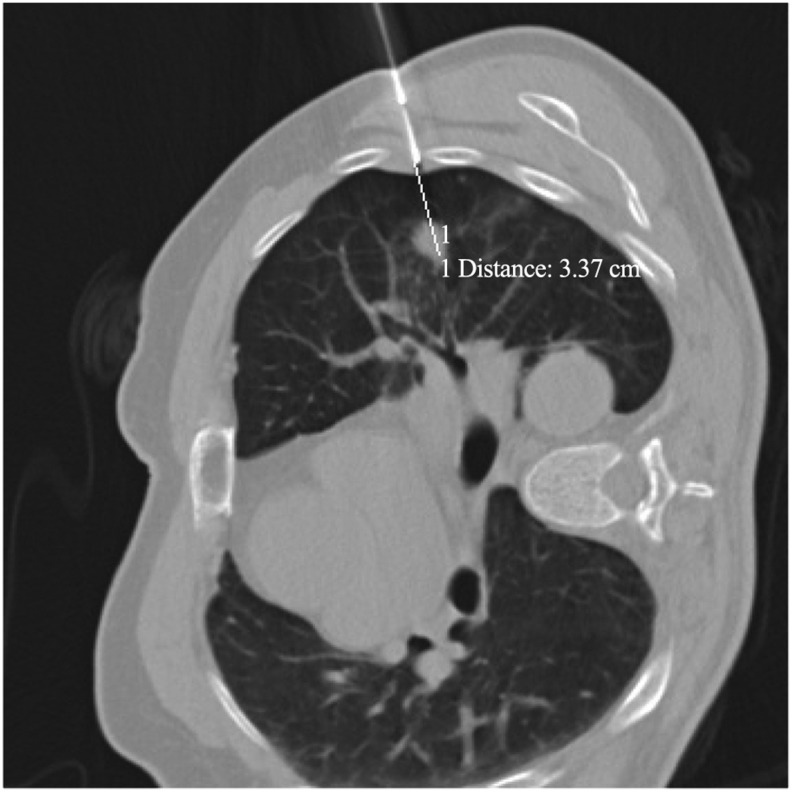
Transthoracic needle biopsy is considered to be safe and effective for the diagnosis of focal lung lesions. The aim of the present study was to evaluate factors affecting the accuracy and safety of automated cutting needle lung biopsy (ACNB) using a new extrapleural locating (EPL) method. Computed tomography (CT)-guided needle biopsies were performed on 1,065 patients between March 2005 and May 2012 using the EPL method. The locating needle remained in the chest following extrapleural positioning, while the radiologist confirmed the puncture angle and distance between the locating needle and lesion. The biopsy instrument was advanced into the lung, and the core needle was subsequently fired into the lesion based on the direction indicated by the locating needle. Univariate and multivariate regression analyses were used to evaluate the diagnostic accuracy and safety of the procedure. The sensitivity, specificity, positive predictive value and negative predictive value of the extrapleural method were 91.9, 100, 100 and 82.9%, respectively, and the overall diagnostic accuracy was 94.2%. Significant risk factors affecting accuracy were younger age, atelectasis, hemoptysis and lesion depth (P<0.03). Multivariate logistic regression analysis revealed that the risk of malignant lesions receiving a false-negative diagnosis decreased for each additional year of subject age [odds ratio (OR), 0.97; P=0.027] and increased with each millimeter increase in lesion depth (OR, 1.03; P=0.008). Among the 1,106 lesions biopsied, 207 were associated with pneumothorax, 251 with hemorrhage and 58 with hemoptysis. Multivariate analysis revealed that lesion size and emphysema affected pneumothorax incidence, while age, lesion location and depth and emphysema significantly affected hemorrhage incidence (P<0.05). In conclusion, low-dose, CT-guided ACNB with the EPL method provides a safe and accurate diagnosis.
经胸针吸活检术被认为是诊断肺部局灶性病变安全有效的方法。本研究旨在评估采用一种新的胸膜外定位(EPL)方法的自动切割针肺活检(ACNB)的准确性和安全性的影响因素。2005年3月至2012年5月期间,对1065例患者采用EPL方法进行了计算机断层扫描(CT)引导下的针吸活检。胸膜外定位后定位针留在胸腔内,同时放射科医生确认穿刺角度以及定位针与病变之间的距离。活检器械进入肺内,随后根据定位针指示的方向将活检针发射至病变处。采用单因素和多因素回归分析评估该操作的诊断准确性和安全性。胸膜外方法的敏感性、特异性、阳性预测值和阴性预测值分别为91.9%、100%、100%和82.9%,总体诊断准确性为94.2%。影响准确性的显著危险因素为年龄较小、肺不张、咯血和病变深度(P<0.03)。多因素logistic回归分析显示,受试者年龄每增加1岁,恶性病变出现假阴性诊断的风险降低[比值比(OR),0.97;P=0.027],病变深度每增加1毫米,该风险增加(OR,1.03;P=0.008)。在1106例接受活检的病变中,207例与气胸相关,251例与出血相关,58例与咯血相关。多因素分析显示,病变大小和肺气肿影响气胸发生率,而年龄、病变位置和深度以及肺气肿显著影响出血发生率(P<0.05)。总之,采用EPL方法的低剂量CT引导下ACNB可提供安全准确的诊断。