Zhao Wenjuan, An Zhongping, Hong Yan, Zhou Guanen, Liu Bin, Guo Jingjing, Yang Yuanju, Ning Xianjia, Wang Jinghua
Department of Neurology, Tianjin Huanhu Hospital, 122 Qixiangtai Road, Hexi District, 300060 Tianjin China ; Tianjin Key Laboratory of Cerebral Vascular and Neurodegenerative Disease, 122 Qixiangtai Road, Hexi District, 300060 Tianjin China.
Tianjin Key Laboratory of Cerebral Vascular and Neurodegenerative Disease, 122 Qixiangtai Road, Hexi District, 300060 Tianjin China ; Department of Ultrasound, Tianjin Huanhu Hospital, 122 Qixiangtai Road, Hexi District, 300060 Tianjin China.
Biol Sex Differ. 2015 Dec 4;6:29. doi: 10.1186/s13293-015-0045-7. eCollection 2015.
Diabetes has been shown to be significantly associated with poor outcome after stroke. However, the sex differences in stroke outcome among patients with diabetes are unknown. Therefore, we aimed to assess the sex differences in long-term prognosis among acute ischemic stroke patients with diabetes.
The ischemic stroke patients with diabetes were recruited to this study between May 2005 and September 2014 in Tianjin, China. Sex differences in mortality, dependency (modified rank scale > 2), and recurrence at 3, 12, and 36 months after stroke were analyzed.
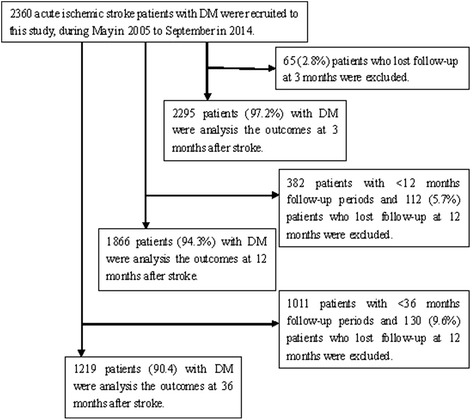
A total of 2360 patients were recruited in this study. The age of stroke onset, National Institute of Health stroke scale (NIHSS), and modified rank scale (mRS) on admission were greater in women than in men (P < 0.05). Women were more likely to have hypertension, obesity, atrial fibrillation, and dyslipidemias. In contrast, men were more likely to have artery stenosis, current smoking, and alcohol consumption (P < 0.001). There was higher mortality in women than in men at 3 months (7.9 % vs 5.2 %), 12 months (12.2 % vs 8.2 %), and 36 months (21.9 % vs 16.1 %) after stroke; but no differences were found in dependency and recurrence. Sex differences were found in associated factors of outcomes by time-point. Trial of Org 10172 in Acute Stroke Treatment (TOAST) of large artery atherothrombosis (LAA), cardioembolism (CE), and smoking were risk factors of outcomes in women at short term and medium term; but atrial fibrillation (AF), obesity, and alcohol were risk factors of outcomes in men at medium term and long term.
These findings suggest that it is crucial to establish the individual scheme of therapy for every patient by different risk factors of stroke, strengthen the rehabilitation of stroke, and carry on the health education early for the secondary prevention of stroke in patients with diabetes mellitus (DM).
糖尿病已被证明与卒中后不良预后显著相关。然而,糖尿病患者卒中结局的性别差异尚不清楚。因此,我们旨在评估急性缺血性卒中合并糖尿病患者长期预后的性别差异。
2005年5月至2014年9月期间,在中国天津招募了缺血性卒中合并糖尿病的患者。分析了卒中后3个月、12个月和36个月时的死亡率、依赖程度(改良Rankin量表>2)和复发率的性别差异。
本研究共招募了2360例患者。女性卒中发病年龄、美国国立卫生研究院卒中量表(NIHSS)评分及入院时改良Rankin量表(mRS)评分均高于男性(P<0.05)。女性更易患高血压、肥胖、心房颤动和血脂异常。相比之下,男性更易患动脉狭窄、当前吸烟和饮酒(P<0.001)。卒中后3个月(7.9%对5.2%)、12个月(12.2%对8.2%)和36个月(21.9%对16.1%)时,女性死亡率高于男性;但在依赖程度和复发率方面未发现差异。按时间点分析,结局的相关因素存在性别差异。大动脉粥样硬化血栓形成(LAA)、心源性栓塞(CE)的急性卒中治疗中组织纤溶酶原激活物10172试验(TOAST)以及吸烟是女性短期和中期结局的危险因素;但心房颤动(AF)、肥胖和饮酒是男性中期和长期结局的危险因素。
这些发现表明,根据卒中的不同危险因素为每位患者制定个体化治疗方案、加强卒中康复并对糖尿病患者进行早期健康教育以预防卒中复发至关重要。