Departamento de Fisioterapia, Universidade Federal de Minas Gerais, Belo Horizonte, MG, Brazil.
Braz J Phys Ther. 2015 Nov-Dec;19(6):498-506. doi: 10.1590/bjpt-rbf.2014.0118. Epub 2015 Oct 6.
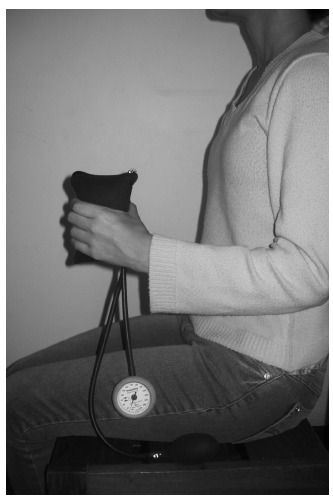
Grip strength, commonly evaluated with the handgrip dynamometer, is a good indicator of upper limb (UL) function in stroke subjects and may reflect the global strength deficits of the whole paretic UL. The Modified Sphygmomanometer Test (MST) also provides objective and adequate measures at low-cost.
To assess whether grip strength values obtained by using the MST and those obtained by using a handgrip dynamometer would present similar correlations with the global strength and motor function of the paretic UL in subjects with stroke, both in the subacute and chronic phases.
Measures of grip strength (MST and handgrip dynamometer), UL global strength (MST and hand-held dynamometer), and UL motor function (Fugl-Meyer motor assessment scale) were obtained with 33 subacute and 44 chronic stroke subjects. Pearson and Spearman correlation coefficients were calculated and Stepwise multiple regression analyses were performed to investigate predictor variables of grip strength (α=0.05).
Significant correlations of similar magnitude were found between measures of global strength of the paretic UL and grip strength assessed with both the MST (0.66≤r≤0.78) and handgrip dynamometer (0.66≤r≤0.78) and between UL motor function and grip strength assessed with both the MST (0.50≤rs≤0.51) and hand-held dynamometer (0.50≤rs≤0.63) in subacute and chronic stroke subjects. Only global strength remained as a significant predictor variable of grip strength for the MST (0.43≤R2≤0.61) and for the handgrip dynamometer (0.44≤R2≤0.61) for both stroke subgroups.
Grip strength assessed with the MST could be used to report paretic UL global strength.
握力通常使用握力计进行评估,是中风患者上肢(UL)功能的良好指标,可能反映整个瘫痪 UL 的整体力量缺陷。改良血压计测试(MST)也以低成本提供客观且充足的测量值。
评估在亚急性期和慢性期,使用 MST 获得的握力值与使用握力计获得的握力值是否与中风患者瘫痪 UL 的整体力量和运动功能具有相似的相关性。
对 33 名亚急性期和 44 名慢性期中风患者进行握力测量(MST 和握力计)、UL 整体力量(MST 和手持测力计)和 UL 运动功能(Fugl-Meyer 运动评估量表)。计算 Pearson 和 Spearman 相关系数,并进行逐步多元回归分析,以研究握力的预测变量(α=0.05)。
在亚急性期和慢性期中风患者中,瘫痪 UL 整体力量与使用 MST(0.66≤r≤0.78)和握力计(0.66≤r≤0.78)评估的握力以及 UL 运动功能与使用 MST(0.50≤rs≤0.51)和手持测力计(0.50≤rs≤0.63)评估的握力之间,均存在相似程度的显著相关性。仅在亚急性期和慢性期中风患者中,MST(0.43≤R2≤0.61)和握力计(0.44≤R2≤0.61)的整体力量仍然是握力的显著预测变量。
MST 评估的握力可用于报告瘫痪 UL 的整体力量。