Petti Stefano, Messano Giuseppe Alessio, Vingolo Enzo Maria, Marsella Luigi Tonino, Scully Crispian
Department of Public Health and Infectious Diseases, Sapienza University, Piazzale Aldo Moro 5, 00185, Rome, Italy.
Ophthalmology Department, Sapienza University, Viale del Policlinico 155, 00186, Rome, Italy.
BMC Infect Dis. 2015 Dec 11;15:564. doi: 10.1186/s12879-015-1302-4.
The West-African (WA) Zaire Ebolavirus disease (EVD) outbreak was characterized by an exceptionally high number of cases and deaths as compared with the Eastern-Central African (ECA) outbreaks. Despite the Zaire Ebolavirus being the most lethal for humans, case-fatality rate, close to 80 % in ECA outbreaks, almost halved to 47 % in Guinea-Liberia-Sierra Leone (WA). Such an improvement was due to the remarkable implementation of international humanitarian aids. Some studies also suggested that the long human-to-human transmission cycle occurred in WA, gave rise to human adaptation and consequent immune escape. Haemorrhage, the main feature in seriously infected EVD patients, is due to the immune system that triggers the infected endothelial cells which expose the spike-like glycoprotein (GP) of the virion on their surface. If the human adaptation hypothesis holds true, the proportion of EVD patients with haemorrhage in the WA outbreak should be lower than in the ECA outbreaks due to immune escape. Therefore, the aim of this meta-analysis was to compare the relative frequencies of three typical haemorrhagic symptoms (conjunctival -CB, nasal -NB, gingival -GB- bleedings) in the ECA and WA outbreaks.
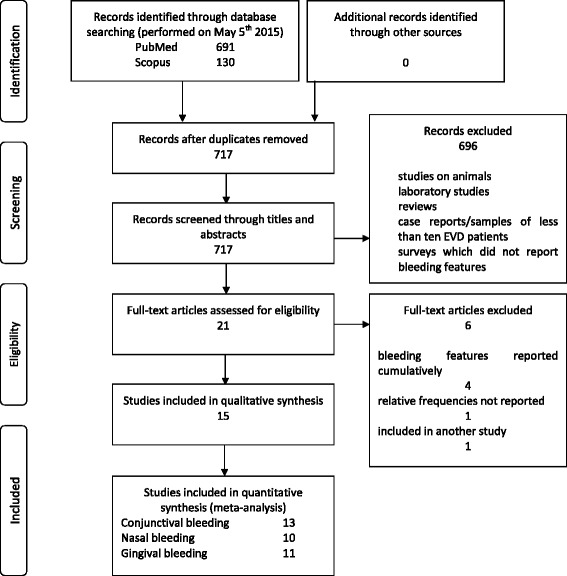
Literature searches were performed through PubMed and Scopus using generic keywords; surveys including at least ten patients reporting CB, NB, GB relative frequencies were extracted and split into ECA and WA. The meta-analytical methods chosen were based on the levels of between-study heterogeneity and publication bias. Pooled CB, NB, GB relative frequencies in ECA and WA were estimated and compared. Subgroup analysis including only studies on Zaire Ebolavirus also was performed.
Fifteen studies (10 ECA, 5 WA) were located with 4,867 (CB), 3,859 (NB), 4,278 (GB) EVD patients overall. GB pooled relative frequency was 45.3 % (95 % confidence interval -95 CI, 34.7-56.1 %) and 18.0 % (95 CI, 6.0-34.5 %), in ECA and WA; NB was 10.6 % (95 CI, 5.7-16.8 %) and 1.3 % (1.0-1.8 %); GB was 24.2 % (95 CI, 11.9-39.2 %) and 1.9 % (95 CI, 1.4-2.4 %). Subgroup analysis confirmed these results.
During the WA outbreak the relative frequency of GB decreased by two thirds, while NB and GB almost disappeared, suggesting that the Zaire Ebolavirus human adaptation hypothesis is plausible.
与东中非(ECA)地区的埃博拉病毒病(EVD)疫情相比,西非(WA)地区的扎伊尔埃博拉病毒病疫情的特点是病例数和死亡人数异常之多。尽管扎伊尔埃博拉病毒对人类的致死性最强,但在ECA地区的疫情中病死率接近80%,而在几内亚-利比里亚-塞拉利昂(WA)地区几乎减半至47%。这种改善归因于国际人道主义援助的出色实施。一些研究还表明,WA地区出现的较长的人际传播周期导致了人类适应以及随之而来的免疫逃逸。出血是严重感染埃博拉病毒病患者的主要特征,这是由于免疫系统触发了被感染的内皮细胞,使其在表面暴露病毒粒子的刺突状糖蛋白(GP)。如果人类适应假说成立,由于免疫逃逸,WA地区疫情中出现出血症状的埃博拉病毒病患者比例应低于ECA地区的疫情。因此,本荟萃分析的目的是比较ECA和WA地区疫情中三种典型出血症状(结膜出血 -CB、鼻出血 -NB、牙龈出血 -GB)的相对频率。
通过PubMed和Scopus使用通用关键词进行文献检索;提取至少有10名患者报告CB、NB、GB相对频率的调查,并分为ECA和WA两组。所选用的荟萃分析方法基于研究间异质性水平和发表偏倚。估计并比较ECA和WA地区合并的CB、NB、GB相对频率。还进行了仅包括扎伊尔埃博拉病毒研究的亚组分析。
共找到15项研究(10项ECA地区的,5项WA地区的),总计有4867名(CB)、3859名(NB)、4278名(GB)埃博拉病毒病患者。在ECA和WA地区,GB的合并相对频率分别为45.3%(95%置信区间 -95 CI,34.7 - 56.1%)和18.0%(95 CI,6.0 - 34.5%);NB分别为10.6%(95 CI,5.7 - 16.8%)和1.3%(1.0 - 1.8%);GB分别为24.2%(95 CI,11.9 - 39.2%)和1.9%(95 CI,1.4 - 2.4%)。亚组分析证实了这些结果。
在WA地区疫情期间,GB的相对频率下降了三分之二,而NB和GB几乎消失,这表明扎伊尔埃博拉病毒的人类适应假说是合理的。