Wu Shunquan, Hou Jun, Ding Yingying, Wu Fuquan, Hu Yan, Jiang Qiyu, Mao Panyong, Yang Yongping
From the Research Center for Clinical and Translational Medicine, the 302nd Hospital of PLA, Beijing, China (SW, JH, YH, QJ, PM); Department of Medical Microbiology and Parasitology, Second Military Medical University, Shanghai, China (YD); Department of General Surgery, the 309th Hospital of PLA, Beijing, China (FW); Center of Therapeutic Research of Hepatocellular Carcinoma, the 302nd Hospital of PLA, Beijing, China (YY).
Medicine (Baltimore). 2015 Dec;94(49):e2252. doi: 10.1097/MD.0000000000002252.
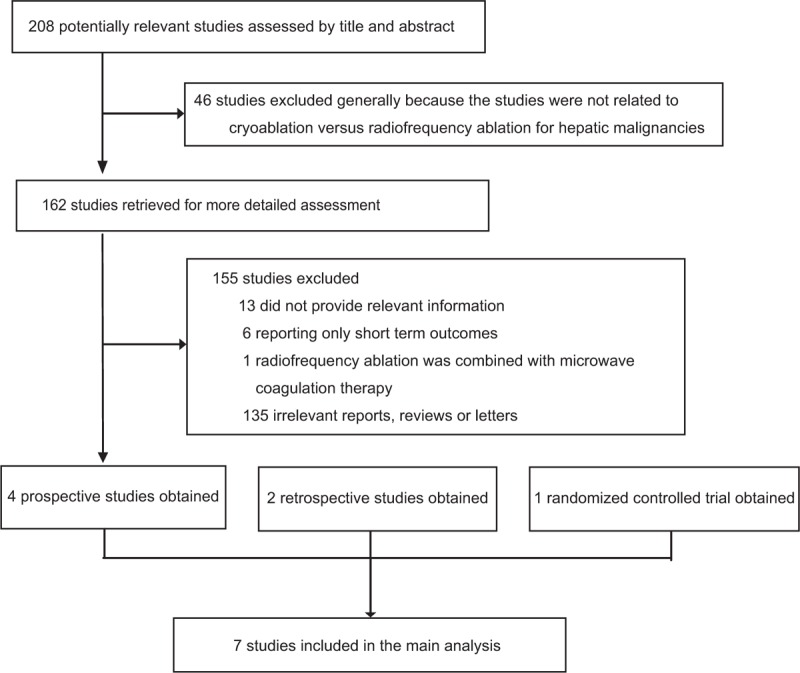
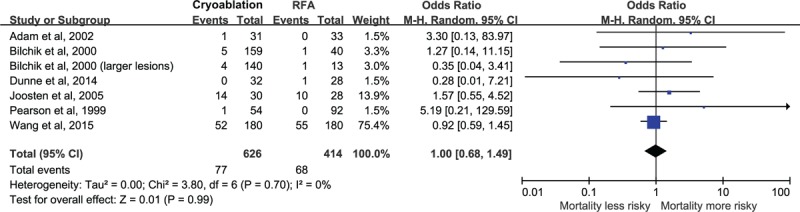
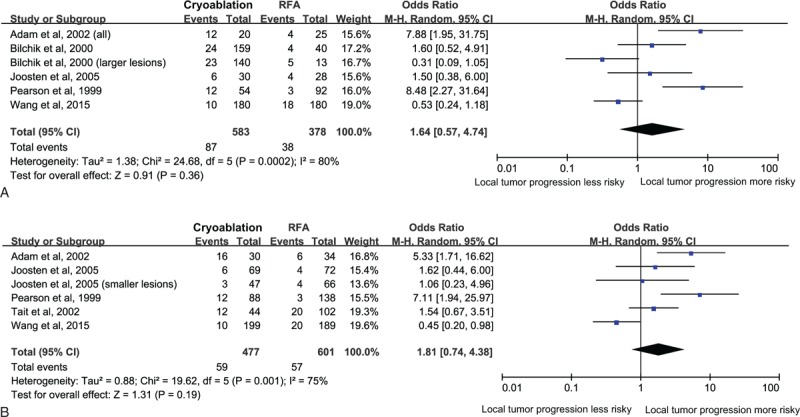
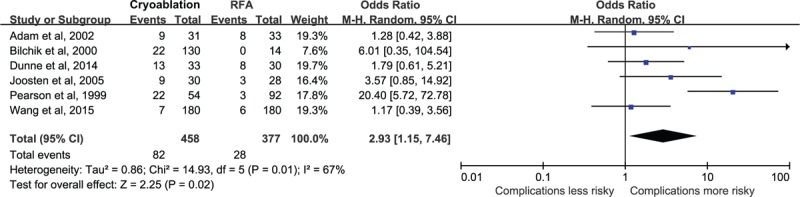
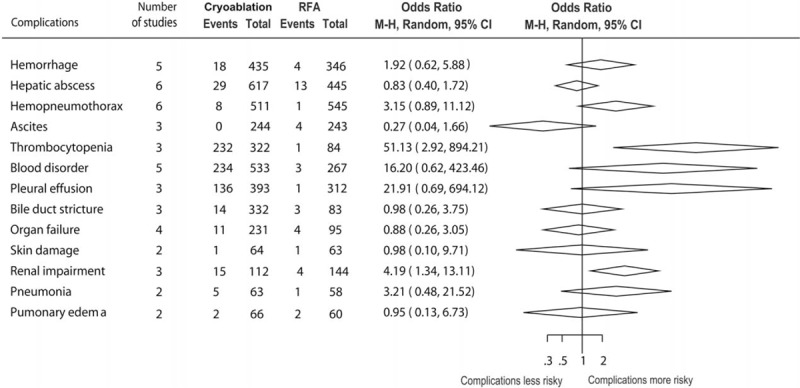
The aim of this study is to summarize and quantify the current evidence on the therapeutic efficacy of cryoablation compared with radiofrequency ablation (RFA) in patients with hepatic malignancies in a meta-analysis.Data were collected by searching PubMed, Scopus, and Cochrane databases for reports published up to May 26, 2015. Studies that reported data on comparisons of therapeutic efficacy of cryoablation and RFA were included. The random effects model was used to estimate the pooled relative risks of events comparing cryoablation to RFA for therapy of hepatic malignancies.Seven articles met the inclusion criteria and were included in the meta-analysis. The meta-analysis showed that there was no statistically significant difference in mortality of at least 6 months (odds ratio [OR] = 1.00, 95% confidence interval [CI]: 0.68-1.49) and local tumor progression according to both patients (OR = 1.64, 95% CI: 0.57-4.74) and tumors (OR = 1.81, 95% CI: 0.74-4.38) between cryoablation group and RFA group. However, the risk of complications was significantly higher in the cryoablation group than that in the RFA group (OR = 2.93, 95% CI: 1.15-7.46). When considering the specific complications, only thrombocytopenia (OR = 51.13, 95% CI: 2.92-894.21) and renal impairment (OR = 4.19, 95% CI: 1.34-13.11) but not other complications were significantly higher in the cryoablation group.In conclusion, the 2 methods had almost equal mortality and nonsignificant difference in local tumor progression, with higher risk of complications in cryoablation. Further large-scale, well-designed randomized controlled trials are needed to identify the current findings and investigate the long-term effects of cryoablation compared with RFA for therapy of hepatic malignancies.
本研究旨在通过荟萃分析总结并量化目前关于冷冻消融与射频消融(RFA)治疗肝恶性肿瘤患者疗效的证据。通过检索PubMed、Scopus和Cochrane数据库收集截至2015年5月26日发表的报告。纳入报告了冷冻消融与RFA疗效比较数据的研究。采用随机效应模型估计冷冻消融与RFA治疗肝恶性肿瘤事件的合并相对风险。
七篇文章符合纳入标准并被纳入荟萃分析。荟萃分析显示,冷冻消融组与RFA组在至少6个月的死亡率(优势比[OR]=1.00,95%置信区间[CI]:0.68 - 1.49)以及根据患者(OR=1.64,95%CI:0.57 - 4.74)和肿瘤(OR=1.81,95%CI:0.74 - 4.38)的局部肿瘤进展方面无统计学显著差异。然而,冷冻消融组的并发症风险显著高于RFA组(OR=2.93,95%CI:1.15 - 7.46)。在考虑具体并发症时,仅冷冻消融组的血小板减少症(OR=51.13,95%CI:2.92 - 894.21)和肾功能损害(OR=4.19,95%CI:1.34 - 13.11)显著高于RFA组,其他并发症无显著差异。
总之,这两种方法的死亡率几乎相同,局部肿瘤进展无显著差异,但冷冻消融的并发症风险更高。需要进一步开展大规模、设计良好的随机对照试验来验证当前研究结果,并调查冷冻消融与RFA治疗肝恶性肿瘤的长期效果。