Pusceddu Claudio, Mascia Luigi, Ninniri Chiara, Ballicu Nicola, Zedda Stefano, Melis Luca, Deiana Giulia, Porcu Alberto, Fancellu Alessandro
Department of Oncological and Interventional Radiology, Oncological Hospital A, Businco, I-09121 Cagliari, Italy.
Department of Medical Oncology, Oncological Hospital A, Businco, I-09121 Cagliari, Italy.
Cancers (Basel). 2022 Jun 19;14(12):3018. doi: 10.3390/cancers14123018.
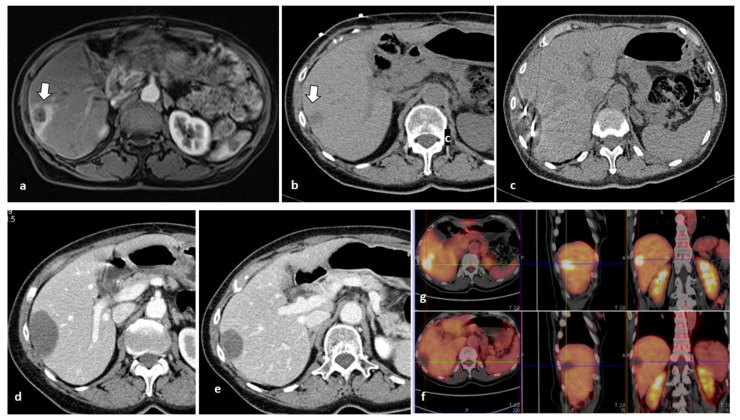
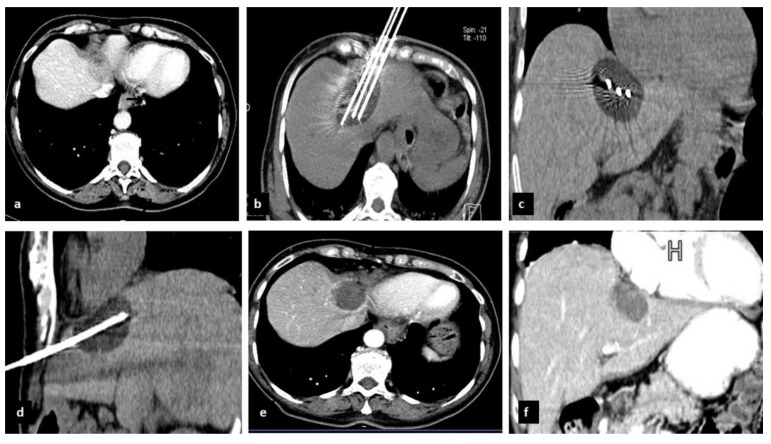
Purpose: Cryoablation (CrA) is a minimally invasive treatment that can be used in primary and metastatic liver cancer. The purpose of this study was to assess the effectiveness of CrA in patients with hepatocellular carcinoma (HCC) and liver metastases. Methods: We retrospectively evaluated the patients who had CrA for HCC or liver metastases between 2015 and 2020. Technical success, complete ablation, CrA-related complications, local tumor progression, local recurrences, and distant metastases were evaluated in the study population. In patients with HCC, the median survival was also estimated. Results: Sixty-four liver tumors in 49 patients were treated with CrA (50 metastases and 14 HCC). The mean tumor diameter was 2.15 cm. The mean follow-up was 19.8 months. Technical success was achieved in the whole study population. Complete tumor ablation was observed after one month in 92% of lesions treated with CrA (79% and 96% in the HCC Group and metastases Group, respectively, p < 0.001). Local tumor progression occurred in 12.5 of lesions, with no difference between the study groups (p = 0.105). Sixteen patients (33%) developed local recurrence (45% and 29% in the HCC Group and metastases Group, respectively, p = 0.477). Seven patients (14%) developed distant metastases in the follow-up period. Ten patients (20.8%) underwent redo CrA for local recurrence or incomplete tumor ablation. Minor complications were observed in 14% of patients. In patients with HCC, the median survival was 22 months. Conclusions: CrA can be safely used for treatment of HCC and liver metastases not amenable of surgical resection. Further studies are necessary to better define the role of CrA in the multidisciplinary treatment of liver malignancies.
冷冻消融(CrA)是一种可用于原发性和转移性肝癌的微创治疗方法。本研究的目的是评估CrA在肝细胞癌(HCC)和肝转移患者中的有效性。方法:我们回顾性评估了2015年至2020年间接受CrA治疗HCC或肝转移的患者。对研究人群评估技术成功率、完全消融、CrA相关并发症、局部肿瘤进展、局部复发和远处转移情况。对于HCC患者,还估计了中位生存期。结果:49例患者的64个肝肿瘤接受了CrA治疗(50个转移瘤和14个HCC)。平均肿瘤直径为2.15 cm。平均随访时间为19.8个月。整个研究人群均实现了技术成功。CrA治疗的病灶中,92%在1个月后观察到肿瘤完全消融(HCC组和转移瘤组分别为79%和96%,p<0.001)。12.5%的病灶出现局部肿瘤进展,研究组之间无差异(p=0.105)。16例患者(33%)发生局部复发(HCC组和转移瘤组分别为45%和29%,p=0.477)。7例患者(14%)在随访期间发生远处转移。10例患者(20.8%)因局部复发或肿瘤消融不完全接受了再次CrA治疗。14%的患者出现轻微并发症。HCC患者的中位生存期为22个月。结论:CrA可安全用于治疗无法进行手术切除的HCC和肝转移瘤。需要进一步研究以更好地明确CrA在肝脏恶性肿瘤多学科治疗中的作用。