Garchitorena Andrés, Ngonghala Calistus N, Texier Gaëtan, Landier Jordi, Eyangoh Sara, Bonds Matthew H, Guégan Jean-François, Roche Benjamin
UMR MIVEGEC 5290 CNRS - IRD - Université de Montpellier, Montpellier, France.
Ecole des Hautes Etudes en Santé Publique, Rennes, France.
Sci Rep. 2015 Dec 11;5:18055. doi: 10.1038/srep18055.
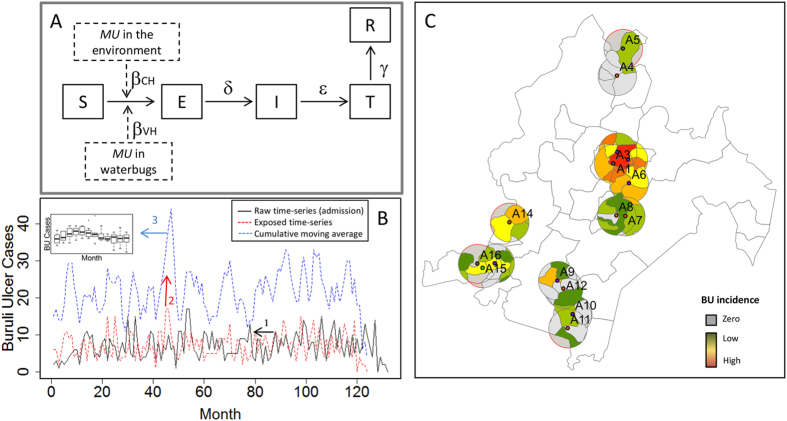
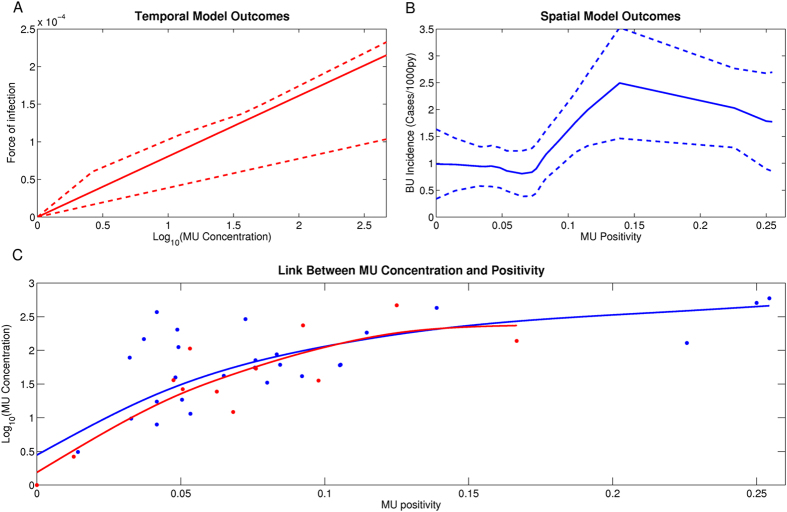
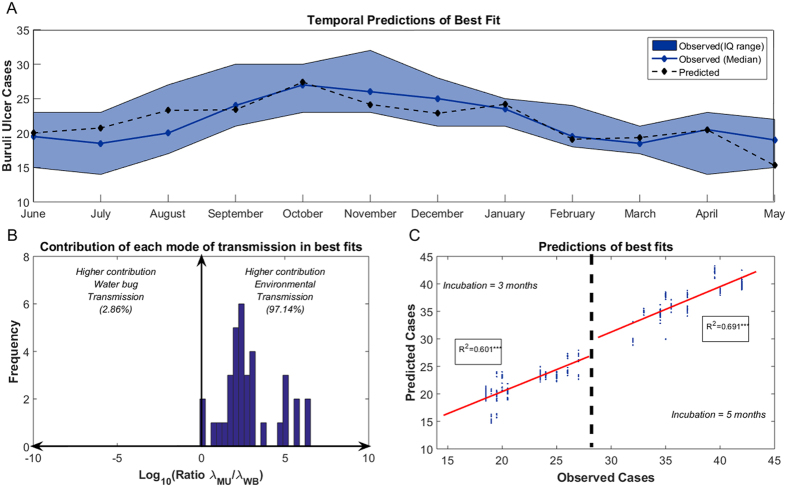
Buruli Ulcer is a devastating skin disease caused by the pathogen Mycobacterium ulcerans. Emergence and distribution of Buruli ulcer cases is clearly linked to aquatic ecosystems, but the specific route of transmission of M. ulcerans to humans remains unclear. Relying on the most detailed field data in space and time on M. ulcerans and Buruli ulcer available today, we assess the relative contribution of two potential transmission routes--environmental and water bug transmission--to the dynamics of Buruli ulcer in two endemic regions of Cameroon. The temporal dynamics of Buruli ulcer incidence are explained by estimating rates of different routes of transmission in mathematical models. Independently, we also estimate statistical models of the different transmission pathways on the spatial distribution of Buruli ulcer. The results of these two independent approaches are corroborative and suggest that environmental transmission pathways explain the temporal and spatial patterns of Buruli ulcer in our endemic areas better than the water bug transmission.
布氏溃疡是由溃疡分枝杆菌病原体引起的一种毁灭性皮肤病。布氏溃疡病例的出现和分布与水生生态系统明显相关,但溃疡分枝杆菌传播给人类的具体途径仍不清楚。依靠目前可得的关于溃疡分枝杆菌和布氏溃疡在空间和时间上最详细的实地数据,我们评估了两种潜在传播途径——环境传播和水蝽传播——对喀麦隆两个流行地区布氏溃疡动态变化的相对贡献。通过在数学模型中估计不同传播途径的发生率来解释布氏溃疡发病率的时间动态变化。另外,我们还估计了不同传播途径对布氏溃疡空间分布的统计模型。这两种独立方法的结果相互印证,表明环境传播途径比水蝽传播途径能更好地解释我们流行地区布氏溃疡的时间和空间模式。