Carolan Kevin, Garchitorena Andres, García-Peña Gabriel E, Morris Aaron, Landier Jordi, Fontanet Arnaud, Le Gall Philippe, Texier Gaëtan, Marsollier Laurent, Gozlan Rodolphe E, Eyangoh Sara, Lo Seen Danny, Guégan Jean-Francois
Unité mixte de recherche (UMR) Maladies Infectieuses et Vecteurs: Écologie, Génétique, Evolution, et Contrôle (MIVEGEC) IRD-CNRS-Universities of Montpellier I and II, Centre IRD de Montpellier, Montpellier, France; UMR Territoires, Environnement, Télédétection et Information Spatiale (TETIS) CIRAD, Montpellier, France; Unité d'Epidémiologie de Maladies Emergentes, Institut Pasteur, Paris, France.
Unité mixte de recherche (UMR) Maladies Infectieuses et Vecteurs: Écologie, Génétique, Evolution, et Contrôle (MIVEGEC) IRD-CNRS-Universities of Montpellier I and II, Centre IRD de Montpellier, Montpellier, France; Ecole des Hautes Etudes en Santé Publique, Rennes, France.
PLoS Negl Trop Dis. 2014 Nov 6;8(11):e3298. doi: 10.1371/journal.pntd.0003298. eCollection 2014.
An understanding of the factors driving the distribution of pathogens is useful in preventing disease. Often we achieve this understanding at a local microhabitat scale; however the larger scale processes are often neglected. This can result in misleading inferences about the distribution of the pathogen, inhibiting our ability to manage the disease. One such disease is Buruli ulcer, an emerging neglected tropical disease afflicting many thousands in Africa, caused by the environmental pathogen Mycobacterium ulcerans. Herein, we aim to describe the larger scale landscape process describing the distribution of M. ulcerans.
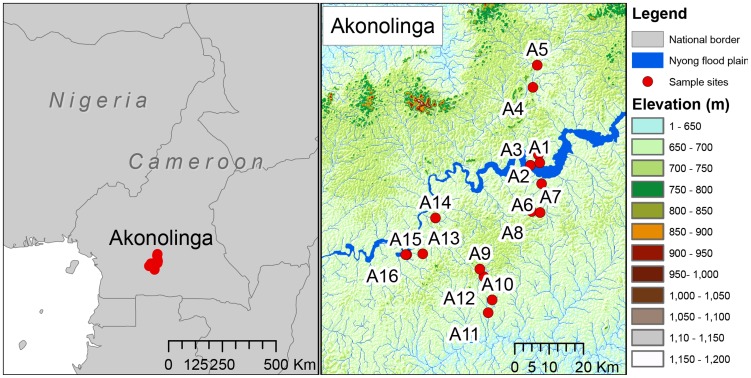
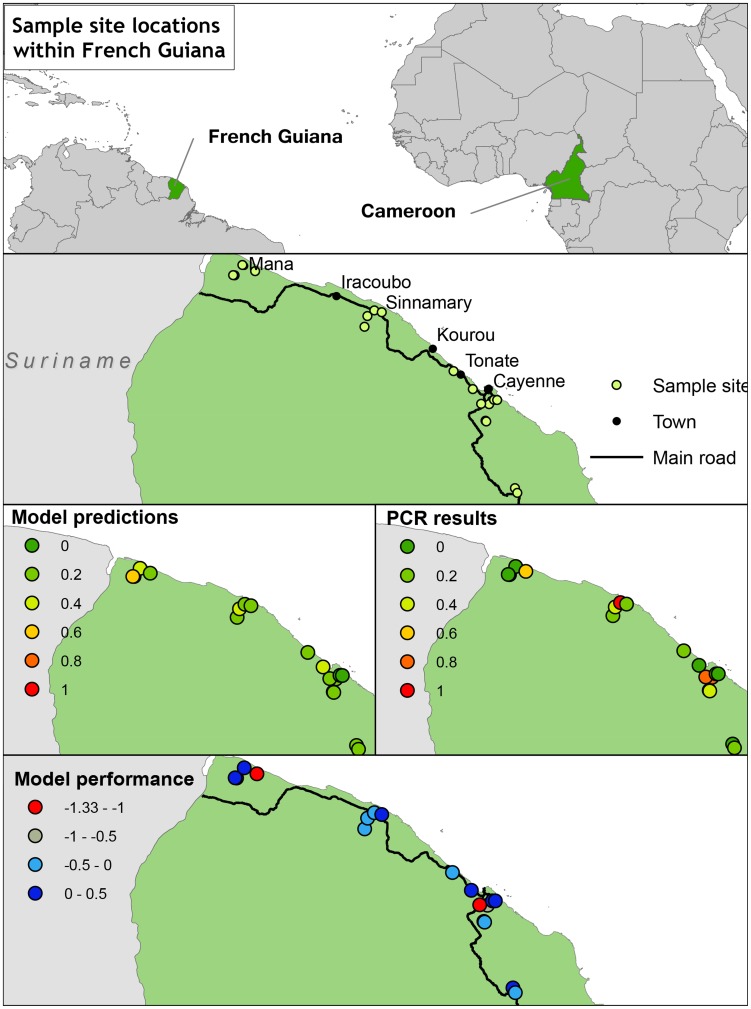
Following extensive sampling of the community of aquatic macroinvertebrates in Cameroon, we select the 5 dominant insect Orders, and conduct an ecological niche model to describe how the distribution of M. ulcerans positive insects changes according to land cover and topography. We then explore the generalizability of the results by testing them against an independent dataset collected in a second endemic region, French Guiana.
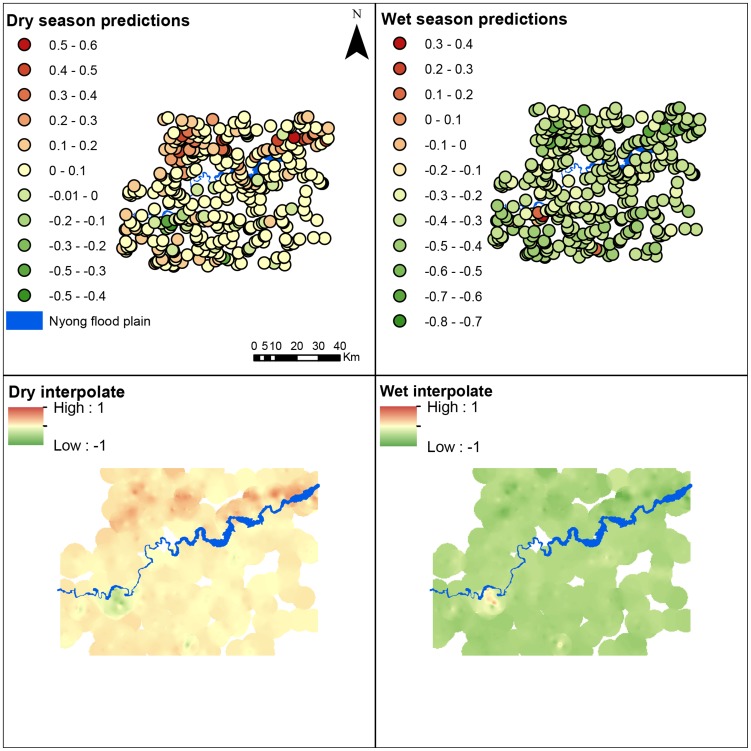
We find that the distribution of the bacterium in Cameroon is accurately described by the land cover and topography of the watershed, that there are notable seasonal differences in distribution, and that the Cameroon model does not predict the distribution of M. ulcerans in French Guiana.
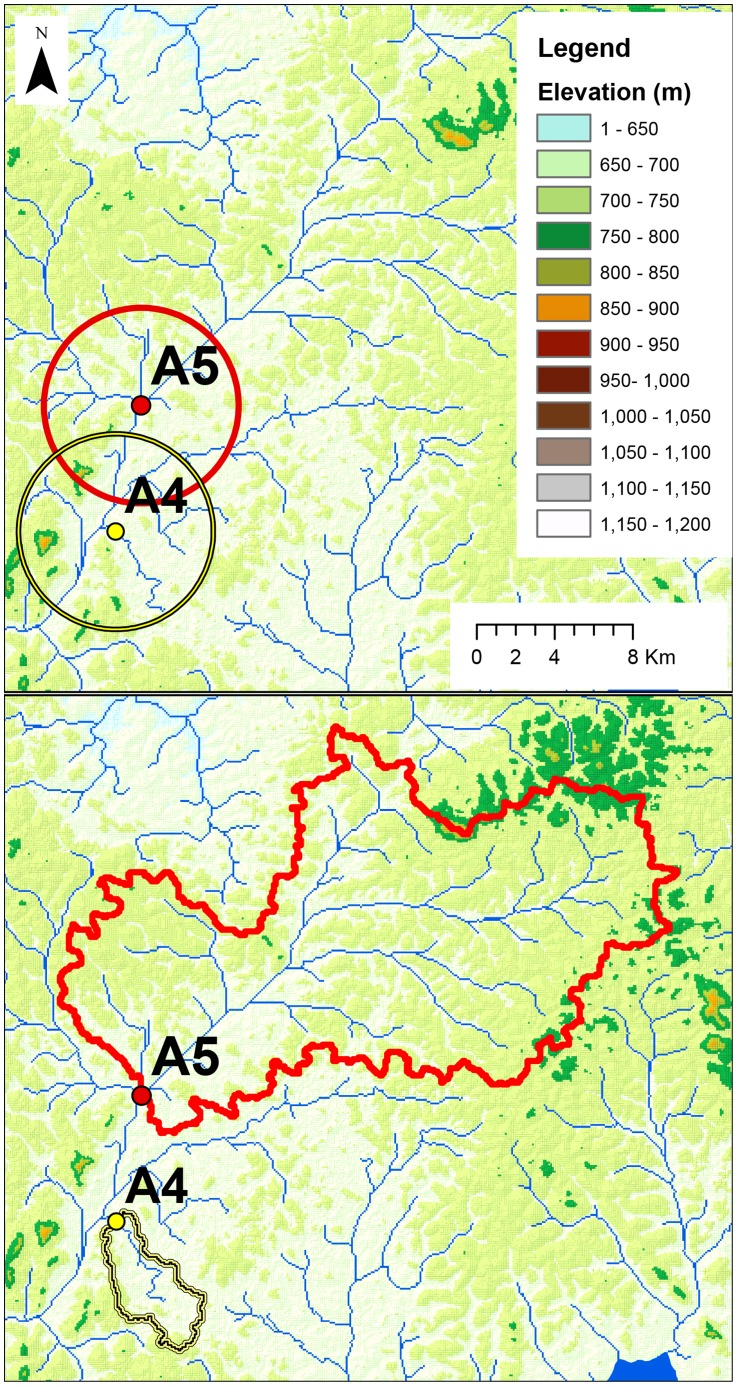
CONCLUSIONS/SIGNIFICANCE: Future studies of M. ulcerans would benefit from consideration of local structure of the local stream network in future sampling, and further work is needed on the reasons for notable differences in the distribution of this species from one region to another. This work represents a first step in the identification of large-scale environmental drivers of this species, for the purposes of disease risk mapping.
了解驱动病原体分布的因素有助于预防疾病。我们通常在局部微生境尺度上达成这种认识;然而,更大尺度的过程往往被忽视。这可能导致对病原体分布的误导性推断,抑制我们管理疾病的能力。布鲁里溃疡就是这样一种疾病,它是一种新出现的被忽视的热带病,在非洲折磨着成千上万人,由环境病原体溃疡分枝杆菌引起。在此,我们旨在描述描述溃疡分枝杆菌分布的更大尺度景观过程。
在对喀麦隆水生大型无脊椎动物群落进行广泛采样后,我们选择了5个主要昆虫目,并进行生态位模型,以描述溃疡分枝杆菌阳性昆虫的分布如何根据土地覆盖和地形而变化。然后,我们通过在第二个流行地区法属圭亚那收集的独立数据集对结果进行测试,来探索结果的普遍性。
我们发现,喀麦隆细菌的分布可以通过流域的土地覆盖和地形准确描述,分布存在明显的季节性差异,并且喀麦隆模型无法预测溃疡分枝杆菌在法属圭亚那的分布。
结论/意义:未来对溃疡分枝杆菌的研究将受益于在未来采样中考虑当地溪流网络的局部结构,并且需要进一步研究该物种在不同地区分布存在显著差异的原因。这项工作是为了疾病风险测绘而识别该物种大规模环境驱动因素的第一步。