Dimova Violeta, Lötsch Jörn, Hühne Kathrin, Winterpacht Andreas, Heesen Michael, Parthum Andreas, Weber Peter G, Carbon Roman, Griessinger Norbert, Sittl Reinhard, Lautenbacher Stefan
Physiological Psychology, Otto-Friedrich University Bamberg, Frankfurt am Main, Germany ; Pain Center, Friedrich-Alexander University Erlangen, Frankfurt am Main, Germany ; Institute of Clinical Pharmacology, Goethe University, Frankfurt am Main, Germany.
Institute of Clinical Pharmacology, Goethe University, Frankfurt am Main, Germany.
J Pain Res. 2015 Nov 27;8:829-44. doi: 10.2147/JPR.S90434. eCollection 2015.
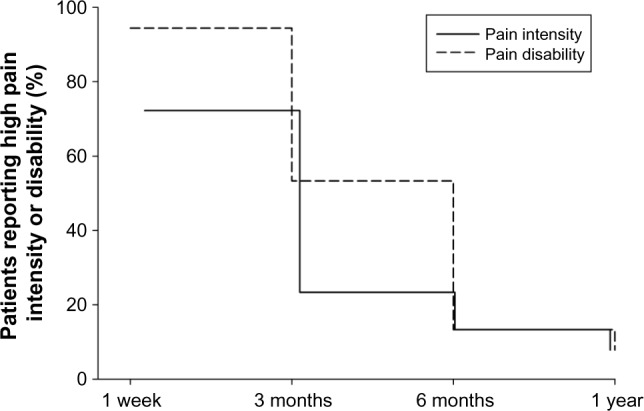
The genetic control of pain has been repeatedly demonstrated in human association studies. In the present study, we assessed the relative contribution of 16 single nucleotide polymorphisms in pain-related genes, such as cathechol-O-methyl transferase gene (COMT), fatty acid amino hydrolase gene (FAAH), transient receptor potential cation channel, subfamily V, member 1 gene (TRPV1), and δ-opioid receptor gene (OPRD1), for postsurgical pain chronification. Ninety preoperatively pain-free male patients were assigned to good or poor outcome groups according to their intensity or disability score assessed at 1 week, 3 months, 6 months, and 1 year after funnel chest correction. The genetic effects were compared with those of two psychological predictors, the attentional bias toward positive words (dot-probe task) and the self-reported pain vigilance (Pain Vigilance and Awareness Questionnaire [PVAQ]), which were already shown to be the best predictors for pain intensity and disability at 6 months after surgery in the same sample, respectively. Cox regression analyses revealed no significant effects of any of the genetic predictors up to the end point of survival time at 1 year after surgery. Adding the genetics to the prediction by the attentional bias to positive words for pain intensity and the PVAQ for pain disability, again no significant additional explanation could be gained by the genetic predictors. In contrast, the preoperative PVAQ score was also, in the present enlarged sample, a meaningful predictor for lasting pain disability after surgery. Effect size measures suggested some genetic variables, for example, the polymorphism rs1800587G>A in the interleukin 1 alpha gene (IL1A) and the COMT haplotype rs4646312T>C/rs165722T>C/rs6269A>G/rs4633T>C/rs4818C>G/rs4680A>G, as possible relevant modulators of long-term postsurgical pain outcome. A comparison between pathophysiologically different predictor groups appears to be helpful in identifying clinically relevant predictors of chronic pain.
疼痛的遗传控制在人类关联研究中已得到反复证实。在本研究中,我们评估了16个疼痛相关基因中的单核苷酸多态性对术后疼痛慢性化的相对贡献,这些基因包括儿茶酚-O-甲基转移酶基因(COMT)、脂肪酸氨基水解酶基因(FAAH)、瞬时受体电位阳离子通道亚家族V成员1基因(TRPV1)和δ-阿片受体基因(OPRD1)。90名术前无疼痛的男性患者根据漏斗胸矫正术后1周、3个月、6个月和1年时评估的强度或残疾评分被分为预后良好或不良组。将基因效应与两种心理预测因素进行比较,即对积极词汇的注意偏向(点探测任务)和自我报告的疼痛警觉性(疼痛警觉与意识问卷 [PVAQ]),在同一样本中,这两种因素已分别被证明是术后6个月时疼痛强度和残疾的最佳预测因素。Cox回归分析显示,直至术后1年生存时间终点,任何基因预测因素均无显著影响。将基因因素添加到基于对积极词汇的注意偏向预测疼痛强度和基于PVAQ预测疼痛残疾的模型中,基因预测因素同样未带来显著的额外解释。相比之下,在本扩大样本中,术前PVAQ评分也是术后持续性疼痛残疾的一个有意义的预测因素。效应量测量表明,一些基因变量,例如白细胞介素1α基因(IL1A)中的多态性rs1800587G>A以及COMT单倍型rs4646312T>C/rs165722T>C/rs6269A>G/rs4633T>C/rs4818C>G/rs4680A>G,可能是术后长期疼痛结局的相关调节因子。比较病理生理学上不同的预测因素组似乎有助于识别慢性疼痛的临床相关预测因素。