
青少年特发性脊柱侧凸中重力诱导的冠状面关节力矩
Gravity-induced coronal plane joint moments in adolescent idiopathic scoliosis.
作者信息
Keenan Bethany E, Pettet Graeme J, Izatt Maree T, Askin Geoffrey N, Labrom Robert D, Pearcy Mark J, Adam Clayton
机构信息
Paediatric Spine Research Group, Institute of Health and Biomedical Innovation, Queensland University of Technology and Mater Health Services, Brisbane, 4101 Queensland Australia.
Institute of Health and Biomedical Innovation, Queensland University of Technology, Brisbane, QLD Australia.
出版信息
Scoliosis. 2015 Dec 17;10:35. doi: 10.1186/s13013-015-0060-9. eCollection 2015.
BACKGROUND
Adolescent Idiopathic Scoliosis is the most common type of spinal deformity, and whilst the isk of progression appears to be biomechanically mediated (larger deformities are more likely to progress), the detailed biomechanical mechanisms driving progression are not well understood. Gravitational forces in the upright position are the primary sustained loads experienced by the spine. In scoliosis they are asymmetrical, generating moments about the spinal joints which may promote asymmetrical growth and deformity progression. Using 3D imaging modalities to estimate segmental torso masses allows the gravitational loading on the scoliotic spine to be determined. The resulting distribution of joint moments aids understanding of the mechanics of scoliosis progression.
METHODS
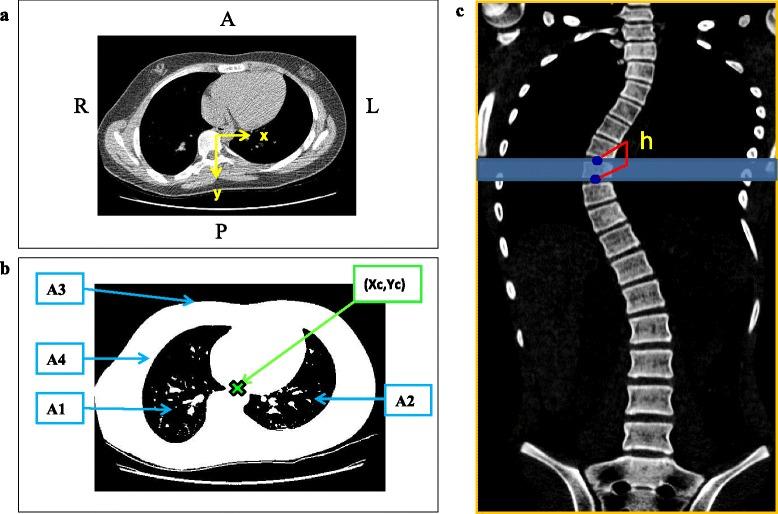
Existing low-dose CT scans were used to estimate torso segment masses and joint moments for 20 female scoliosis patients. Intervertebral joint moments at each vertebral level were found by summing the moments of each of the torso segment masses above the required joint.
RESULTS
The patients' mean age was 15.3 years (SD 2.3; range 11.9-22.3 years); mean thoracic major Cobb angle 52(°) (SD 5.9(°); range 42-63(°)) and mean weight 57.5 kg (SD 11.5 kg; range 41-84.7 kg). Joint moments of up to 7 Nm were estimated at the apical level. No significant correlation was found between the patients' major Cobb angles and apical joint moments.
CONCLUSIONS
Patients with larger Cobb angles do not necessarily have higher joint moments, and curve shape is an important determinant of joint moment distribution. These findings may help to explain the variations in progression between individual patients. This study suggests that substantial corrective forces are required of either internal instrumentation or orthoses to effectively counter the gravity-induced moments acting to deform the spinal joints of idiopathic scoliosis patients.
背景
青少年特发性脊柱侧凸是最常见的脊柱畸形类型,虽然进展风险似乎由生物力学介导(较大的畸形更有可能进展),但驱动进展的详细生物力学机制尚不清楚。直立位时的重力是脊柱承受的主要持续负荷。在脊柱侧凸中,这些力是不对称的,会在脊柱关节处产生力矩,这可能会促进不对称生长和畸形进展。使用三维成像方法来估计躯干各节段的质量,可以确定脊柱侧凸脊柱上的重力负荷。由此产生的关节力矩分布有助于理解脊柱侧凸进展的力学原理。
方法
利用现有的低剂量CT扫描来估计20名女性脊柱侧凸患者的躯干节段质量和关节力矩。通过将所需关节上方每个躯干节段质量的力矩相加,得出每个椎体水平的椎间关节力矩。
结果
患者的平均年龄为15.3岁(标准差2.3;范围11.9 - 22.3岁);平均胸段主 Cobb角为52°(标准差5.9°;范围42 - 63°),平均体重为57.5千克(标准差11.5千克;范围41 - 84.7千克)。在顶椎水平估计的关节力矩高达7牛米。未发现患者的主Cobb角与顶椎关节力矩之间存在显著相关性。
结论
Cobb角较大的患者不一定具有更高的关节力矩,曲线形状是关节力矩分布的重要决定因素。这些发现可能有助于解释个体患者之间进展的差异。本研究表明,无论是内固定器械还是矫形器,都需要相当大的矫正力才能有效抵消重力引起的力矩,这些力矩会使特发性脊柱侧凸患者的脊柱关节变形。



 Zotero 插件