Driban Jeffrey B, Eaton Charles B, Lo Grace H, Price Lori Lyn, Lu Bing, Barbe Mary F, McAlindon Timothy E
Division of Rheumatology, Tufts Medical Center, 800 Washington Street, Box #406, Boston, MA, 02111, USA.
Center for Primary Care and Prevention, Alpert Medical School of Brown University, 111 Brewster Street, Pawtucket, RI, 02860, USA.
Clin Rheumatol. 2016 Apr;35(4):1071-6. doi: 10.1007/s10067-015-3152-2. Epub 2015 Dec 21.
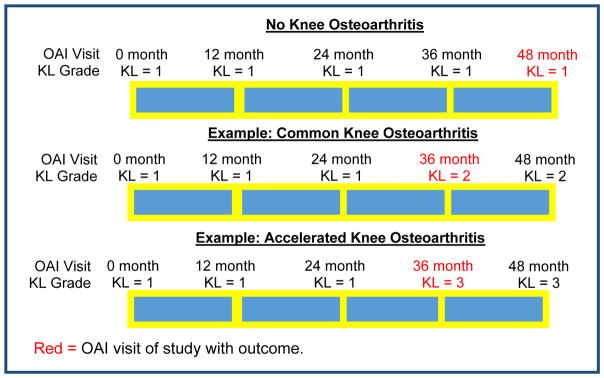
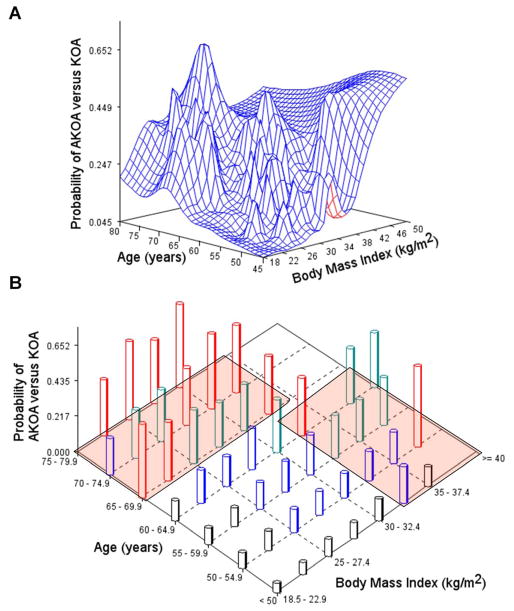
We explored whether age and body mass index (BMI) can help identify a subset of individuals who are at high risk for accelerated knee osteoarthritis (AKOA) compared with common knee osteoarthritis (KOA). In the Osteoarthritis Initiative, a multicenter observational cohort study of KOA (n = 4796), we studied participants without KOA at baseline (Kellgren-Lawrence (KL) <2). Participants could have one of three outcomes: (1) AKOA, ≥1 knee progressed to end-stage KOA within 48 months; (2) common KOA, ≥1 knee increased in radiographic scoring within 48 months (excluding those with AKOA); and (3) no KOA, no change in KL grade in either knee. After verifying an interaction between age, BMI, and recent knee injury, we determined if we could identify a specific subset of individuals at high risk for AKOA instead of KOA. First, we reviewed three-dimensional graphs with age, BMI, and probability of AKOA versus KOA on the axes. We then conducted a logistic regression with AKOA as the outcome and age-BMI groups as the predictor. In our main analyses, we found that older individuals with a BMI <35 kg/m(2) were more likely to develop AKOA than common KOA (n = 64; mean [SD] BMI = 27.3 [3.1] kg/m(2); odds ratio = 3.47, 95 % confidence interval = 1.70 to 7.10), especially if they had a recent knee injury. While older age and greater BMI are independently associated with AKOA, we found that older individuals who had a higher BMI, particularly if they have an injury, were more likely to develop AKOA than common KOA.
我们探讨了年龄和体重指数(BMI)是否有助于识别与普通膝关节骨关节炎(KOA)相比,患快速进展性膝关节骨关节炎(AKOA)风险较高的个体亚组。在骨关节炎倡议组织(OAI)中,一项针对KOA的多中心观察性队列研究(n = 4796),我们研究了基线时无KOA(Kellgren-Lawrence(KL)<2)的参与者。参与者可能有以下三种结果之一:(1)AKOA,至少1个膝关节在48个月内进展为终末期KOA;(2)普通KOA,至少1个膝关节在48个月内放射学评分增加(不包括AKOA患者);(3)无KOA,双膝KL分级无变化。在验证年龄、BMI和近期膝关节损伤之间的相互作用后,我们确定是否能够识别出患AKOA而非KOA风险较高的特定个体亚组。首先,我们查看了以年龄、BMI以及AKOA与KOA的概率为坐标轴的三维图。然后,我们进行了以AKOA为结局、年龄-BMI组为预测因素的逻辑回归分析。在我们的主要分析中,我们发现BMI<35 kg/m²的老年人比普通KOA更易发生AKOA(n = 64;平均[标准差]BMI = 27.3 [3.1] kg/m²;优势比 = 3.47,95%置信区间 = 1.70至7.10),尤其是如果他们近期有膝关节损伤。虽然年龄较大和BMI较高均与AKOA独立相关,但我们发现BMI较高的老年人,特别是如果他们有损伤,比普通KOA更易发生AKOA。