School of Biotechnology & Biomolecular Sciences, University of New South Wales, Sydney, 2052, NSW, Australia.
Evolution & Ecology Research Centre, University of New South Wales, Sydney, 2052, NSW, Australia.
BMC Evol Biol. 2015 Dec 21;15:288. doi: 10.1186/s12862-015-0560-5.
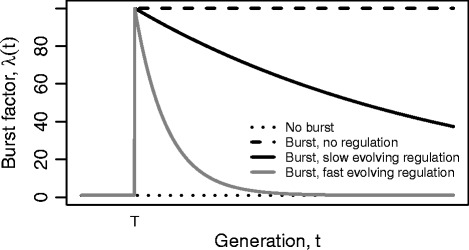
Currently there is no satisfactory explanation for why bacterial insertion sequences (ISs) widely occur across prokaryotes despite being mostly harmful to their host genomes. Rates of horizontal gene transfer are likely to be too low to maintain ISs within a population. IS-induced beneficial mutations may be important for both prevalence of ISs and microbial adaptation to changing environments but may be too rare to sustain IS elements in the long run. Environmental stress can induce elevated rates of IS transposition activities; such episodes are known as 'transposition bursts'. By examining how selective forces and transposition events interact to influence IS dynamics, this study asks whether transposition bursts can lead to IS persistence.
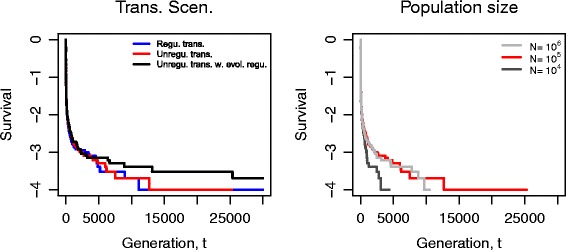
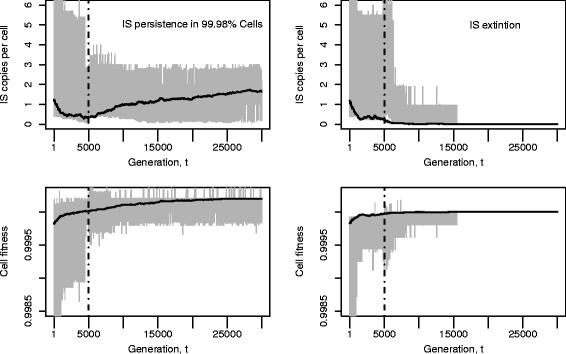
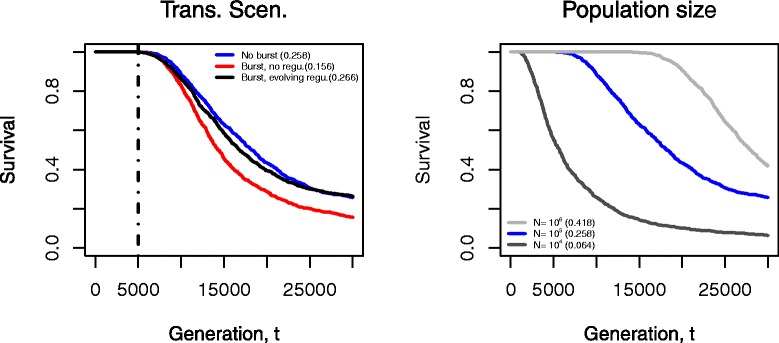
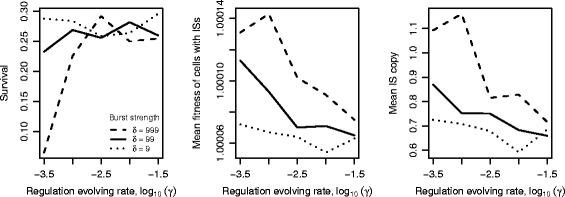
We show through a simulation model that ISs are gradually eliminated from a population even if IS transpositions occasionally cause advantageous mutations. With beneficial mutations, transposition bursts create variation in IS copy numbers and improve cell fitness on average. However, these benefits are not usually sufficient to overcome the negative selection against the elements, and transposition bursts amplify the mean fitness effect which, if negative, simply accelerates the extinction of ISs. If down regulation of transposition occurs, IS extinctions are reduced while ISs still generate variation amongst bacterial genomes.
Transposition bursts do not help ISs persist in a bacterial population in the long run because most burst-induced mutations are deleterious and therefore not favoured by natural selection. However, bursts do create more genetic variation through which occasional advantageous mutations can help organisms adapt. Regulation of IS transposition bursts and stronger positive selection of the elements interact to slow down the burst-induced extinction of ISs.
目前,尽管细菌插入序列(IS)对其宿主基因组大多有害,但仍广泛存在于原核生物中,其原因尚无令人满意的解释。水平基因转移的速率可能太低,无法在种群内维持 IS。IS 诱导的有益突变可能对 IS 的普遍性和微生物对不断变化的环境的适应都很重要,但从长远来看,这些突变可能太罕见,无法维持 IS 元件。环境压力会诱导 IS 转座活性的升高;这种情况被称为“转座爆发”。通过研究选择压力和转座事件如何相互作用来影响 IS 的动态,本研究探讨了转座爆发是否可以导致 IS 的持续存在。
我们通过模拟模型表明,即使 IS 转座偶尔会导致有利的突变,IS 也会逐渐从种群中消除。有了有益的突变,转座爆发会在 IS 拷贝数上产生变异,并平均提高细胞的适应性。然而,这些好处通常不足以克服对元件的负选择,转座爆发放大了平均适应性效应,如果是负的,只会加速 IS 的灭绝。如果转座调控发生下调,IS 的灭绝会减少,而 IS 仍然会在细菌基因组中产生变异。
从长远来看,转座爆发并不能帮助 IS 在细菌种群中持续存在,因为大多数爆发诱导的突变是有害的,因此不受自然选择的青睐。然而,爆发确实通过偶尔有利的突变创造了更多的遗传变异,帮助生物体适应。IS 转座爆发的调控和元件的更强的正选择相互作用,减缓了爆发诱导的 IS 灭绝。