Jorge Juliana de Goes, Santos Marcos Antonio Almeida, Barreto Filho José Augusto Soares, Oliveira Joselina Luzia Menezes, de Melo Enaldo Vieira, de Oliveira Norma Alves, Faro Gustavo Baptista de Almeida, Sousa Antônio Carlos Sobral
Núcleo de Pós-graduação em Ciências da Saúde, Universidade Federal de Sergipe, Aracaju, SE, Brazil.
Centro de Ensino e Pesquisa, Hospital e Fundação São Lucas, Aracaju, SE, Brazil.
Arq Bras Cardiol. 2016 Jan;106(1):33-40. doi: 10.5935/abc.20160006. Epub 2015 Dec 22.
Acute coronary syndrome (ACS) is one of the main causes of morbidity and mortality in the modern world. A sedentary lifestyle, present in 85% of the Brazilian population, is considered a risk factor for the development of coronary artery disease. However, the correlation of a sedentary lifestyle with cardiovascular events (CVE) during hospitalization for ACS is not well established.
To evaluate the association between physical activity level, assessed with the International Physical Activity Questionnaire (IPAQ), with in-hospital prognosis in patients with ACS.
Observational, cross-sectional, and analytical study with 215 subjects with a diagnosis of ACS consecutively admitted to a referral hospital for cardiac patients between July 2009 and February 2011. All volunteers answered the short version of the IPAQ and were observed for the occurrence of CVE during hospitalization with a standardized assessment conducted by the researcher and corroborated by data from medical records.
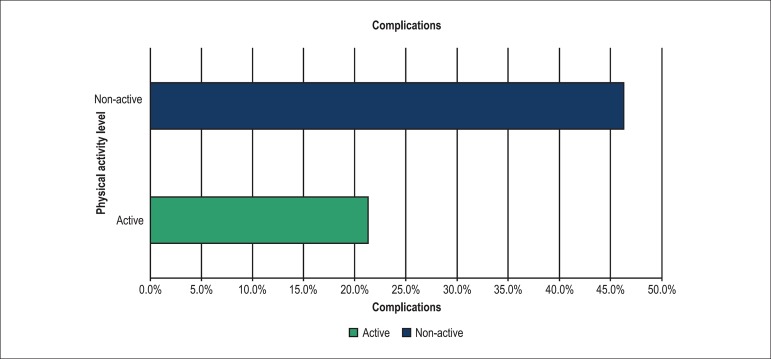
The patients were admitted with diagnoses of unstable angina (34.4%), acute myocardial infarction (AMI) without ST elevation (41.4%), and AMI with ST elevation (24.2%). According to the level of physical activity, the patients were classified as non-active (56.3%) and active (43.7%). A CVE occurred in 35.3% of the cohort. The occurrence of in-hospital complications was associated with the length of hospital stay (odds ratio [OR] = 1.15) and physical inactivity (OR = 2.54), and was independent of age, systolic blood pressure, and prior congestive heart failure.
A physically active lifestyle reduces the risk of CVE during hospitalization in patients with ACS.
急性冠状动脉综合征(ACS)是现代世界发病和死亡的主要原因之一。巴西85%的人口存在久坐不动的生活方式,这被认为是冠状动脉疾病发展的一个危险因素。然而,久坐不动的生活方式与ACS住院期间心血管事件(CVE)之间的相关性尚未明确确立。
使用国际体力活动问卷(IPAQ)评估体力活动水平与ACS患者住院预后之间的关联。
2009年7月至2011年2月期间,对215名连续入住一家心脏病转诊医院且诊断为ACS的患者进行观察性、横断面分析研究。所有志愿者均回答了IPAQ简版问卷,并由研究人员进行标准化评估以观察住院期间CVE的发生情况,同时病历数据也予以佐证。
患者入院诊断为不稳定型心绞痛(34.4%)、非ST段抬高型急性心肌梗死(AMI)(41.4%)和ST段抬高型AMI(24.2%)。根据体力活动水平,患者分为非活跃组(56.3%)和活跃组(43.7%)。该队列中35.3%的患者发生了CVE。住院并发症的发生与住院时间(比值比[OR]=1.15)和缺乏体力活动(OR=2.54)相关,且与年龄、收缩压和既往充血性心力衰竭无关。
积极的生活方式可降低ACS患者住院期间发生CVE的风险。