Bittoni Alessandro, Del Prete Michela, Scartozzi Mario, Pistelli Mirco, Giampieri Riccardo, Faloppi Luca, Bianconi Maristella, Cascinu Stefano
Medical Oncology, AOU Ospedali Riuniti-Università, Politecnica Delle Marche, 60126 Ancona, Italy.
Oncologia Medica, Azienda Ospedaliero-Universitaria di Cagliari, Presidio Policlinico D. Casula, Strada St. 554, KM 4.500, Cagliari, 09042 Monserrato, CA Italy.
Springerplus. 2015 Dec 1;4:743. doi: 10.1186/s40064-015-1545-y. eCollection 2015.
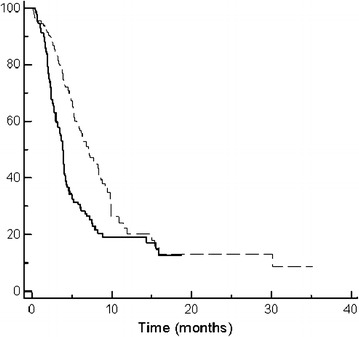
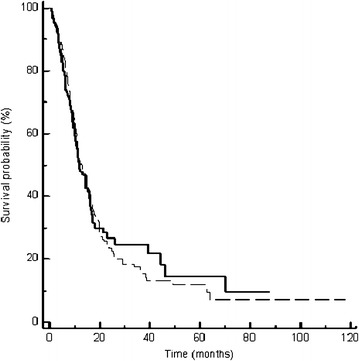
The definition of the standard chemotherapy regimen for advanced gastric cancer is still a matter of debate. Aim of our analysis was to retrospectively assess whether an intensive, three-drugs, front line approach could be comparable to a sequential (two-drugs front line then second line) in terms of RR (response rate), PFS (progression free survival) and OS (overall survival) in advanced gastric cancer patients in the clinical practice. Patients with metastatic gastric cancer who have received a first-line combination chemotherapy with a two or three-drugs regimen were included in our analysis. We divided our patients into two groups, A and B, based on the first line chemotherapy administered (group A = three drugs; group B = two drugs). A total of 425 patients were eligible for our analysis. 216 patients (50.8 %) received three chemotherapeutic agents (group A) and 209 patients (49.2 %) received a two drugs regimen as first-line combination chemotherapy (group B). RR for group A and B was 44 and 29.6 %, respectively (p = 0.0005), median PFS was 7.3 months in group A and 4.5 months in group B (p = 0.0007). No significant difference was found in terms of OS. The addition of a third drug to a doublet chemotherapy regimen appeared more active in terms of response rate and PFS. However median OS resulted comparable. On this basis, the use of a sequential approach may represent a reasonable strategy for patients unwilling or unable to undergo a more intensive treatment without compromising OS.
晚期胃癌标准化疗方案的定义仍存在争议。我们分析的目的是回顾性评估在临床实践中,对于晚期胃癌患者,强化的三药一线治疗方案在缓解率(RR)、无进展生存期(PFS)和总生存期(OS)方面是否与序贯治疗(两药一线然后二线治疗)相当。接受两药或三药方案一线联合化疗的转移性胃癌患者纳入我们的分析。根据一线化疗方案将患者分为A、B两组(A组 = 三药;B组 = 两药)。共有425例患者符合我们的分析条件。216例患者(50.8%)接受三药化疗(A组),209例患者(49.2%)接受两药方案作为一线联合化疗(B组)。A组和B组的RR分别为44%和29.6%(p = 0.0005),A组的中位PFS为7.3个月,B组为4.5个月(p = 0.0007)。在OS方面未发现显著差异。在双联化疗方案中添加第三种药物在缓解率和PFS方面似乎更有效。然而,中位OS结果相当。在此基础上,对于不愿或无法接受更强化治疗且不影响OS的患者,采用序贯治疗方法可能是一种合理的策略。