Park Jong Kook, Seo Jung Seon, Lee Suk Kyeong, Chan Kenneth K, Kuh Hyo-Jeong
Department of Biomedical Science and Research Institute for Bioscience & Biotechnology, Hallym University, Chuncheon 24252, Republic of Korea.
Department of Biomedicine & Health Science, Graduate School, The Catholic University of Korea, Seoul 06591, Republic of Korea.
Biomol Ther (Seoul). 2018 Nov 1;26(6):591-598. doi: 10.4062/biomolther.2018.061.
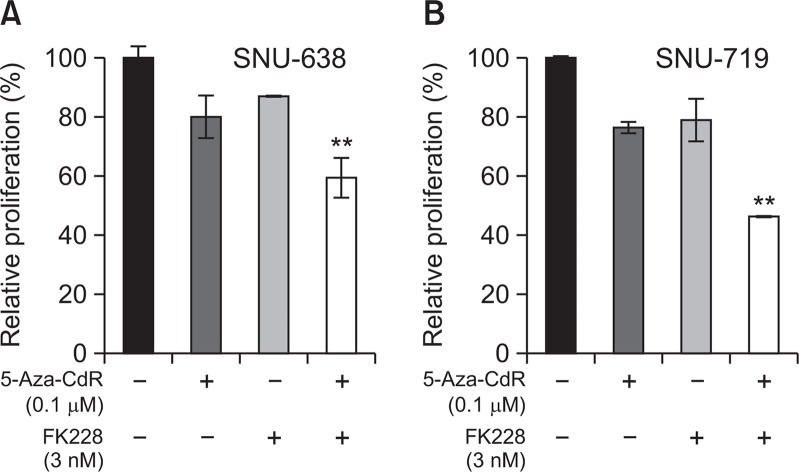
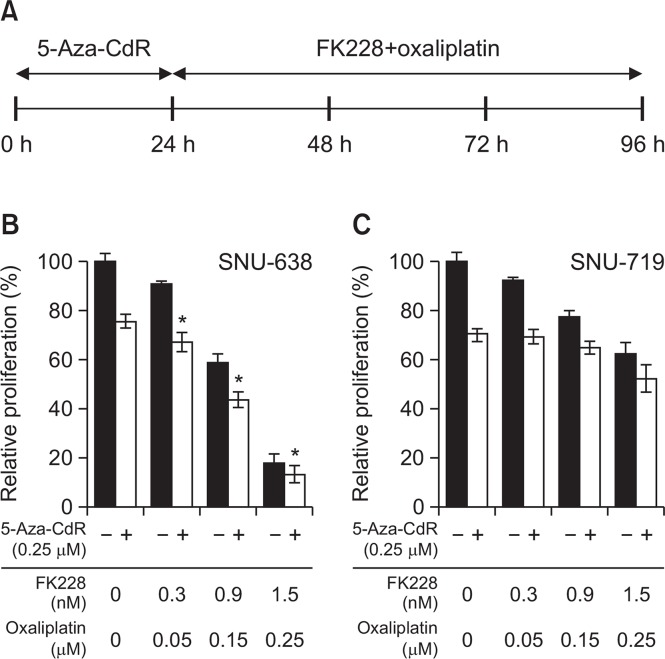
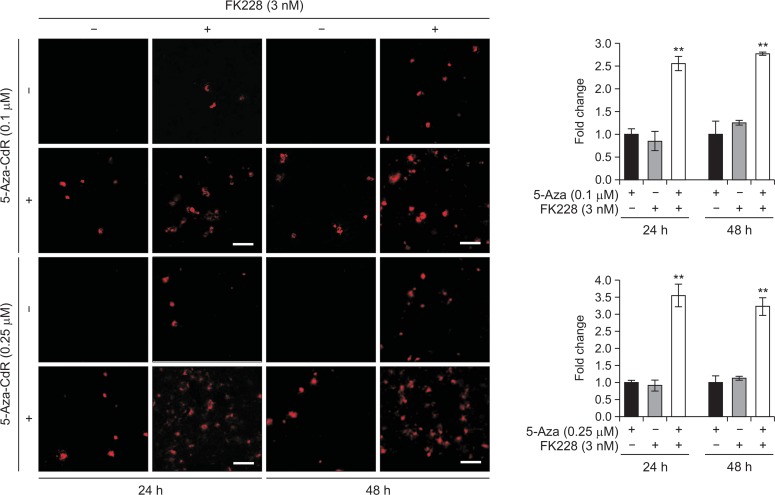
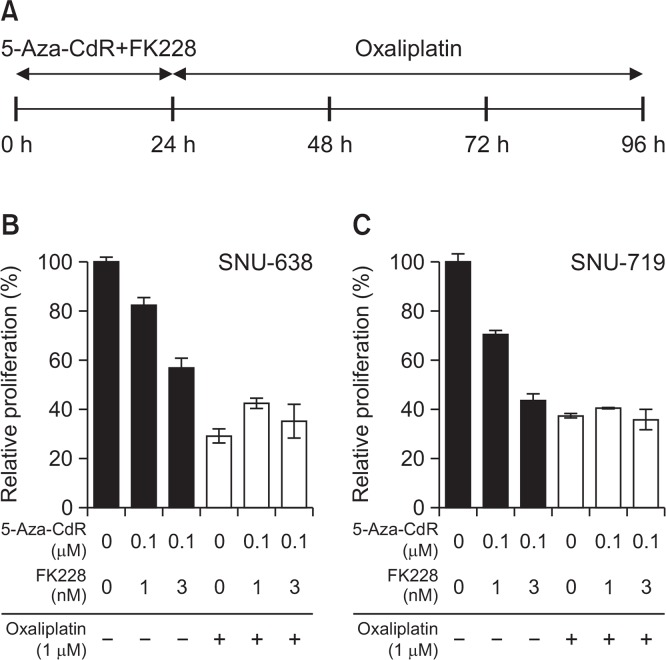
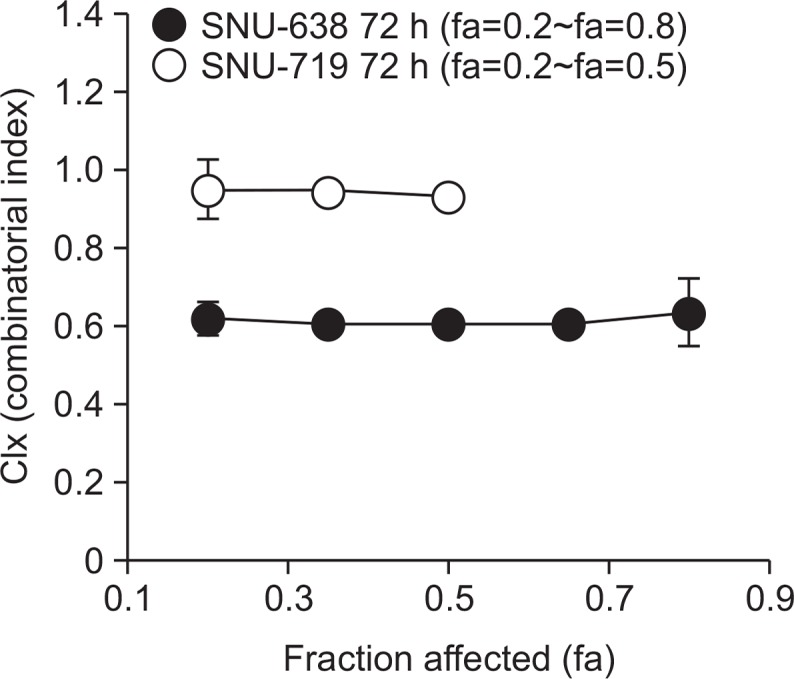
Epigenetic silencing is considered to be a major mechanism for loss of activity in tumor suppressors. Reversal of epigenetic silencing by using inhibitors of DNA methyltransferase (DNMT) or histone deacetylases (HDACs) such as 5-Aza-CdR and FK228 has shown to enhance cytotoxic activities of several anticancer agents. This study aims to assess the combinatorial effects of gene-silencing reversal agents (5-Aza-CdR and FK228) and oxaliplatin in gastric cancer cells, i.e., Epstein-Barr virus (EBV)-negative SNU-638 and EBV-positive SNU-719 cells. The doublet combinatorial treatment of 5-Aza-CdR and FK228 exhibited synergistic effects in both cell lines, and this was further corroborated by Zta expression induction in SNU-719 cells. Three drug combinations as 5-Aza-CdR/FK228 followed by oxaliplatin, however, resulted in antagonistic effects in both cell lines. Simultaneous treatment with FK228 and oxaliplatin induced synergistic and additive effects in SNU-638 and SNU-719 cells, respectively. Three drug combinations as 5-Aza-CdR prior to FK228/oxaliplatin, however, again resulted in antagonistic effects in both cell lines. This work demonstrated that efficacy of doublet synergistic combination using DNMT or HDACs inhibitors can be compromised by adding the third drug in pre- or post-treatment approach in gastric cancer cells. This implies that the development of clinical trial protocols for triplet combinations using gene-silencing reversal agents should be carefully evaluated in light of their potential antagonistic effects.
表观遗传沉默被认为是肿瘤抑制因子活性丧失的主要机制。使用DNA甲基转移酶(DNMT)抑制剂或组蛋白去乙酰化酶(HDAC)抑制剂(如5-氮杂胞苷和FK228)逆转表观遗传沉默已显示可增强几种抗癌药物的细胞毒性活性。本研究旨在评估基因沉默逆转剂(5-氮杂胞苷和FK228)与奥沙利铂在胃癌细胞(即爱泼斯坦-巴尔病毒(EBV)阴性的SNU-638细胞和EBV阳性的SNU-719细胞)中的联合作用。5-氮杂胞苷和FK228的双重联合治疗在两种细胞系中均表现出协同作用,并且SNU-719细胞中Zta表达的诱导进一步证实了这一点。然而,三种药物组合(5-氮杂胞苷/FK228后接奥沙利铂)在两种细胞系中均产生拮抗作用。FK228和奥沙利铂同时治疗分别在SNU-638和SNU-719细胞中诱导了协同和相加作用。然而,三种药物组合(5-氮杂胞苷先于FK228/奥沙利铂)在两种细胞系中再次产生拮抗作用。这项工作表明,在胃癌细胞中,通过在治疗前或治疗后添加第三种药物,使用DNMT或HDAC抑制剂的双重协同组合的疗效可能会受到影响。这意味着使用基因沉默逆转剂的三联组合临床试验方案的开发应根据其潜在的拮抗作用进行仔细评估。