Hackney Madeleine E, Lee Ho Lim, Battisto Jessica, Crosson Bruce, McGregor Keith M
Atlanta VA Center for Visual and Neurocognitive Rehabilitation , Decatur, GA , USA ; Division of General Medicine and Geriatrics, Department of Medicine, Emory School of Medicine , Atlanta, GA , USA.
Emory College of Arts and Sciences, Emory University , Atlanta, GA , USA.
Front Neurol. 2015 Dec 2;6:251. doi: 10.3389/fneur.2015.00251. eCollection 2015.
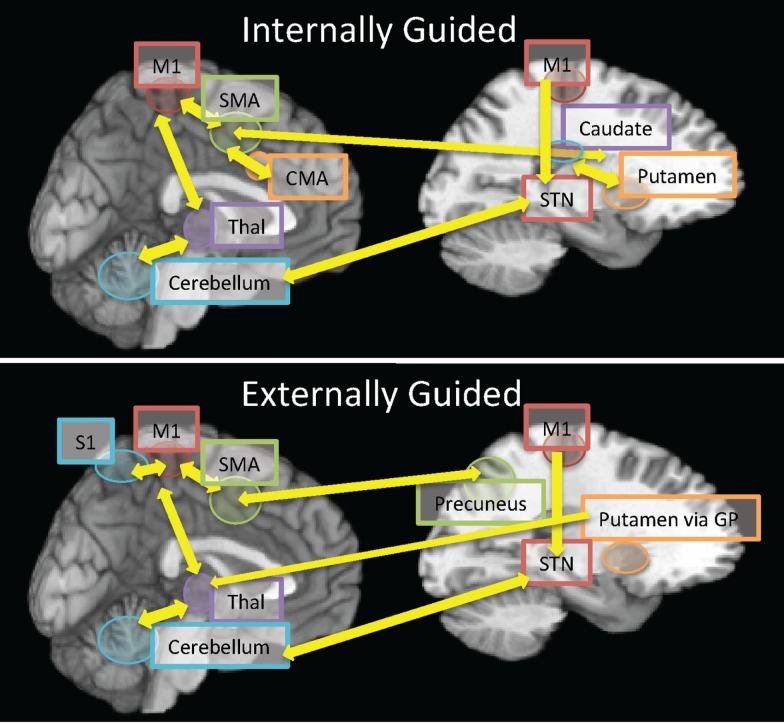
Parkinson's disease is a neurodegenerative disorder that has received considerable attention in allopathic medicine over the past decades. However, it is clear that, to date, pharmacological and surgical interventions do not fully address symptoms of PD and patients' quality of life. As both an alternative therapy and as an adjuvant to conventional approaches, several types of rhythmic movement (e.g., movement strategies, dance, tandem biking, and Tai Chi) have shown improvements to motor symptoms, lower limb control, and postural stability in people with PD (1-6). However, while these programs are increasing in number, still little is known about the neural mechanisms underlying motor improvements attained with such interventions. Studying limb motor control under task-specific contexts can help determine the mechanisms of rehabilitation effectiveness. Both internally guided (IG) and externally guided (EG) movement strategies have evidence to support their use in rehabilitative programs. However, there appears to be a degree of differentiation in the neural substrates involved in IG vs. EG designs. Because of the potential task-specific benefits of rhythmic training within a rehabilitative context, this report will consider the use of IG and EG movement strategies, and observations produced by functional magnetic resonance imaging and other imaging techniques. This review will present findings from lower limb imaging studies, under IG and EG conditions for populations with and without movement disorders. We will discuss how these studies might inform movement disorders rehabilitation (in the form of rhythmic, music-based movement training) and highlight research gaps. We believe better understanding of lower limb neural activity with respect to PD impairment during rhythmic IG and EG movement will facilitate the development of novel and effective therapeutic approaches to mobility limitations and postural instability.
帕金森病是一种神经退行性疾病,在过去几十年里受到了西医的广泛关注。然而,很明显,迄今为止,药物和手术干预并不能完全解决帕金森病的症状以及患者的生活质量问题。作为一种替代疗法以及传统方法的辅助手段,几种类型的节律性运动(如运动策略、舞蹈、双人自行车和太极拳)已显示出对帕金森病患者的运动症状、下肢控制和姿势稳定性有改善作用(1 - 6)。然而,尽管这类项目的数量在增加,但对于通过此类干预实现运动改善的神经机制仍知之甚少。研究特定任务背景下的肢体运动控制有助于确定康复效果的机制。内部引导(IG)和外部引导(EG)运动策略都有证据支持其在康复项目中的应用。然而,IG与EG设计所涉及的神经基质似乎存在一定程度的差异。鉴于康复背景下节律性训练可能具有特定任务的益处,本报告将考虑IG和EG运动策略的应用,以及功能磁共振成像和其他成像技术所产生的观察结果。本综述将呈现针对有和没有运动障碍人群在IG和EG条件下的下肢成像研究结果。我们将讨论这些研究如何为运动障碍康复(以基于音乐的节律性运动训练形式)提供信息,并突出研究空白。我们相信,更好地理解在节律性IG和EG运动过程中与帕金森病损伤相关的下肢神经活动,将有助于开发针对行动受限和姿势不稳的新型有效治疗方法。