Herrmann Ken, Queiroz Marcelo, Huellner Martin W, de Galiza Barbosa Felipe, Buck Andreas, Schaefer Niklaus, Stolzman Paul, Veit-Haibach Patrick
Department of Nuclear Medicine, University Hospital Zurich, Rämistrasse 100, CH-8091, Zurich, Switzerland.
Department of Nuclear Medicine, Universitätsklinikum Würzburg, Oberdürrbacher Str. 6, DE-97080, Würzburg, Germany.
BMC Cancer. 2015 Dec 23;15:1002. doi: 10.1186/s12885-015-2009-z.
Use of FDG-PET/CT for staging and restaging of lymphoma patients is widely incorporated into current practice guidelines. Our aim was to prospectively evaluate the diagnostic performance of FDG-PET/MRI and WB-DW-MRI compared with FDG-FDG-PET/CT using a tri-modality PET/CT-MRI system.
From 04/12 to 01/14, a total of 82 FDG-PET/CT examinations including an additional scientific MRI on a tri-modality setup were performed in 61 patients. FDG-PET/CT, FDG-PET/MRI, and WB-DW-MRI were independently analyzed. A lesion with a mean ADC below a threshold of 1.2 × 10(-3) mm(2)/s was defined as positive for restricted diffusion. FDG-PET/CT and FDG-PET/MRI were evaluated for the detection of lesions corresponding to lymphoma manifestations according to the German Hodgkin Study Group. Imaging findings were validated by biopsy (n = 21), by follow-up imaging comprising CT, FDG-PET/CT, and/or FDG-PET/MRI (n = 32), or clinically (n = 25) (mean follow-up: 9.1 months).
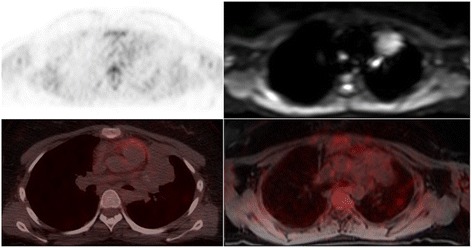
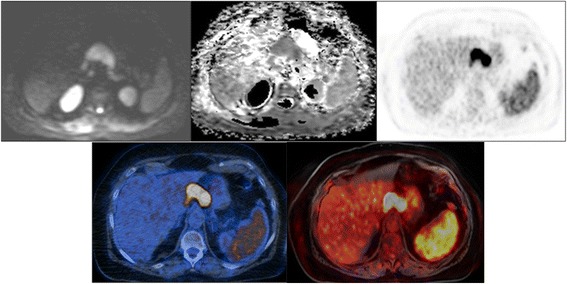
FDG-PET/MRI and FDG-PET/CT accurately detected 188 lesions in 27 patients. Another 54 examinations in 35 patients were negative. WB-DW-MRI detected 524 lesions, of which 125 (66.5% of the aforementioned 188 lesions) were true positive. Among the 188 lesions positive for lymphoma, FDG-PET/MRI detected all 170 instances of nodal disease and also all 18 extranodal lymphoma manifestations; by comparison, WB-DW-MRI characterized 115 (67.6%) and 10 (55.6%) lesions as positive for nodal and extranodal disease, respectively. FDG-PET/MRI was superior to WB-DW-MRI in detecting lymphoma manifestations in patients included for staging (113 vs. 73), for restaging (75 vs. 52), for evaluation of high- (127 vs. 81) and low-grade lymphomas (61 vs. 46), and for definition of Ann Arbor stage (WB-DW-MRI resulted in upstaging in 60 cases, including 45 patients free of disease, and downstaging in 4).
Our results indicate that FDG-PET/CT and FDG-PET/MRI probably have a similar performance in the clinical work-up of lymphomas. The performance of WB-DW-MRI was generally inferior to that of both FDG-PET-based methods but the technique might be used in specific scenarios, e.g., in low-grade lymphomas and during surveillance.
氟代脱氧葡萄糖正电子发射断层扫描/计算机断层扫描(FDG-PET/CT)用于淋巴瘤患者的分期及再分期,已广泛纳入当前的实践指南。我们的目的是使用三联模式PET/CT-MRI系统,前瞻性评估FDG-PET/MRI和全身弥散加权磁共振成像(WB-DW-MRI)与FDG-PET/CT相比的诊断性能。
从2012年4月至2014年1月,61例患者共进行了82次FDG-PET/CT检查,其中包括在三联模式设备上额外进行的科学磁共振成像检查。FDG-PET/CT、FDG-PET/MRI和WB-DW-MRI均进行独立分析。表观扩散系数(ADC)平均值低于1.2×10⁻³mm²/s阈值的病变定义为弥散受限阳性。根据德国霍奇金淋巴瘤研究组标准,评估FDG-PET/CT和FDG-PET/MRI检测与淋巴瘤表现相应的病变情况。影像学检查结果通过活检(n = 21)、包括CT、FDG-PET/CT和/或FDG-PET/MRI的随访成像(n = 32)或临床检查(n = 25)进行验证(平均随访时间:9.1个月)。
FDG-PET/MRI和FDG-PET/CT准确检测出27例患者的188个病变。另外35例患者的54次检查结果为阴性。WB-DW-MRI检测出524个病变,其中125个(上述188个病变的66.5%)为真阳性。在188个淋巴瘤阳性病变中,FDG-PET/MRI检测出所有170例淋巴结病变以及所有18例结外淋巴瘤表现;相比之下,WB-DW-MRI将115个(67.6%)和10个(55.6%)病变分别判定为淋巴结和结外病变阳性。在分期患者(113对73)、再分期患者(75对52)、高级别(127对81)和低级别淋巴瘤(61对46)的评估以及Ann Arbor分期的定义方面,FDG-PET/MRI优于WB-DW-MRI(WB-DW-MRI导致60例分期上调,包括45例无疾病患者,4例分期下调)。
我们的结果表明,FDG-PET/CT和FDG-PET/MRI在淋巴瘤的临床检查中可能具有相似的性能。WB-DW-MRI的性能总体上低于两种基于FDG-PET的方法,但该技术可能在特定情况下使用,例如在低级别淋巴瘤和监测期间。