Moisan Frédéric, Kab Sofiane, Mohamed Fatima, Canonico Marianne, Le Guern Morgane, Quintin Cécile, Carcaillon Laure, Nicolau Javier, Duport Nicolas, Singh-Manoux Archana, Boussac-Zarebska Marjorie, Elbaz Alexis
Département santé travail, Institut de veille sanitaire (InVS), Saint-Maurice, France.
Département santé travail, Institut de veille sanitaire (InVS), Saint-Maurice, France Department of Epidemiology of ageing and age related diseases, INSERM, Centre for Research in Epidemiology and Population Health, U1018, Villejuif, France University Paris-Sud, UMRS 1018, Villejuif, France.
J Neurol Neurosurg Psychiatry. 2016 Sep;87(9):952-7. doi: 10.1136/jnnp-2015-312283. Epub 2015 Dec 23.
Parkinson's disease (PD) is 1.5 times more frequent in men than women. Whether age modifies this ratio is unclear. We examined whether male-to-female (M-F) ratios change with age through a French nationwide prevalence/incidence study (2010) and a meta-analysis of incidence studies.
We used French national drug claims databases to identify PD cases using a validated algorithm. We computed M-F prevalence/incidence ratios overall and by age using Poisson regression. Ratios were regressed on age to estimate their annual change. We identified all PD incidence studies with age/sex-specific data, and performed a meta-analysis of M-F ratios.
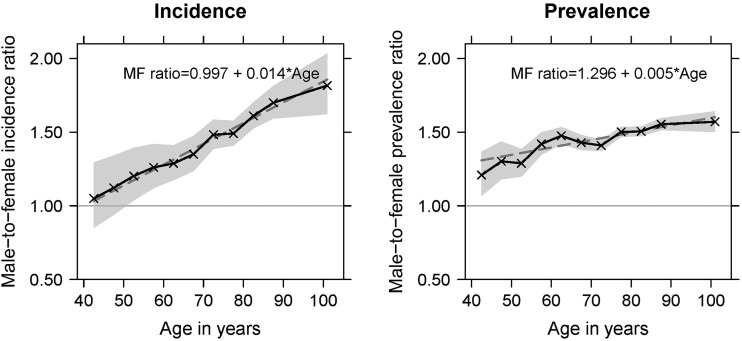
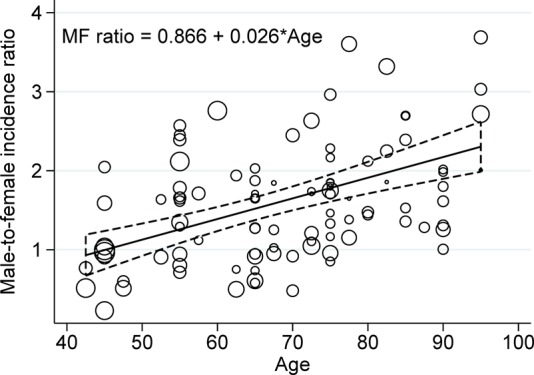
On the basis of 149 672 prevalent (50% women) and 25 438 incident (49% women) cases, age-standardised rates were higher in men (prevalence=2.865/1000; incidence=0.490/1000 person-years) than women (prevalence=1.934/1000; incidence=0.328/1000 person-years). The overall M-F ratio was 1.48 for prevalence and 1.49 for incidence. Prevalence and incidence M-F ratios increased by 0.05 and 0.14, respectively, per 10 years of age. Incidence was similar in men and women under 50 years (M-F ratio <1.2, p>0.20), and over 1.6 (p<0.001) times higher in men than women above 80 years (p trend <0.001). A meta-analysis of 22 incidence studies (14 126 cases, 46% women) confirmed that M- F ratios increased with age (0.26 per 10 years, p trend=0.005).
Age-increasing M-F ratios suggest that PD aetiology changes with age. Sex-related risk/protective factors may play a different role across the continuum of age at onset. This finding may inform aetiological PD research.
帕金森病(PD)在男性中的发病率是女性的1.5倍。年龄是否会改变这一比例尚不清楚。我们通过一项法国全国性的患病率/发病率研究(2010年)以及对发病率研究的荟萃分析,研究了男女比例(M-F)是否随年龄变化。
我们使用法国国家药物报销数据库,通过经过验证的算法识别帕金森病病例。我们使用泊松回归计算总体以及按年龄划分的男女患病率/发病率比例。将比例与年龄进行回归分析,以估计其年度变化。我们识别了所有具有年龄/性别特异性数据的帕金森病发病率研究,并对男女比例进行了荟萃分析。
基于149672例患病率病例(50%为女性)和25438例发病率病例(49%为女性),年龄标准化发病率男性(患病率=2.865/1000;发病率=0.490/1000人年)高于女性(患病率=1.934/1000;发病率=0.328/1000人年)。总体男女比例患病率为1.48,发病率为1.49。每增长10岁,患病率和发病率的男女比例分别增加0.05和0.14。50岁以下男性和女性的发病率相似(男女比例<1.2,p>0.20),而80岁以上男性的发病率比女性高1.6倍以上(p<0.001)(p趋势<0.001)。对22项发病率研究(14126例病例,46%为女性)的荟萃分析证实,男女比例随年龄增加(每10年增加0.26,p趋势=0.005)。
男女比例随年龄增加表明帕金森病的病因随年龄变化。与性别相关的风险/保护因素在发病年龄的连续过程中可能发挥不同作用。这一发现可能为帕金森病的病因研究提供参考。