Metta Vinod, Qamar Mubasher A, Poplawska-Domaszewicz Karolina, Ibrahim Huzaifa, Hussain Hasna, Nalarakettil Afsal, Tanjung Gloria, Chaudhuri K Ray
Department of Basic and Clinical Neuroscience, The Maurice Wohl Clinical Neuroscience Institute, Institute of Psychiatry, Psychology and Neuroscience, King's College London, 5 Cutcombe Road, London, SE5 9RX, UK.
Parkinson's Foundation Centre of Excellence, King's College Hospital, Denmark Hill, London, SE5 9RS, UK.
J Neural Transm (Vienna). 2025 Apr;132(4):591-601. doi: 10.1007/s00702-024-02873-0. Epub 2024 Dec 27.
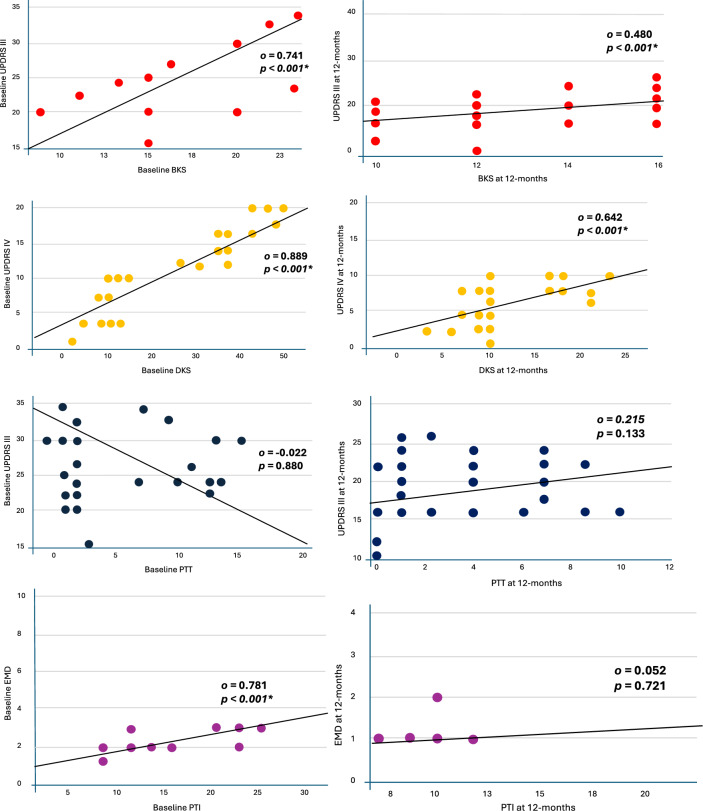
Parkinson's disease (PD) is a progressive neurodegenerative disorder marked by both motor and non-motor symptoms that necessitate ongoing clinical evaluation and medication adjustments. Home-based wearable sensor monitoring offers a detailed and continuous record of patient symptoms, potentially enhancing disease management. The EmPark-PKG study aims to evaluate the effectiveness of the Parkinson's KinetoGraph (PKG), a wearable sensor device, in monitoring and tracking the progression of motor symptoms over 12 months in Emirati and non-Emirati PD patients. Fifty PD patients (32% Emirati, 68% non-Emirati) were assessed at baseline and a 12-month follow-up. Clinical evaluations included levodopa equivalent daily dosage (LEDD) and motor and non-motor assessments. Concurrently, the PKG provided metrics such as bradykinesia score (BKS) and dyskinesia score (DKS). Statistical analyses were conducted to determine changes from baseline to six months, differences between Emirati and non-Emirati groups, and correlations between PKG metrics and clinical assessments. Significant reductions in LEDD and improvements in both motor and non-motor scores were observed from baseline to six months (p < 0.05). PKG-guided medication adjustments were associated with enhanced motor and non-motor outcomes (p < 0.05). Specifically, non-Emirati patients exhibited a significant reduction in LEDD (Z = - 2.010, p = 0.044), whereas Emirati patients did not (Z = - 0.468, p = 0.640). Both groups showed significant improvements in motor scale scores and motor complication scores. Spearman correlation analysis revealed strong relationships between PKG metrics and subjective clinical assessments (p < 0.001). The EmPark-PKG study demonstrates the potential benefits of remote PKG monitoring for personalised motor symptom management in PD. PKG supports a stepped care paradigm by enabling bespoke medication titration based on objective data, facilitating tailored and effective patient care.
帕金森病(PD)是一种进行性神经退行性疾病,其特征为运动和非运动症状,需要持续的临床评估和药物调整。基于家庭的可穿戴传感器监测可详细、连续地记录患者症状,可能改善疾病管理。EmPark-PKG研究旨在评估可穿戴传感器设备帕金森运动记录仪(PKG)在监测和跟踪阿联酋和非阿联酋帕金森病患者运动症状进展12个月中的有效性。50名帕金森病患者(32%为阿联酋人,68%为非阿联酋人)在基线期和12个月随访时接受了评估。临床评估包括左旋多巴等效日剂量(LEDD)以及运动和非运动评估。同时,PKG提供了诸如运动迟缓评分(BKS)和异动症评分(DKS)等指标。进行了统计分析,以确定从基线到6个月的变化、阿联酋和非阿联酋组之间的差异以及PKG指标与临床评估之间的相关性。从基线到6个月,观察到LEDD显著降低,运动和非运动评分均有所改善(p < 0.05)。PKG指导的药物调整与运动和非运动结果的改善相关(p < 0.05)。具体而言,非阿联酋患者的LEDD显著降低(Z = - 2.010,p = 0.044),而阿联酋患者则没有(Z = - 0.468,p = 0.640)。两组在运动量表评分和运动并发症评分方面均有显著改善。Spearman相关性分析显示PKG指标与主观临床评估之间存在密切关系(p < 0.001)。EmPark-PKG研究证明了远程PKG监测对帕金森病个性化运动症状管理的潜在益处。PKG通过基于客观数据进行定制化药物滴定来支持分级护理模式,促进个性化且有效的患者护理。