Shiao Chih-Chung, Wu Pei-Chen, Huang Tao-Min, Lai Tai-Shuan, Yang Wei-Shun, Wu Che-Hsiung, Lai Chun-Fu, Wu Vin-Cent, Chu Tzong-Shinn, Wu Kwan-Dun
Division of Nephrology, Department of Internal Medicine, Saint Mary's Hospital Luodong, 160 Chong-Cheng South Road, Luodong, Yilan, 265, Taiwan.
Saint Mary's Medicine, Nursing and Management College, 160 Chong-Cheng South Road, Luodong, Yilan, 265, Taiwan.
Crit Care. 2015 Dec 28;19:438. doi: 10.1186/s13054-015-1149-5.
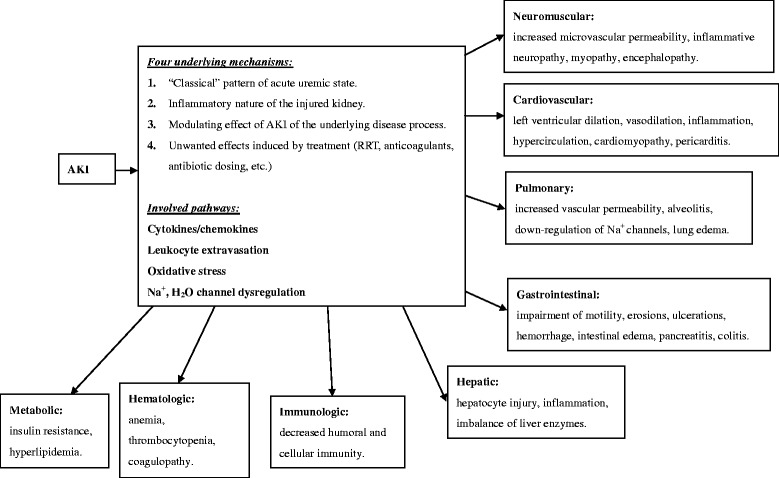
Acute kidney injury (AKI) has been a global health epidemic problem with soaring incidence, increased long-term risks for multiple comorbidities and mortality, as well as elevated medical costs. Despite the improvement of patient outcomes following the advancements in preventive and therapeutic strategies, the mortality rates among critically ill patients with AKI remain as high as 40-60 %. The distant organ injury, a direct consequence of deleterious systemic effects, following AKI is an important explanation for this phenomenon. To date, most evidence of remote organ injury in AKI is obtained from animal models. Whereas the observations in humans are from a limited number of participants in a relatively short follow-up period, or just focusing on the cytokine levels rather than clinical solid outcomes. The remote organ injury is caused with four underlying mechanisms: (1) "classical" pattern of acute uremic state; (2) inflammatory nature of the injured kidneys; (3) modulating effect of AKI of the underlying disease process; and (4) healthcare dilemma. While cytokines/chemokines, leukocyte extravasation, oxidative stress, and certain channel dysregulation are the pathways involving in the remote organ damage. In the current review, we summarized the data from experimental studies to clinical outcome studies in the field of organ crosstalk following AKI. Further, the long-term consequences of distant organ-system, including liver, heart, brain, lung, gut, bone, immune system, and malignancy following AKI with temporary dialysis were reviewed and discussed.
急性肾损伤(AKI)已成为一个全球性的健康流行问题,其发病率飙升,多种合并症和死亡率的长期风险增加,医疗成本也不断上升。尽管随着预防和治疗策略的进步,患者的治疗效果有所改善,但AKI重症患者的死亡率仍高达40%-60%。AKI后出现的远隔器官损伤是有害全身效应的直接后果,这是对这一现象的重要解释。迄今为止,AKI远隔器官损伤的大多数证据来自动物模型。而在人类中的观察结果则来自数量有限的参与者,随访期相对较短,或者只是关注细胞因子水平而非临床确凿的结果。远隔器官损伤由四种潜在机制引起:(1)急性尿毒症状态的“经典”模式;(2)受损肾脏的炎症性质;(3)AKI对基础疾病进程的调节作用;(4)医疗困境。细胞因子/趋化因子、白细胞渗出、氧化应激和某些通道失调是涉及远隔器官损伤的途径。在本综述中,我们总结了AKI后器官相互作用领域从实验研究到临床结果研究的数据。此外,还对包括肝脏、心脏、大脑、肺、肠道、骨骼、免疫系统和恶性肿瘤在内的远隔器官系统在AKI伴临时透析后的长期后果进行了综述和讨论。