Lee Mi-Kyung, Kim Sinyoung, Kim Mi-Na, Kweon Oh Joo, Lim Yong Kwan, Ki Chang-Seok, Kim Jae-Seok, Seong Moon-Woo, Sung Heungsup, Yong Dongeun, Lee Hyukmin, Choi Jong-Rak, Kim Jeong-Ho
Department of Laboratory Medicine, Chung-Ang University College of Medicine, Seoul, Korea.
Department of Laboratory Medicine, Yonsei University College of Medicine, Seoul, Korea.
Ann Lab Med. 2016 Mar;36(2):154-61. doi: 10.3343/alm.2016.36.2.154.
It is crucial to understand the current status of clinical laboratory practices for the largest outbreak of Middle East respiratory syndrome coronavirus (MERS-CoV) infections in the Republic of Korea to be well prepared for future emerging infectious diseases.
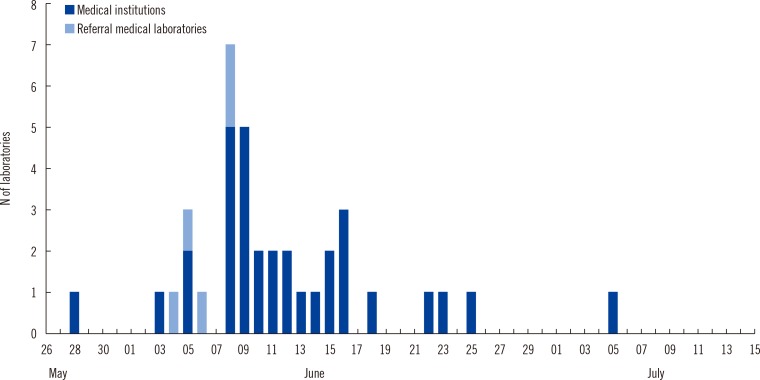
We conducted a survey of 49 clinical laboratories in medical institutions and referral medical laboratories. A short questionnaire to survey clinical laboratory practices relating to MERS-CoV diagnostic testing was sent by email to the directors and clinical pathologists in charge of the clinical laboratories performing MERS-CoV testing. The survey focused on testing volume, reporting of results, resources, and laboratory safety.
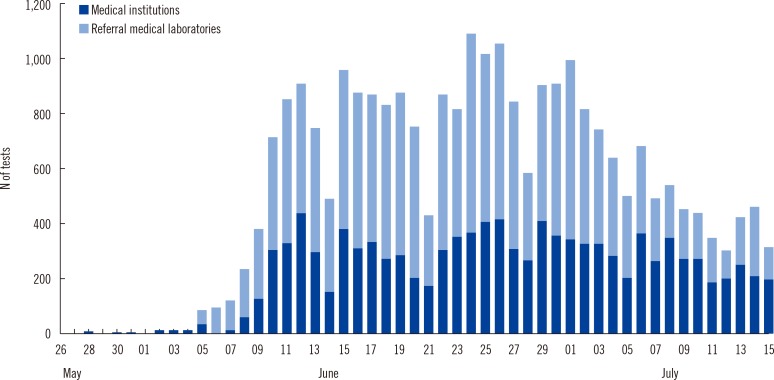
A total of 40 clinical laboratories responded to the survey. A total of 27,009 MERS-CoV real-time reverse transcription PCR (rRT-PCR) tests were performed. Most of the specimens were sputum (73.5%). The median turnaround time (TAT) was 5.29 hr (first and third quartile, 4.11 and 7.48 hr) in 26 medical institutions. The median TAT of more than a half of the laboratories (57.7%) was less than 6 hr. Many laboratories were able to perform tests throughout the whole week. Laboratory biosafety preparedness included class II biosafety cabinets (100%); separated pre-PCR, PCR, and post-PCR rooms (88.6%); negative pressure pretreatment rooms (48.6%); and negative pressure sputum collection rooms (20.0%).
Clinical laboratories were able to quickly expand their diagnostic capacity in response to the 2015 MERS-CoV outbreak. Our results show that clinical laboratories play an important role in the maintenance and enhancement of laboratory response in preparation for future emerging infections.
了解韩国中东呼吸综合征冠状病毒(MERS-CoV)感染最大规模暴发期间临床实验室操作的现状,对于为未来新发传染病做好充分准备至关重要。
我们对医疗机构和转诊医学实验室中的49家临床实验室进行了调查。通过电子邮件向负责进行MERS-CoV检测的临床实验室主任和临床病理学家发送了一份简短问卷,以调查与MERS-CoV诊断检测相关的临床实验室操作。该调查聚焦于检测量、结果报告、资源和实验室安全。
共有40家临床实验室回复了调查。共进行了27009次MERS-CoV实时逆转录聚合酶链反应(rRT-PCR)检测。大多数标本为痰液(73.5%)。26家医疗机构的中位周转时间(TAT)为5.29小时(第一和第三四分位数分别为4.11小时和7.48小时)。超过一半的实验室(57.7%)的中位TAT小于6小时。许多实验室能够在整周内进行检测。实验室生物安全准备措施包括二级生物安全柜(100%);独立的PCR前、PCR和PCR后房间(88.6%);负压预处理房间(48.6%);以及负压痰液采集房间(20.0%)。
临床实验室能够迅速扩大其诊断能力以应对2015年MERS-CoV疫情。我们的结果表明,临床实验室在维护和增强实验室应对能力以防范未来新发感染方面发挥着重要作用。