Laboratory for Developmental Neurobiology, RIKEN Brain Science Institute (BSI), 2-1 Hirosawa, Wako, Saitama 351-0198, Japan; Division of Biological Science, Graduate School of Science, Nagoya University, Furo-cho, Chikusa, Nagoya 464-8602, Japan; Nagoya Research Center for Brain & Neural Circuits, Graduate School of Science, Nagoya University, Furo-cho, Chikusa, Nagoya 464-8602, Japan; École Normale Supérieure, Institut de Biologie de l'ENS (IBENS), INSERM, CNRS, Ecole Normale Supérieure, PSL Research University, 46 rue d'Ulm, 75005 Paris, France.
Laboratory for Developmental Neurobiology, RIKEN Brain Science Institute (BSI), 2-1 Hirosawa, Wako, Saitama 351-0198, Japan.
Cell Rep. 2015 Dec 29;13(12):2768-80. doi: 10.1016/j.celrep.2015.12.002. Epub 2015 Dec 17.
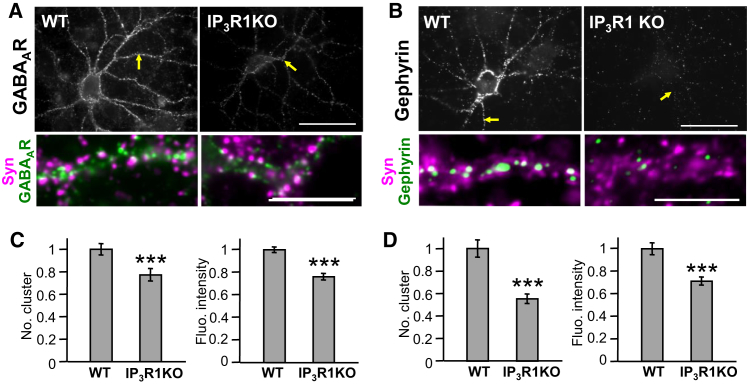
GABAergic synaptic transmission regulates brain function by establishing the appropriate excitation-inhibition (E/I) balance in neural circuits. The structure and function of GABAergic synapses are sensitive to destabilization by impinging neurotransmitters. However, signaling mechanisms that promote the restorative homeostatic stabilization of GABAergic synapses remain unknown. Here, by quantum dot single-particle tracking, we characterize a signaling pathway that promotes the stability of GABAA receptor (GABAAR) postsynaptic organization. Slow metabotropic glutamate receptor signaling activates IP3 receptor-dependent calcium release and protein kinase C to promote GABAAR clustering and GABAergic transmission. This GABAAR stabilization pathway counteracts the rapid cluster dispersion caused by glutamate-driven NMDA receptor-dependent calcium influx and calcineurin dephosphorylation, including in conditions of pathological glutamate toxicity. These findings show that glutamate activates distinct receptors and spatiotemporal patterns of calcium signaling for opposing control of GABAergic synapses.
GABA 能性突触传递通过在神经回路中建立适当的兴奋-抑制(E/I)平衡来调节大脑功能。GABA 能突触的结构和功能对外源神经递质的干扰很敏感。然而,促进 GABA 能突触恢复性稳态稳定的信号机制尚不清楚。在这里,通过量子点单颗粒跟踪,我们描述了一种促进 GABAA 受体(GABAAR)突触后组织稳定性的信号通路。慢代谢型谷氨酸受体信号激活 IP3 受体依赖性钙释放和蛋白激酶 C,以促进 GABAAR 聚集和 GABA 能传递。这种 GABAAR 稳定途径可以对抗由谷氨酸驱动的 NMDA 受体依赖性钙内流和钙调磷酸酶去磷酸化引起的快速簇分散,包括在病理性谷氨酸毒性条件下。这些发现表明,谷氨酸激活不同的受体和钙信号的时空模式,以对立控制 GABA 能突触。