Kapitonov Vladimir V, Makarova Kira S, Koonin Eugene V
National Center for Biotechnology Information, National Library of Medicine, National Institutes of Health, Bethesda, Maryland, USA.
National Center for Biotechnology Information, National Library of Medicine, National Institutes of Health, Bethesda, Maryland, USA
J Bacteriol. 2015 Dec 28;198(5):797-807. doi: 10.1128/JB.00783-15.
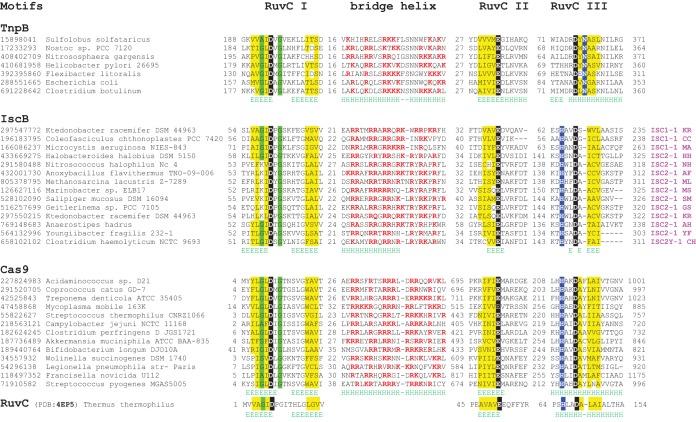
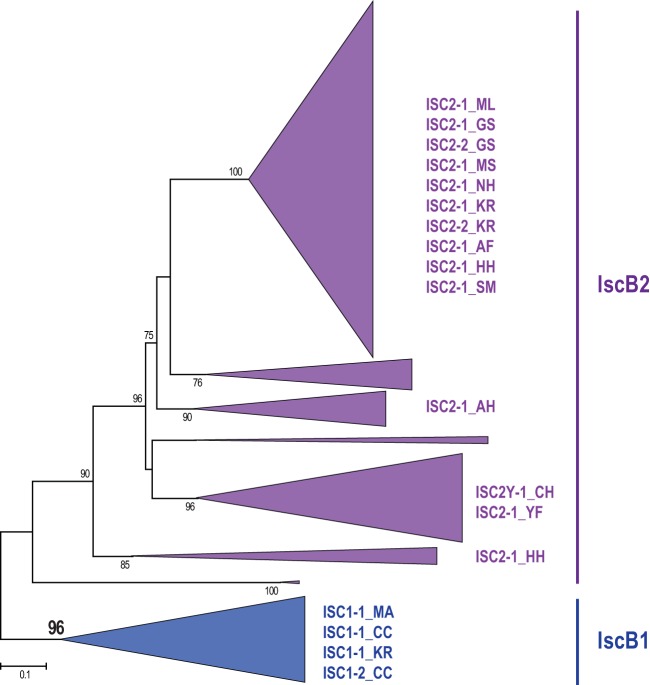
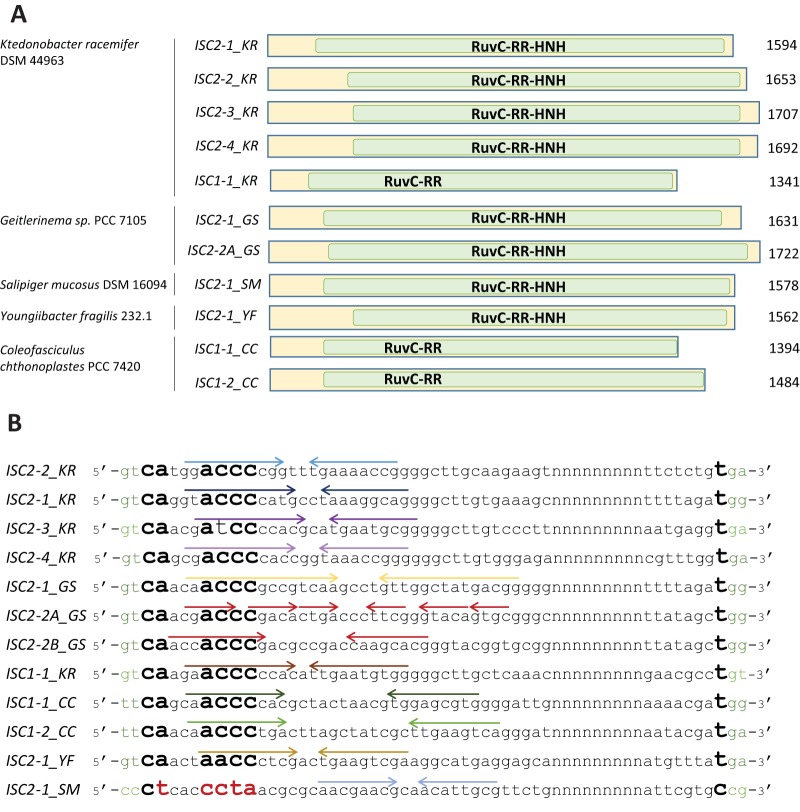
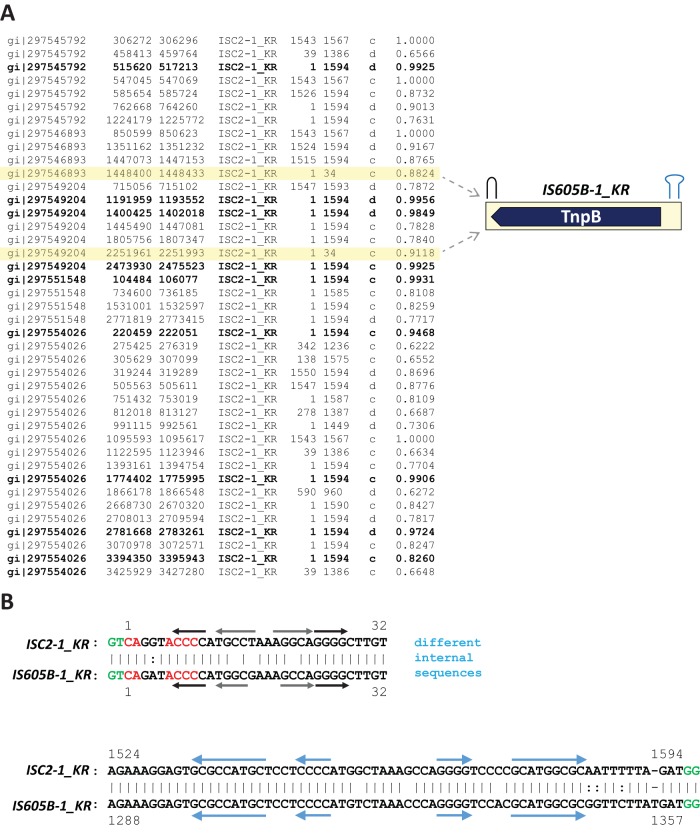
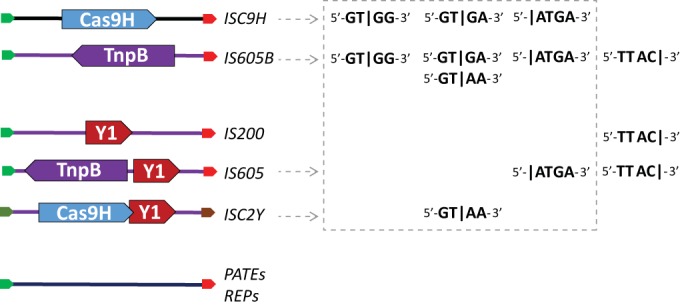
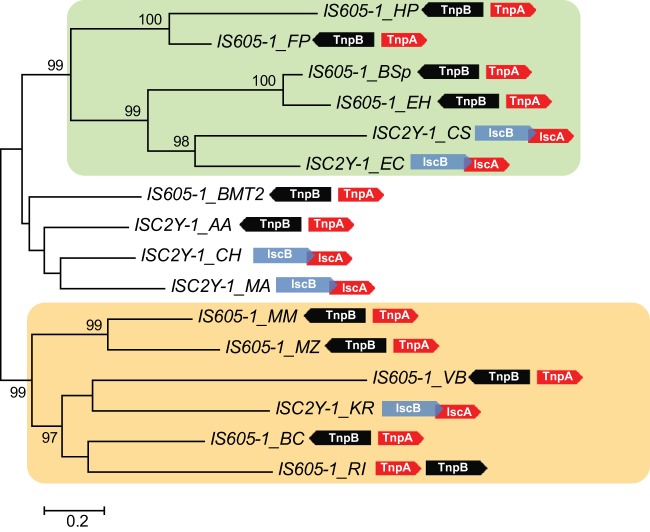
Bacterial genomes encode numerous homologs of Cas9, the effector protein of the type II CRISPR-Cas systems. The homology region includes the arginine-rich helix and the HNH nuclease domain that is inserted into the RuvC-like nuclease domain. These genes, however, are not linked to cas genes or CRISPR. Here, we show that Cas9 homologs represent a distinct group of nonautonomous transposons, which we denote ISC (insertion sequences Cas9-like). We identify many diverse families of full-length ISC transposons and demonstrate that their terminal sequences (particularly 3' termini) are similar to those of IS605 superfamily transposons that are mobilized by the Y1 tyrosine transposase encoded by the TnpA gene and often also encode the TnpB protein containing the RuvC-like endonuclease domain. The terminal regions of the ISC and IS605 transposons contain palindromic structures that are likely recognized by the Y1 transposase. The transposons from these two groups are inserted either exactly in the middle or upstream of specific 4-bp target sites, without target site duplication. We also identify autonomous ISC transposons that encode TnpA-like Y1 transposases. Thus, the nonautonomous ISC transposons could be mobilized in trans either by Y1 transposases of other, autonomous ISC transposons or by Y1 transposases of the more abundant IS605 transposons. These findings imply an evolutionary scenario in which the ISC transposons evolved from IS605 family transposons, possibly via insertion of a mobile group II intron encoding the HNH domain, and Cas9 subsequently evolved via immobilization of an ISC transposon.
Cas9 endonucleases, the effectors of type II CRISPR-Cas systems, represent the new generation of genome-engineering tools. Here, we describe in detail a novel family of transposable elements that encode the likely ancestors of Cas9 and outline the evolutionary scenario connecting different varieties of these transposons and Cas9.
细菌基因组编码众多Cas9的同源物,Cas9是II型CRISPR - Cas系统的效应蛋白。同源区域包括富含精氨酸的螺旋结构以及插入到类RuvC核酸酶结构域中的HNH核酸酶结构域。然而,这些基因并不与cas基因或CRISPR相连。在此,我们表明Cas9同源物代表了一类独特的非自主转座子,我们将其命名为ISC(类Cas9插入序列)。我们鉴定出许多不同的全长ISC转座子家族,并证明它们的末端序列(特别是3'末端)与由TnpA基因编码的Y1酪氨酸转座酶所动员的IS605超家族转座子的末端序列相似,并且通常还编码含有类RuvC核酸内切酶结构域的TnpB蛋白。ISC和IS605转座子的末端区域含有可能被Y1转座酶识别的回文结构。来自这两组的转座子精确插入特定4碱基对靶位点的中间或上游,无靶位点重复。我们还鉴定出编码类TnpA的Y1转座酶的自主ISC转座子。因此,非自主ISC转座子可以由其他自主ISC转座子的Y1转座酶或更丰富的IS605转座子的Y1转座酶进行反式动员。
Cas9核酸内切酶是II型CRISPR - Cas系统的效应物,代表了新一代的基因组工程工具。在此,我们详细描述了一个编码Cas9可能祖先的新型转座元件家族,并概述了连接这些转座子和Cas9不同变体的进化情况。