Tülü Selma, Mulino Miriam, Pinggera Daniel, Luger Markus, Würtinger Philipp, Grams Astrid, Bodner Thomas, Beer Ronny, Helbok Raimund, Matteucci-Gothe Raffaella, Unterhofer Claudia, Gizewski Elke, Schmutzhard Erich, Thomé Claudius, Ortler Martin
Department of Neurosurgery, Medical University of Innsbruck, 35, Anichstrasse, Innsbruck, 6020, Austria.
Department of Anesthesiology and Intensive Care Medicine, Medical University of Innsbruck, Innsbruck, 6020, Austria.
Trials. 2015 Dec 29;16:594. doi: 10.1186/s13063-015-1102-6.
The treatment of intracranial aneurysms may be associated with cerebral ischemia. We hypothesize that pre-interventional remote ischemic preconditioning (RIPC) reduces ischemic cerebral tissue damage in patients undergoing elective intracranial aneurysm treatment.
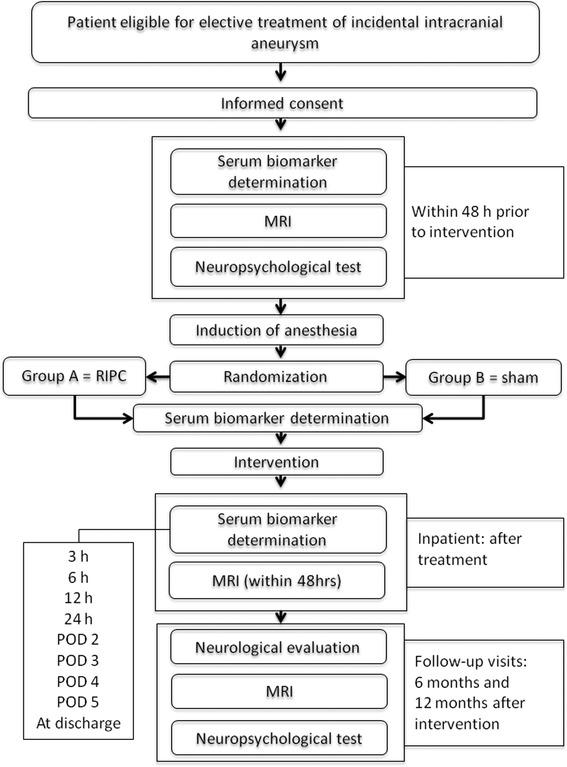
METHODS/DESIGN: This study is a single-center, prospective, randomized, double-blind explorative trial. Patients with an unruptured intracranial aneurysm admitted to Innsbruck Medical University Hospital for coiling or clipping will be consecutively randomized to either the intervention group (= RIPC by inflating an upper extremity blood-pressure cuff for 3 x 5 min to 200 mmHg) or the control group after induction of anesthesia. Participants will be randomized 1:1 to either the preconditioning group or the sham group using a random allocation sequence and block randomization. The precalculated sample size is n = 24 per group. The primary endpoint is the area-under-the-curve concentration of serum biomarkers (S100B, NSE, GFAP, MMP9, MBP, and cellular microparticles) in the first five days after treatment. Secondary endpoints are the number and volume of new ischemic lesions in magnetic resonance imaging and clinical outcome evaluated with the National Institutes of Health Stroke Scale, the modified Rankin Scale, and neuropsychological tests at six and twelve months. All outcome variables will be determined by observers blinded to group allocation. This study was approved by the local institutional Ethics Committee (UN5164), version 3.0 of the study protocol, dated 20 October 2013.
This study uses the elective treatment of intracranial aneurysms as a paradigmatic situation to explore the neuroprotective effects of RIPC. If effects are demonstrable in this pilot trial, a larger, prospective phase III trial will be considered.
颅内动脉瘤的治疗可能与脑缺血相关。我们假设介入前远程缺血预处理(RIPC)可减少择期颅内动脉瘤治疗患者的缺血性脑组织损伤。
方法/设计:本研究为单中心、前瞻性、随机、双盲探索性试验。因需进行弹簧圈栓塞或夹闭术而入住因斯布鲁克医科大学医院的未破裂颅内动脉瘤患者,在麻醉诱导后将被连续随机分为干预组(通过将上肢血压袖带充气至200 mmHg并保持3次5分钟进行RIPC)或对照组。参与者将使用随机分配序列和区组随机化按1:1随机分为预处理组或假手术组。预先计算的样本量为每组n = 24。主要终点是治疗后前五天血清生物标志物(S100B、NSE、GFAP、MMP9、MBP和细胞微粒)的曲线下面积浓度。次要终点是磁共振成像中新发缺血性病变的数量和体积,以及在6个月和12个月时使用美国国立卫生研究院卒中量表、改良Rankin量表和神经心理学测试评估的临床结局。所有结局变量将由对分组情况不知情的观察者确定。本研究已获得当地机构伦理委员会(UN5164)批准,研究方案版本3.0,日期为2013年10月20日。
本研究以颅内动脉瘤的择期治疗作为典型情况来探索RIPC的神经保护作用。如果在该试点试验中能证明其效果,将考虑开展更大规模的前瞻性III期试验。