Choi Jae Woong, Yim Sung Sun, Kim Min Jeong, Jeong Ki Jun
Department of Chemical and Biomolecular Engineering (BK Plus program), KAIST, 291 Daehakro, Yuseong-gu, Daejeon, 34141, Republic of Korea.
Institute for the BioCentury, KAIST, 291 Daehakro, Yuseong-gu, Daejeon, 34141, Republic of Korea.
Microb Cell Fact. 2015 Dec 29;14:207. doi: 10.1186/s12934-015-0401-7.
In most bacteria, various jumping genetic elements including insertion sequences elements (IS elements) cause a variety of genetic rearrangements resulting in harmful effects such as genome and recombinant plasmid instability. The genetic stability of a plasmid in a host is critical for high-level production of recombinant proteins, and in this regard, the development of an IS element-free strain could be a useful strategy for the enhanced production of recombinant proteins. Corynebacterium glutamicum, which is a workhorse in the industrial-scale production of various biomolecules including recombinant proteins, also has several IS elements, and it is necessary to identify the critical IS elements and to develop IS element deleted strain.
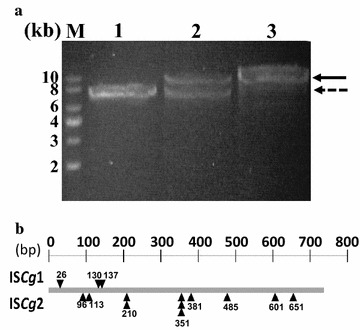
From the cultivation of C. glutamicum harboring a plasmid for green fluorescent protein (GFP) gene expression, non-fluorescent clones were isolated by FACS (fluorescent activated cell sorting). All the isolated clones had insertions of IS elements in the GFP coding region, and two major IS elements (ISCg1 and ISCg2 families) were identified. By co-cultivating cells harboring either the isolated IS element-inserted plasmid or intact plasmid, it was clearly confirmed that cells harboring the IS element-inserted plasmids became dominant during the cultivation due to their growth advantage over cells containing intact plasmids, which can cause a significant reduction in recombinant protein production during cultivation. To minimize the harmful effects of IS elements on the expression of heterologous genes in C. glutamicum, two IS element free C. glutamicum strains were developed in which each major IS element was deleted, and enhanced productivity in the engineered C. glutamicum strain was successfully demonstrated with three models: GFP, poly(3-hydroxybutyrate) [P(3HB)] and γ-aminobutyrate (GABA).
Our findings clearly indicate that the hopping of IS elements could be detrimental to the production of recombinant proteins in C. glutamicum, emphasizing the importance of developing IS element free host strains.
在大多数细菌中,包括插入序列元件(IS元件)在内的各种跳跃基因元件会导致多种基因重排,从而产生有害影响,如基因组和重组质粒不稳定。质粒在宿主中的遗传稳定性对于重组蛋白的高水平生产至关重要,在这方面,开发无IS元件菌株可能是提高重组蛋白产量的有用策略。谷氨酸棒杆菌是包括重组蛋白在内的各种生物分子工业规模生产中的主力军,也有几个IS元件,因此有必要鉴定关键的IS元件并开发缺失IS元件的菌株。
通过培养携带绿色荧光蛋白(GFP)基因表达质粒的谷氨酸棒杆菌,利用荧光激活细胞分选(FACS)分离出非荧光克隆。所有分离的克隆在GFP编码区都有IS元件插入,并鉴定出两个主要的IS元件家族(ISCg1和ISCg2家族)。通过共培养携带分离的插入IS元件质粒或完整质粒的细胞,清楚地证实携带插入IS元件质粒的细胞在培养过程中由于其比含有完整质粒的细胞具有生长优势而占主导地位,这可能导致培养过程中重组蛋白产量显著降低。为了最小化IS元件对谷氨酸棒杆菌中异源基因表达的有害影响,开发了两种缺失每个主要IS元件的无IS元件谷氨酸棒杆菌菌株,并通过三种模型成功证明了工程化谷氨酸棒杆菌菌株的生产力提高:绿色荧光蛋白(GFP)、聚(3-羟基丁酸酯)[P(3HB)]和γ-氨基丁酸(GABA)。
我们的研究结果清楚地表明,IS元件的跳跃可能对谷氨酸棒杆菌中重组蛋白的生产有害,强调了开发无IS元件宿主菌株的重要性。