Lindsay Karen L, Hellmuth Christian, Uhl Olaf, Buss Claudia, Wadhwa Pathik D, Koletzko Berthold, Entringer Sonja
Development, Health and Disease Research Program, University of California Irvine, School of Medicine, Irvine, California, 92697, United States of America.
Ludwig-Maximillian-University München, Division of Metabolic and Nutritional Medicine, Dr. von Hauner Children's Hospital, University of Munich Medical Centre, Lindwurmstrasse 4, D-80337, Munich, Germany.
PLoS One. 2015 Dec 30;10(12):e0145794. doi: 10.1371/journal.pone.0145794. eCollection 2015.
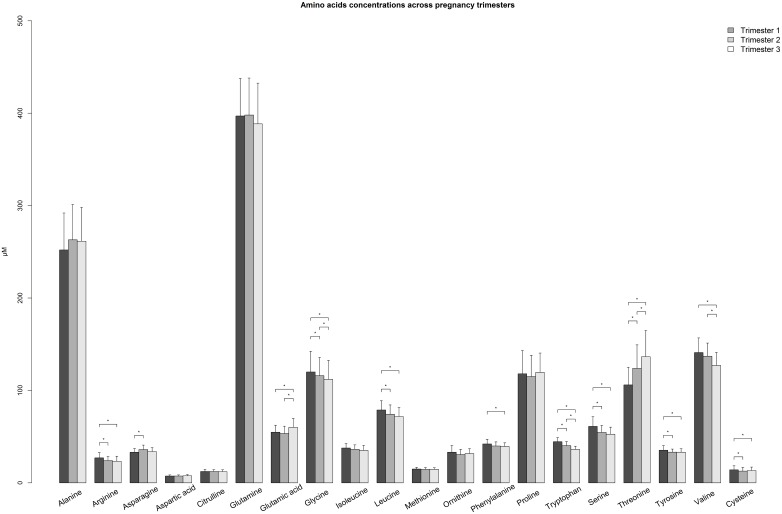
Pregnancy is characterized by a complexity of metabolic processes that may impact fetal development and ultimately, infant health outcomes. However, our understanding of whole body maternal and fetal metabolism during this critical life stage remains incomplete. The objective of this study is to utilize metabolomics to profile longitudinal patterns of fasting maternal metabolites among a cohort of non-diabetic, healthy pregnant women in order to advance our understanding of changes in protein and lipid concentrations across gestation, the biochemical pathways by which they are metabolized and to describe variation in maternal metabolites between ethnic groups. Among 160 pregnant women, amino acids, tricarboxylic acid (TCA) cycle intermediates, keto-bodies and non-esterified fatty acids were detected by liquid chromatography coupled with mass spectrometry, while polar lipids were detected through flow-injected mass spectrometry. The maternal plasma concentration of several essential and non-essential amino acids, long-chain polyunsaturated fatty acids, free carnitine, acetylcarnitine, phosphatidylcholines and sphingomyelins significantly decreased across pregnancy. Concentrations of several TCA intermediates increase as pregnancy progresses, as well as the keto-body β-hydroxybutyrate. Ratios of specific acylcarnitines used as indicators of metabolic pathways suggest a decreased beta-oxidation rate and increased carnitine palmitoyltransferase-1 enzyme activity with advancing gestation. Decreasing amino acid concentrations likely reflects placental uptake and tissue biosynthesis. The absence of any increase in plasma non-esterified fatty acids is unexpected in the catabolic phase of later pregnancy and may reflect enhanced placental fatty acid uptake and utilization for fetal tissue growth. While it appears that energy production through the TCA cycle increases as pregnancy progresses, decreasing patterns of free carnitine and acetylcarnitine as well as increased carnitine palmitoyltransferase-1 rate and β-hydroxybutyrate levels suggest a concomitant upregulation of ketogenesis to ensure sufficient energy supply in the fasting state. Several differences in metabolomic profiles between Hispanic and non-Hispanic women demonstrate phenotypic variations in prenatal metabolism which should be considered in future studies.
怀孕的特点是代谢过程复杂,这可能会影响胎儿发育,并最终影响婴儿的健康结局。然而,我们对这一关键生命阶段母体和胎儿全身代谢的理解仍不完整。本研究的目的是利用代谢组学分析一组非糖尿病健康孕妇空腹母体代谢物的纵向模式,以增进我们对整个孕期蛋白质和脂质浓度变化、其代谢的生化途径的理解,并描述不同种族群体之间母体代谢物的差异。在160名孕妇中,通过液相色谱-质谱联用检测氨基酸、三羧酸(TCA)循环中间体、酮体和非酯化脂肪酸,通过流动注射质谱检测极性脂质。几种必需和非必需氨基酸、长链多不饱和脂肪酸、游离肉碱、乙酰肉碱、磷脂酰胆碱和鞘磷脂的母体血浆浓度在整个孕期显著降低。随着孕期进展,几种TCA中间体以及酮体β-羟基丁酸的浓度增加。用作代谢途径指标的特定酰基肉碱的比率表明,随着孕期进展,β-氧化率降低,肉碱棕榈酰转移酶-1酶活性增加。氨基酸浓度降低可能反映了胎盘摄取和组织生物合成。在妊娠后期的分解代谢阶段,血浆非酯化脂肪酸没有增加是出乎意料的,这可能反映了胎盘对脂肪酸摄取和利用的增强,以促进胎儿组织生长。虽然随着孕期进展,通过TCA循环产生能量似乎增加,但游离肉碱和乙酰肉碱的降低模式以及肉碱棕榈酰转移酶-1速率和β-羟基丁酸水平的增加表明,酮生成同时上调,以确保空腹状态下有足够的能量供应。西班牙裔和非西班牙裔女性在代谢组学特征上的一些差异表明了产前代谢的表型差异,这在未来的研究中应予以考虑。