Feierabend Dashiell, Kielland Knut
Department of Biology and Wildlife, University of Alaska Fairbanks, Fairbanks, Alaska, United States of America.
Institute of Arctic Biology, University of Alaska Fairbanks, Fairbanks, Alaska, United States of America.
PLoS One. 2015 Dec 30;10(12):e0143543. doi: 10.1371/journal.pone.0143543. eCollection 2015.
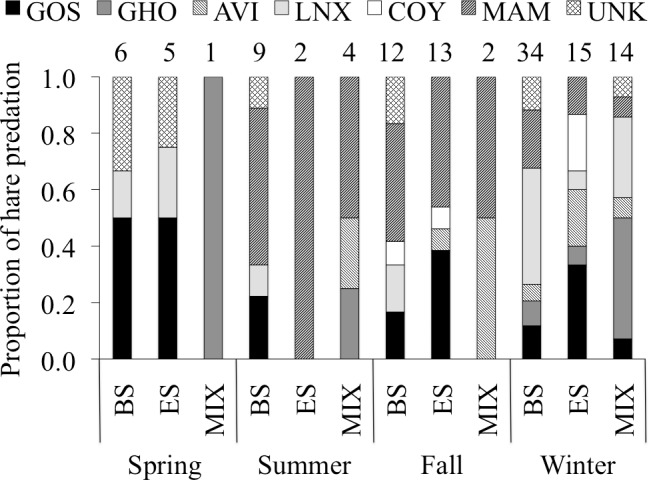
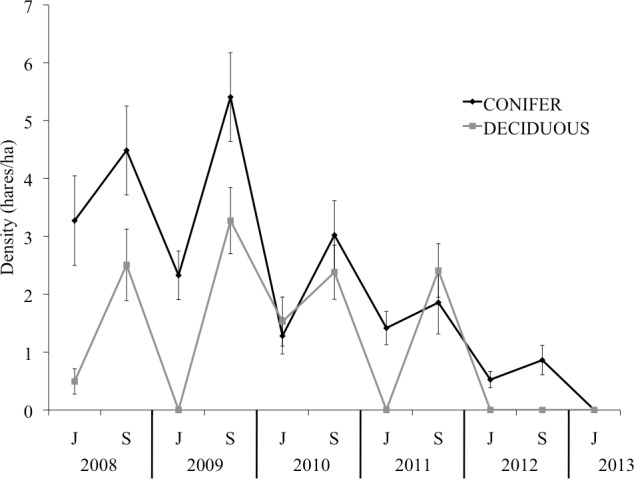
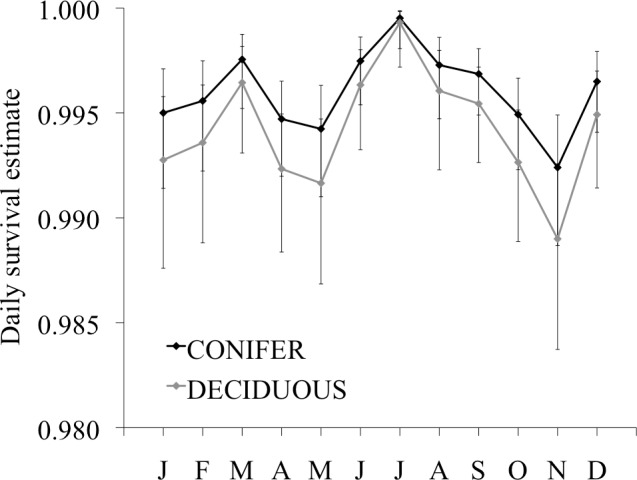
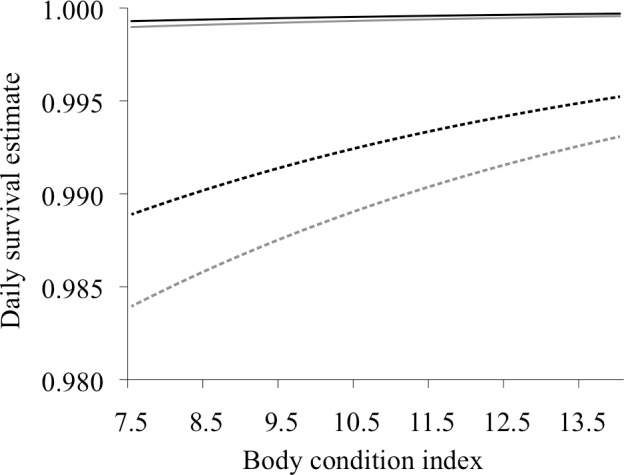
Survival and predation of snowshoe hares (Lepus americanus) has been widely studied, yet there has been little quantification of the changes in vulnerability of hares to specific predators that may result from seasonal changes in vegetation and cover. We investigated survival and causes of mortalities of snowshoe hares during the late increase, peak, and decline of a population in interior Alaska. From June 2008 to May 2012, we radio-tagged 288 adult and older juvenile hares in early successional and black spruce (Picea mariana) forests and, using known-fate methods in program MARK, evaluated 85 survival models that included variables for sex, age, and body condition of hares, as well as trapping site, month, season, year, snowfall, snow depth, and air temperature. We compared the models using Akaike's information criterion with correction for small sample size. Model results indicated that month, capture site, and body condition were the most important variables in explaining survival rates. Survival was highest in July, and more generally during summer, when alternative prey was available to predators of hares. Low survival rates coincided with molting periods, breeding activity in the spring, and the introduction of juveniles to the sample population in the fall. We identified predation as the cause of mortality in 86% of hare deaths. When the source of predation could be determined, hares were killed more often by goshawks (Accipiter gentilis) than other predators in early successional forest (30%), and more often by lynx (Lynx canadensis) than other predators in black spruce forest (31%). Great horned owls (Bubo virginianus) and coyotes (Canis latrans) represented smaller proportions of hare predation, and non-predatory causes were a minor source (3%) of mortality. Because hares rely on vegetative cover for concealment from predators, we measured cover in predation sites and habitats that the hares occupied and concluded that habitat type had a greater influence on the sources of predation than the amount of cover in any given location within a habitat. Our observations illustrate the vulnerability of hares to predators in even the densest coniferous habitat available in the boreal forest, and indicate strong seasonal changes in the rates and sources of predation.
雪兔(美洲兔)的生存和被捕食情况已得到广泛研究,但对于因植被和掩护的季节性变化可能导致的雪兔对特定捕食者脆弱性的变化,却鲜有量化研究。我们调查了阿拉斯加内陆一个种群数量在增长后期、高峰期和下降期时雪兔的生存情况及死亡原因。从2008年6月至2012年5月,我们在早期演替森林和黑云杉(黑云杉)林中给288只成年及大龄幼年雪兔佩戴无线电标签,并在MARK程序中使用已知命运方法,评估了85个生存模型,这些模型包括雪兔的性别、年龄和身体状况变量,以及诱捕地点、月份、季节、年份、降雪量、积雪深度和气温。我们使用赤池信息准则并针对小样本量进行校正来比较这些模型。模型结果表明,月份、捕获地点和身体状况是解释生存率的最重要变量。生存率在7月最高,更普遍地是在夏季,此时雪兔的捕食者有其他猎物可供选择。低生存率与换毛期、春季繁殖活动以及秋季幼兔加入样本种群的时间相吻合。我们确定86%的雪兔死亡原因是被捕食。当能确定捕食来源时,在早期演替森林中,雪兔被苍鹰(苍鹰)捕杀的频率高于其他捕食者(30%),在黑云杉林中,被猞猁(加拿大猞猁)捕杀的频率高于其他捕食者(31%)。大角鸮(大角鸮)和郊狼(犬属)在雪兔被捕食中所占比例较小,非捕食性原因是死亡的次要来源(3%)。由于雪兔依靠植被掩护来躲避捕食者,我们测量了雪兔占据的捕食地点和栖息地的掩护情况,并得出结论,栖息地类型对捕食来源的影响大于栖息地内任何给定位置的掩护量。我们的观察结果表明,即使在北方森林中最茂密的针叶林栖息地,雪兔也容易被捕食者捕食,并且表明捕食率和捕食来源存在强烈的季节性变化。