Yendiki Anastasia, Reuter Martin, Wilkens Paul, Rosas H Diana, Fischl Bruce
Athinoula A. Martinos Center for Biomedical Imaging, Department of Radiology, Massachusetts General Hospital and Harvard Medical School, Boston, MA, USA.
Athinoula A. Martinos Center for Biomedical Imaging, Department of Radiology, Massachusetts General Hospital and Harvard Medical School, Boston, MA, USA.
Neuroimage. 2016 Feb 15;127:277-286. doi: 10.1016/j.neuroimage.2015.12.003. Epub 2015 Dec 21.
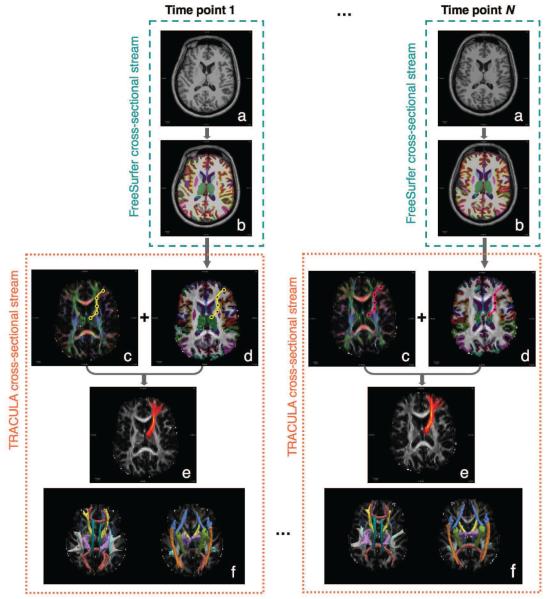
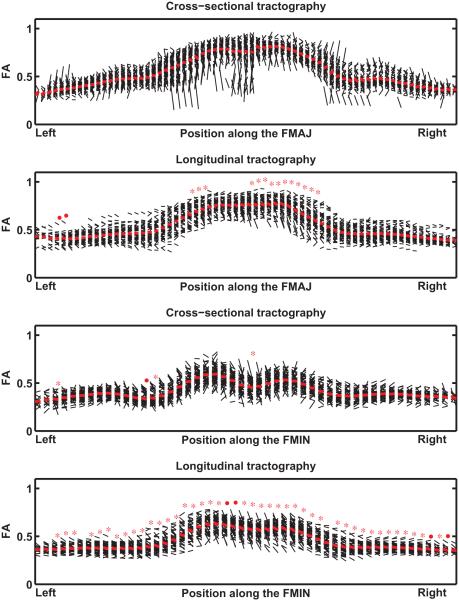
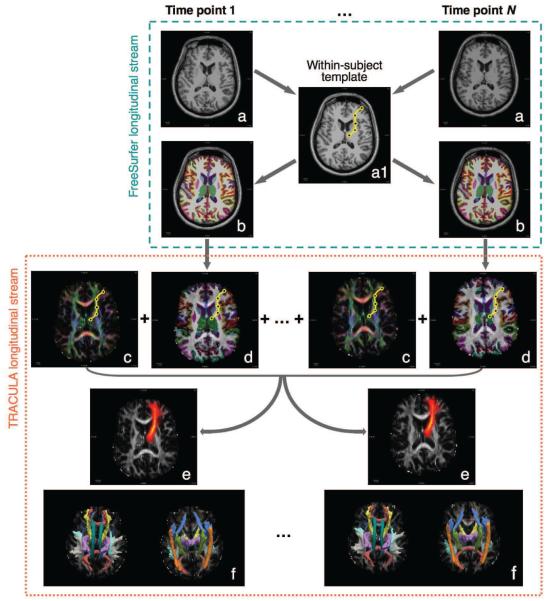
We consider the problem of reconstructing white-matter pathways in a longitudinal study, where diffusion-weighted and T1-weighted MR images have been acquired at multiple time points for the same subject. We propose a method for joint reconstruction of a subject's pathways at all time points given the subject's entire set of longitudinal data. We apply a method for unbiased within-subject registration to generate a within-subject template from the T1-weighted images of the subject at all time points. We follow a global probabilistic tractography approach, where the unknown pathway is represented in the space of this within-subject template and propagated to the native space of the diffusion-weighted images at all time points to compute its posterior probability given the images. This ensures spatial correspondence of the reconstructed pathway among time points, which in turn allows longitudinal changes in diffusion measures to be estimated consistently along the pathway. We evaluate the reliability of the proposed method on data from healthy controls scanned twice within a month, where no changes in white-matter microstructure are expected between scans. We evaluate the sensitivity of the method on data from Huntington's disease patients scanned repeatedly over the course of several months, where changes are expected between scans. We show that reconstructing white-matter pathways jointly using the data from all time points leads to improved reliability and sensitivity, when compared to reconstructing the pathways at each time point independently.
我们考虑在一项纵向研究中重建白质通路的问题,在该研究中,针对同一受试者在多个时间点采集了扩散加权和T1加权磁共振图像。我们提出了一种方法,在给定受试者的整个纵向数据集的情况下,对所有时间点的受试者通路进行联合重建。我们应用一种无偏的受试者内配准方法,从受试者在所有时间点的T1加权图像生成受试者内模板。我们采用一种全局概率纤维束成像方法,其中未知通路在该受试者内模板的空间中表示,并传播到所有时间点扩散加权图像的原始空间,以根据图像计算其后验概率。这确保了重建通路在各时间点之间的空间对应性,进而使得能够沿着通路一致地估计扩散测量值的纵向变化。我们在一个月内扫描两次的健康对照的数据上评估所提出方法的可靠性,在这些扫描之间预计白质微观结构不会发生变化。我们在患有亨廷顿舞蹈症的患者在几个月的过程中反复扫描的数据上评估该方法的敏感性,在这些扫描之间预计会发生变化。我们表明,与在每个时间点独立重建通路相比,使用所有时间点的数据联合重建白质通路可提高可靠性和敏感性。