Soler Zachary M, Hyer J Madison, Karnezis Tom T, Schlosser Rodney J
Department of Otolaryngology-Head and Neck Surgery, Medical University of South Carolina, Charleston, SC.
Department of Public Health Sciences, Medical University of South Carolina, Charleston, SC.
Int Forum Allergy Rhinol. 2016 Mar;6(3):293-8. doi: 10.1002/alr.21655. Epub 2015 Dec 31.
Olfactory loss affects a majority of patients with chronic rhinosinusitis (CRS). Traditional objective measures of disease severity, including endoscopy scales, focus upon the paranasal sinuses and often have weak correlation to olfaction.
Adults with CRS were prospectively evaluated by blinded reviewers with a novel Olfactory Cleft Endoscopy Scale (OCES) that evaluated discharge, polyps, edema, crusting, and scarring of the olfactory cleft. Objective olfactory function was assessed using "Sniffin' Sticks" testing, including composite threshold-discrimination-identification (TDI) scores. Olfactory-specific quality of life was evaluated using the short modified version of the Questionnaire of Olfactory Disorders (QOD-NS). Interrater and intrarater reliability was assessed among 3 reviewers for OCES grading. Multivariate linear regression was then used to test associations between OCES scores and measures of olfaction, controlling for potential confounding factors.
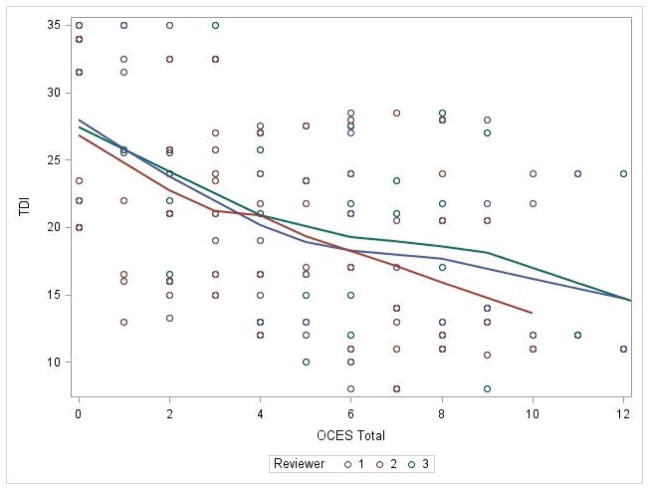
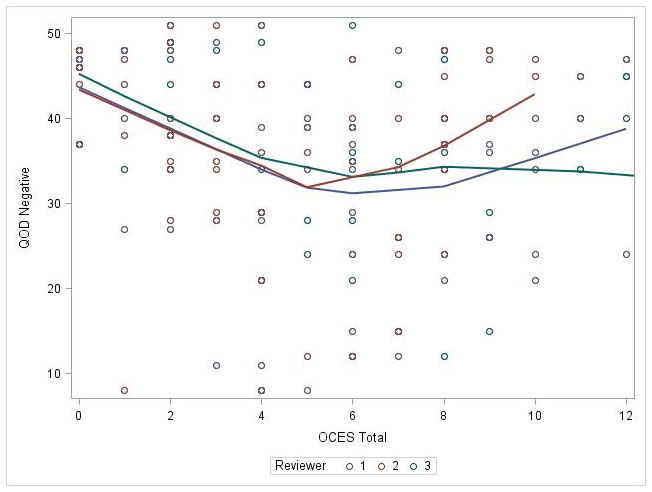
The OCES score was evaluated in 38 patients and had a high overall reliability (intraclass correlation coefficient [ICC] = 0.92; 95% confidence interval [CI], 0.91 to 0.96). The OCES significantly correlated with objective olfaction as measured by TDI score (p < 0.001), with TDI score falling by 1.13 points for every 1-point increase in OCES score. Similar significant associations were found for threshold, discrimination, and identification scores (p < 0.003 for all) after controlling for age, gender, race, and reviewer/review. The OCES was also highly associated with patient-reported QOD-NS scores (p = 0.009).
A novel olfactory cleft endoscopy scale, OCES, shows high reliability and correlates with both objective and patient-reported olfaction in patients with CRS. Further studies to determine prognostic value and responsiveness to change are warranted.
嗅觉丧失影响大多数慢性鼻窦炎(CRS)患者。传统的疾病严重程度客观指标,包括内镜评分,主要关注鼻窦,且与嗅觉的相关性往往较弱。
对成年CRS患者进行前瞻性评估,由盲法评估者使用一种新的嗅觉裂内镜评分量表(OCES),该量表评估嗅觉裂的分泌物、息肉、水肿、结痂和瘢痕形成情况。使用“嗅觉棒”测试评估客观嗅觉功能,包括综合阈值-辨别-识别(TDI)分数。使用嗅觉障碍问卷(QOD-NS)的简短修订版评估嗅觉特异性生活质量。在3名评估者之间评估OCES分级的评分者间和评分者内信度。然后使用多元线性回归测试OCES评分与嗅觉指标之间的关联,并控制潜在的混杂因素。
对38例患者评估了OCES评分,其总体信度较高(组内相关系数[ICC]=0.92;95%置信区间[CI],0.91至0.96)。OCES与TDI评分所测量的客观嗅觉显著相关(p<0.001),OCES评分每增加1分,TDI评分下降1.13分。在控制年龄、性别、种族和评估者/评估因素后,阈值、辨别和识别分数也发现了类似的显著关联(所有p<0.003)。OCES还与患者报告的QOD-NS评分高度相关(p=0.009)。
一种新的嗅觉裂内镜评分量表OCES显示出高信度,并且与CRS患者的客观嗅觉和患者报告的嗅觉均相关。有必要进行进一步研究以确定其预后价值和对变化的反应性。