Akl Elie A, Shawwa Khaled, Kahale Lara A, Agoritsas Thomas, Brignardello-Petersen Romina, Busse Jason W, Carrasco-Labra Alonso, Ebrahim Shanil, Johnston Bradley C, Neumann Ignacio, Sola Ivan, Sun Xin, Vandvik Per, Zhang Yuqing, Alonso-Coello Pablo, Guyatt Gordon H
Department of Internal Medicine, American University of Beirut, Beirut, Lebanon Faculty of Health Sciences, American University of Beirut, Beirut, Lebanon Department of Clinical Epidemiology & Biostatistics, McMaster University, Hamilton, Ontario, Canada.
Department of Internal Medicine, American University of Beirut, Beirut, Lebanon.
BMJ Open. 2015 Dec 30;5(12):e008431. doi: 10.1136/bmjopen-2015-008431.
We conducted a systematic survey of the methodological literature to identify recommended approaches for how and what randomised clinical trial (RCT) authors should report on missing participant data and, on the basis of these approaches, to propose guidance for RCT authors.
We defined missing participant data (MPD) as missing outcome data for trial participants. We considered both categorical and continuous outcome data. We searched MEDLINE and the Cochrane Methodology Register for articles in which authors proposed approaches to reporting MPD from RCTs. We selected eligible articles independently and in duplicate and extracted data in duplicate. Using an iterative process of discussion and revisions, we used the findings to develop guidance.
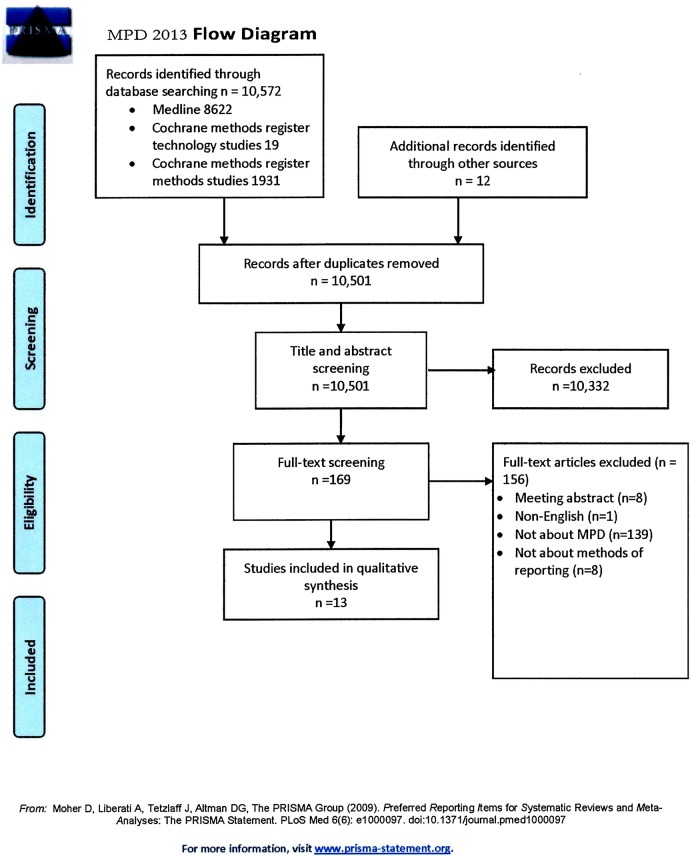
Of 10,501 unique citations identified, 13 articles reporting on 10 approaches proved eligible. The identified approaches recommend reporting the following aspects (from most to least frequently recommended): number of participants with MPD (n=10), reasons for MPD (n=7), methods used to handle MPD in the analysis (n=4), flow of participants (n=3), pattern of missingness (eg, whether at random) (n=3), differences in rates of MPD between trial arms (n=2), differences between participants with and without MPD (n=2), results of any sensitivity analyses (n=2), implication of MPD on interpreting the results (n=2) and methods used to prevent missing data (n=1). We propose a guide with nine items related to reporting the number, reasons, patterns, analytical methods and interpretation of MPD.
Most identified approaches invite trial authors to report the extent of MPD and the underlying reasons. Fewer approaches focus on reporting missingness patterns, methods for handling MPD and implications of MPD on results. Our proposed guidance could help RCT authors to better report, and readers to better identify participants with missing data.
我们对方法学文献进行了系统综述,以确定关于随机临床试验(RCT)作者应如何以及报告哪些缺失参与者数据的推荐方法,并在此基础上为RCT作者提出指导建议。
我们将缺失参与者数据(MPD)定义为试验参与者的缺失结局数据。我们考虑了分类和连续结局数据。我们在MEDLINE和Cochrane方法学注册库中检索了作者提出RCT中MPD报告方法的文章。我们独立且重复地筛选符合条件的文章,并重复提取数据。通过反复讨论和修订的过程,我们利用研究结果制定了指导建议。
在识别出的10501条独特引用中,有13篇报告10种方法的文章被证明符合条件。所确定的方法建议报告以下方面(从最常被推荐到最少被推荐):有MPD的参与者数量(n = 10)、MPD的原因(n = 7)、分析中处理MPD所使用的方法(n = 4)、参与者流程(n = 3)、缺失模式(例如是否随机)(n = 3)、试验组间MPD发生率的差异(n = 2)、有和没有MPD的参与者之间的差异(n = 2)、任何敏感性分析的结果(n = 2)、MPD对结果解释的影响(n = 2)以及用于预防缺失数据的方法(n = 1)。我们提出了一份包含九个项目的指南,涉及报告MPD的数量、原因、模式、分析方法和解释。
大多数确定的方法要求试验作者报告MPD的程度和潜在原因。较少的方法关注报告缺失模式、处理MPD的方法以及MPD对结果的影响。我们提出的指南可以帮助RCT作者更好地报告,也有助于读者更好地识别有缺失数据的参与者。