Bender Max Ernst, Edwards Suzanne, von Philipsborn Peter, Steinbeis Fridolin, Keil Thomas, Tinnemann Peter
Institute for Social Medicine, Epidemiology and Health Economics, Charité-Universitätsmedizin Berlin, Berlin, Germany.
Universities Allied for Essential Medicines Europe e.V. (UAEM), Berlin, Germany.
PLoS Negl Trop Dis. 2015 Dec 31;9(12):e0004182. doi: 10.1371/journal.pntd.0004182. eCollection 2015 Dec.
Research on Neglected Tropical Diseases (NTDs) has increased in recent decades, and significant need-gaps in diagnostic and treatment tools remain. Analysing bibliometric data from published research is a powerful method for revealing research efforts, partnerships and expertise. We aim to identify and map NTD research networks in Germany and their partners abroad to enable an informed and transparent evaluation of German contributions to NTD research.
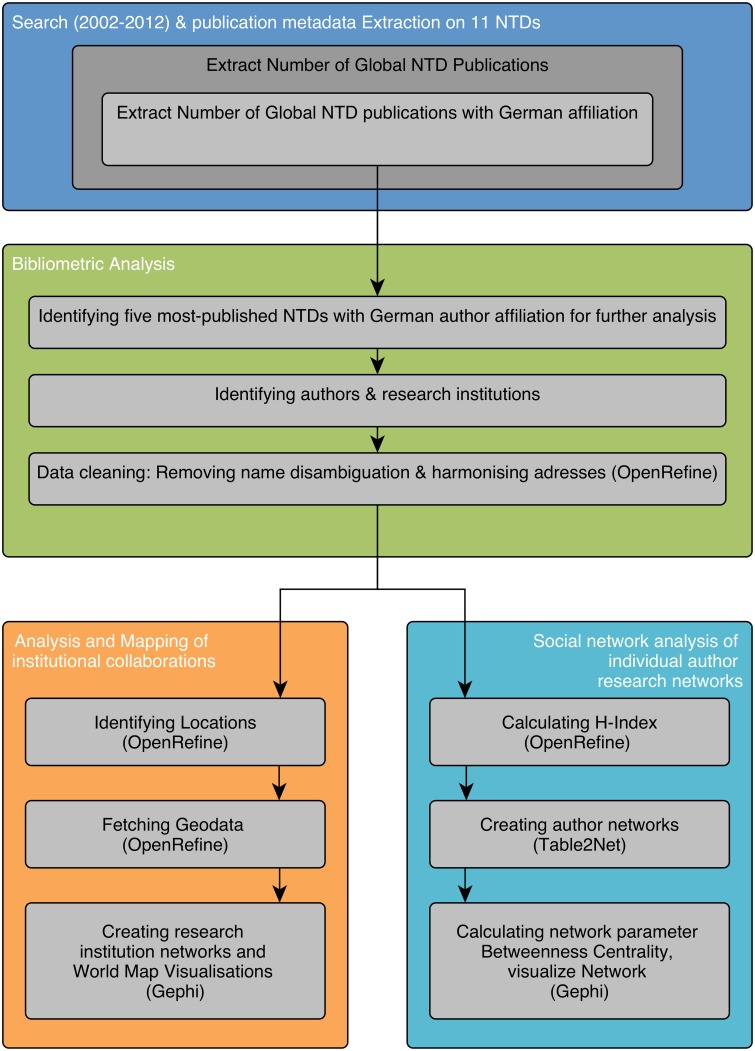
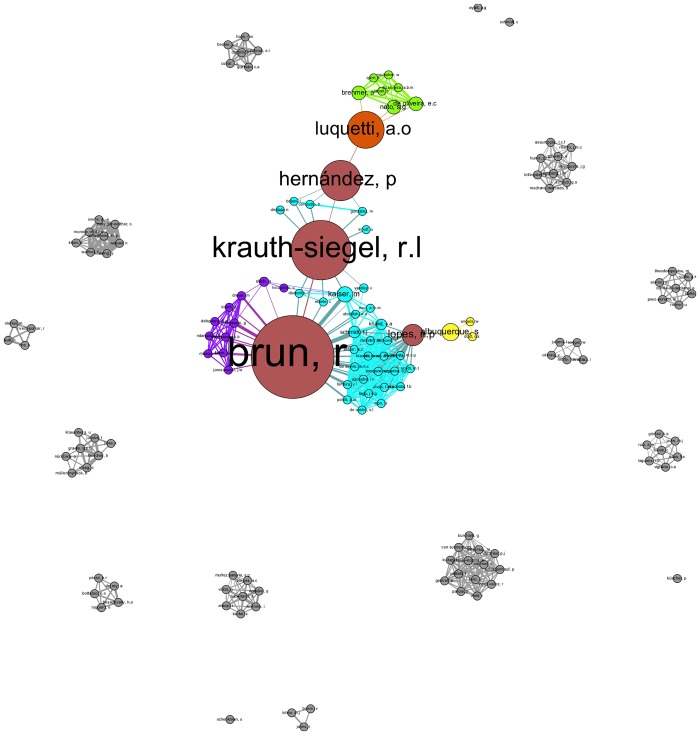
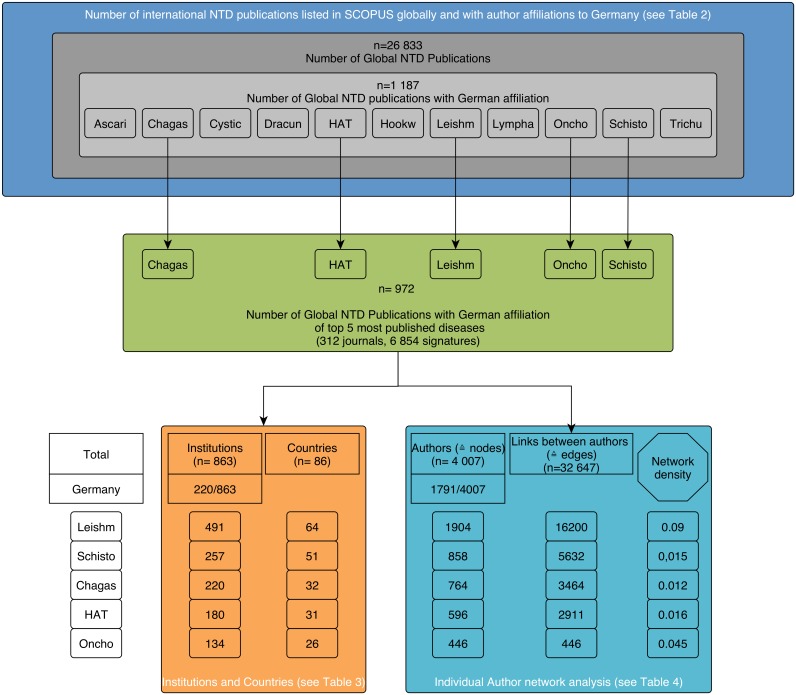
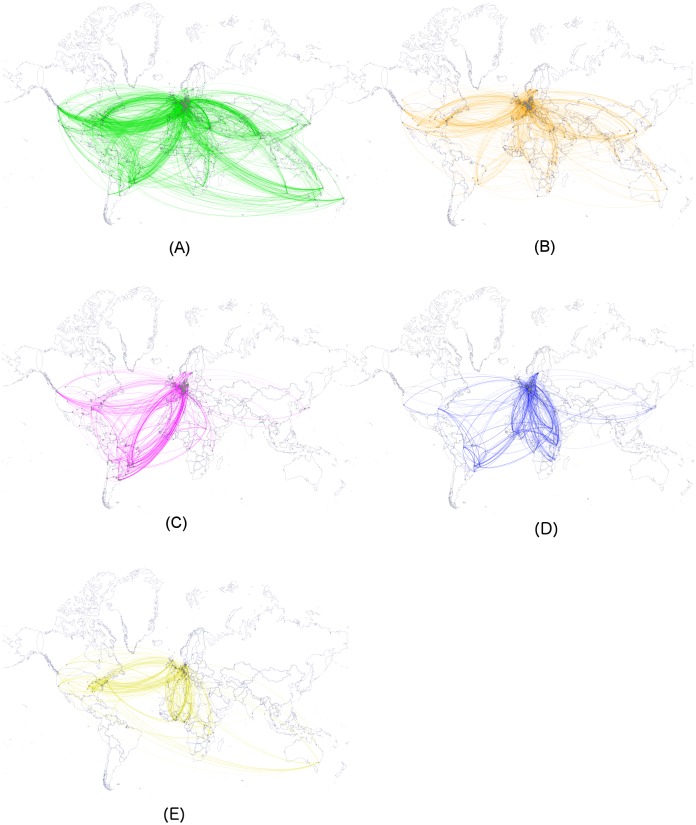
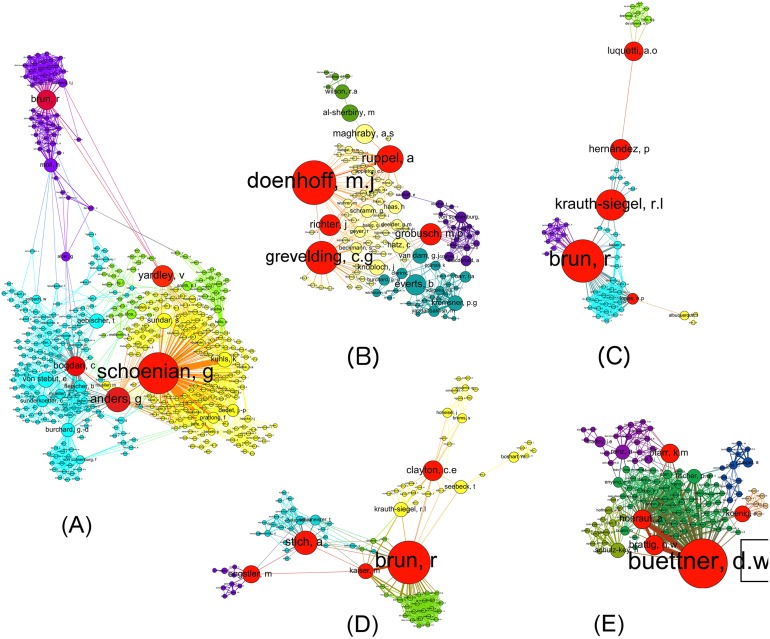
METHODOLOGY/PRINCIPAL FINDINGS: A SCOPUS database search for articles with German author affiliations that were published between 2002 and 2012 was conducted for kinetoplastid and helminth diseases. Open-access tools were used for data cleaning and scientometrics (OpenRefine), geocoding (OpenStreetMaps) and to create (Table2Net), visualise and analyse co-authorship networks (Gephi). From 26,833 publications from around the world that addressed 11 diseases, we identified 1,187 (4.4%) with at least one German author affiliation, and we processed 972 publications for the five most published-about diseases. Of those, we extracted 4,007 individual authors and 863 research institutions to construct co-author networks. The majority of co-authors outside Germany were from high-income countries and Brazil. Collaborations with partners on the African continent remain scattered. NTD research within Germany was distributed among 220 research institutions. We identified strong performers on an individual level by using classic parameters (number of publications, h-index) and social network analysis parameters (betweenness centrality). The research network characteristics varied strongly between diseases.
CONCLUSIONS/SIGNIFICANCE: The share of NTD publications with German affiliations is approximately half of its share in other fields of medical research. This finding underlines the need to identify barriers and expand Germany's otherwise strong research activities towards NTDs. A geospatial analysis of research collaborations with partners abroad can support decisions to strengthen research capacity, particularly in low- and middle-income countries, which were less involved in collaborations than high-income countries. Identifying knowledge hubs within individual researcher networks complements traditional scientometric indicators that are used to identify opportunities for collaboration. Using free tools to analyse research processes and output could facilitate data-driven health policies. Our findings contribute to the prioritisation of efforts in German NTD research at a time of impending local and global policy decisions.
近几十年来,对被忽视热带病(NTDs)的研究有所增加,但诊断和治疗工具方面仍存在重大需求差距。分析已发表研究的文献计量数据是揭示研究工作、合作关系和专业知识的有力方法。我们旨在识别和绘制德国的NTD研究网络及其国外合作伙伴,以便对德国在NTD研究中的贡献进行明智且透明的评估。
方法/主要发现:在SCOPUS数据库中搜索2002年至2012年间发表的、作者隶属于德国机构的有关动基体疾病和蠕虫病的文章。使用开放获取工具进行数据清理和科学计量分析(OpenRefine)、地理编码(OpenStreetMaps)以及创建(Table2Net)、可视化和分析共同作者网络(Gephi)。从全球26,833篇涉及11种疾病的出版物中,我们识别出1,187篇(4.4%)至少有一位作者隶属于德国机构,并且我们对发表量最高的五种疾病的972篇出版物进行了处理。其中,我们提取了4,007位个人作者和863个研究机构来构建共同作者网络。德国以外的大多数共同作者来自高收入国家和巴西。与非洲大陆合作伙伴的合作仍然较为分散。德国国内的NTD研究分布在220个研究机构中。我们通过使用经典参数(出版物数量、h指数)和社会网络分析参数(中介中心性)在个体层面识别出了表现出色的机构。不同疾病的研究网络特征差异很大。
结论/意义:德国机构附属的NTD出版物份额约为其在医学研究其他领域份额的一半。这一发现凸显了识别障碍并扩大德国在NTD方面原本强大的研究活动的必要性。对与国外合作伙伴的研究合作进行地理空间分析可以支持加强研究能力的决策,特别是在低收入和中等收入国家,这些国家参与合作的程度低于高收入国家。在个体研究人员网络中识别知识中心补充了用于识别合作机会的传统科学计量指标。使用免费工具分析研究过程和成果可以促进以数据为驱动的卫生政策制定。在即将做出地方和全球政策决策之际,我们的研究结果有助于为德国NTD研究的工作重点排序。