Marino Carlos Antonio, Diaz Paz Claudia
CENTRUM Católica Graduate Business School, Lima, Peru, Pontifical Catholic University of Peru, Lima, Peru.
J Med Internet Res. 2025 Apr 25;27:e69465. doi: 10.2196/69465.
Creating a sustainable, patient-centered health care system necessitates integrated supply chains supported by information technologies. However, achieving interoperability among various devices and systems remains a significant hurdle. Our research highlights the need for systematic reviews that address health care interoperability as a holistic knowledge domain. Notably, we observed a lack of studies that outline its structure or develop a comprehensive, high-order facet-based taxonomy from the perspective of supply or value chains. This study aims to address that gap.
The primary aim of this study is to elucidate the knowledge structure within the extensive domain of health care interoperability, with an emphasis on trending topics, critical hot spots, and the categorization of significant issues. Furthermore, we aim to model the higher-order elements of a taxonomy for health care interoperability within the context of the health care value chain framework.
We used both quantitative and qualitative methodologies. The PRISMA (Preferred Reporting Items for Systematic Reviews and Meta-Analyses) framework guided our selection process. We examined 6 databases-Scopus, Web of Science, IEEE Xplore, Embase, Cochrane, and PubMed-focusing on journal articles and gray literature published from 2011 onward. Articles were screened using predefined eligibility criteria. Quantitative bibliometric techniques-including cluster, factor, and network analyses-were applied to explore the structure of the knowledge. A subset of articles was selected for qualitative synthesis using an iterative coding process to develop a higher-order facet-based taxonomy.
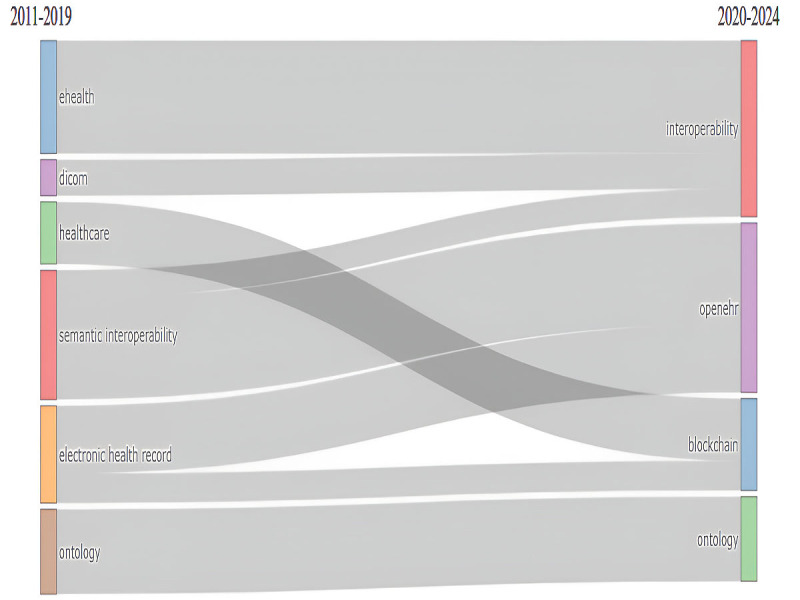
We identified 370 articles for quantitative analysis. The bibliometric analysis revealed 2 major clusters. Key terms in the first cluster included interoperability, electronic health record, and eHealth-with betweenness centralities of 70.971, 59.460, and 12.000, respectively, and closeness centralities of 0.047, 0.043, and 0.034, respectively. In the second cluster, the most relevant terms were IoT, blockchain, and health care-with betweenness centralities of 6.765, 2.581, and 1.283, respectively, and closeness centralities of 0.034, 0.030, and 0.030, respectively. Factor analysis explained 59.46% of the variance in a 2-factor model, with the first dimension accounting for 36.78% and the second dimension for 22.68%. The qualitative review of 79 articles yielded a taxonomy with 4 higher-order facets: object (what is shared), source (what mechanism is used), ambit (space covered), and content (technology primarily involved). Each facet extended to a third level of classification.
The comprehensive domain of health care interoperability, viewed through the lens of a sustainable value chain, encompasses studies that highlight various facets or attributes. These studies underscore the relevance of eHealth within this knowledge domain and reflect a strong focus on 2 key health information technologies: electronic health records and the Internet of Things.

创建一个可持续的、以患者为中心的医疗保健系统需要由信息技术支持的集成供应链。然而,实现各种设备和系统之间的互操作性仍然是一个重大障碍。我们的研究强调了进行系统评价的必要性,这些评价将医疗保健互操作性作为一个整体知识领域来探讨。值得注意的是,我们发现缺乏从供应链或价值链角度概述其结构或开发全面的、基于高阶层面的分类法的研究。本研究旨在填补这一空白。
本研究的主要目的是阐明医疗保健互操作性广泛领域内的知识结构,重点关注趋势性主题、关键热点问题以及重大问题的分类。此外,我们旨在在医疗保健价值链框架的背景下,为医疗保健互操作性分类法的高阶要素建立模型。
我们使用了定量和定性方法。PRISMA(系统评价和荟萃分析的首选报告项目)框架指导我们的选择过程。我们检索了6个数据库——Scopus、科学网、IEEE Xplore、Embase、Cochrane和PubMed——重点关注2011年以来发表的期刊文章和灰色文献。使用预先定义的纳入标准对文章进行筛选。应用定量文献计量技术——包括聚类分析、因子分析和网络分析——来探索知识结构。选择一部分文章进行定性综合分析,采用迭代编码过程来开发基于高阶层面的分类法。
我们确定了370篇文章进行定量分析。文献计量分析揭示了2个主要聚类。第一个聚类中的关键术语包括互操作性、电子健康记录和电子健康——中介中心性分别为70.971、59.460和12.000,接近中心性分别为0.047、0.043和0.034。在第二个聚类中,最相关的术语是物联网、区块链和医疗保健——中介中心性分别为6.765、2.581和1.283,接近中心性分别为0.034、0.030和0.030。因子分析在一个双因子模型中解释了59.46%的方差,第一个维度占36.78%,第二个维度占22.68%。对79篇文章的定性综述产生了一个分类法,有4个高阶层面:对象(共享的内容)、来源(使用的机制)、范围(涵盖的空间)和内容(主要涉及的技术)。每个层面扩展到第三级分类。
从可持续价值链的角度来看,医疗保健互操作性的综合领域包括突出各种层面或属性的研究。这些研究强调了电子健康在这一知识领域的相关性,并反映出对2种关键健康信息技术的强烈关注:电子健康记录和物联网。