Ballesteros Cristina, Tritten Lucienne, O'Neill Maeghan, Burkman Erica, Zaky Weam I, Xia Jianguo, Moorhead Andrew, Williams Steven A, Geary Timothy G
Institute of Parasitology, Centre for Host-Parasite Interactions, McGill University, Sainte-Anne-de-Bellevue, Quebec, Canada.
Department of Infectious Diseases, College of Veterinary Medicine, University of Georgia, Athens, Georgia, United States of America.
PLoS Negl Trop Dis. 2016 Jan 4;10(1):e0004311. doi: 10.1371/journal.pntd.0004311. eCollection 2016 Jan.
Filarial nematodes cause serious and debilitating infections in human populations of tropical countries, contributing to an entrenched cycle of poverty. Only one human filarial parasite, Brugia malayi, can be maintained in rodents in the laboratory setting. It has been a widely used model organism in experiments that employ culture systems, the impact of which on the worms is unknown.
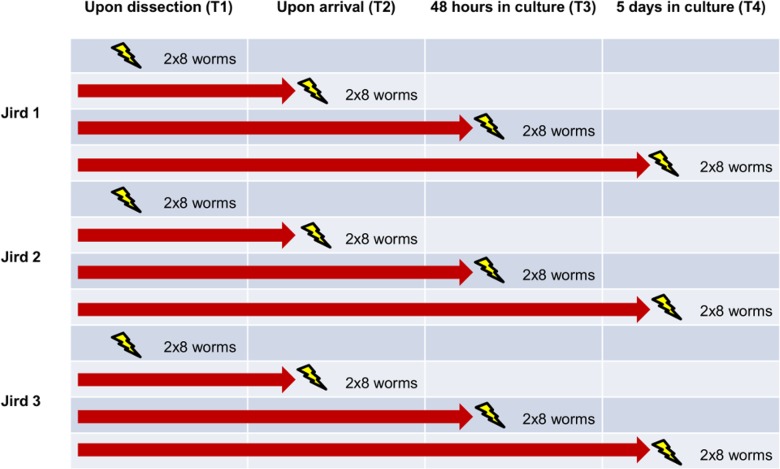
METHODOLOGY/PRINCIPAL FINDINGS: Using Illumina RNA sequencing, we characterized changes in gene expression upon in vitro maintenance of adult B. malayi female worms at four time points: immediately upon removal from the host, immediately after receipt following shipment, and after 48 h and 5 days in liquid culture media. The dramatic environmental change and the 24 h time lapse between removal from the host and establishment in culture caused a globally dysregulated gene expression profile. We found a maximum of 562 differentially expressed genes based on pairwise comparison between time points. After an initial shock upon removal from the host and shipping, a few stress fingerprints remained after 48 h in culture and until the experiment was stopped. This was best illustrated by a strong and persistent up-regulation of several genes encoding cuticle collagens, as well as serpins.
CONCLUSIONS/SIGNIFICANCE: These findings suggest that B. malayi can be maintained in culture as a valid system for pharmacological and biological studies, at least for several days after removal from the host and adaptation to the new environment. However, genes encoding several stress indicators remained dysregulated until the experiment was stopped.
丝虫线虫在热带国家的人群中引发严重且使人衰弱的感染,导致贫困的恶性循环难以消除。在实验室环境中,只有一种人体丝虫寄生虫——马来布鲁线虫能够在啮齿动物体内维持存活。它一直是在采用培养系统的实验中广泛使用的模式生物,但其对蠕虫的影响尚不清楚。
方法/主要发现:我们使用Illumina RNA测序技术,对成年马来布鲁线虫雌性蠕虫在体外培养的四个时间点的基因表达变化进行了表征:从宿主取出后立即、运输后接收时、在液体培养基中培养48小时和5天后。从宿主取出到在培养环境中建立之间剧烈的环境变化和24小时的时间间隔导致了整体基因表达谱失调。基于时间点之间的成对比较,我们发现最多有562个差异表达基因。从宿主取出并运输后最初的冲击过后,培养48小时直至实验结束,仍有一些应激特征存在。这最明显地表现为几个编码表皮胶原蛋白以及丝氨酸蛋白酶抑制剂的基因持续强烈上调。
结论/意义:这些发现表明,马来布鲁线虫可以在培养中作为药理学和生物学研究的有效系统维持存活,至少在从宿主取出并适应新环境后的几天内如此。然而,直到实验结束,几个编码应激指标的基因仍处于失调状态。