Pino-Angeles Almudena, Leveritt John M, Lazaridis Themis
Department of Chemistry, The City College of New York, New York, New York, United States of America.
PLoS Comput Biol. 2016 Jan 4;12(1):e1004570. doi: 10.1371/journal.pcbi.1004570. eCollection 2016 Jan.
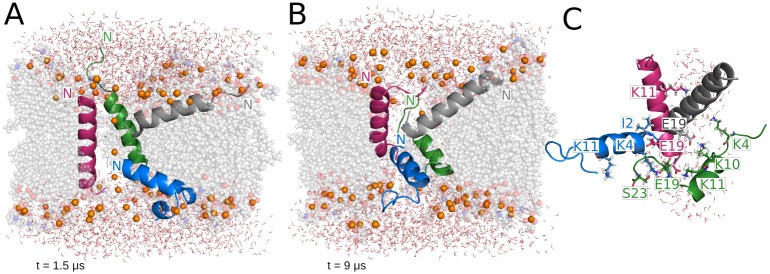
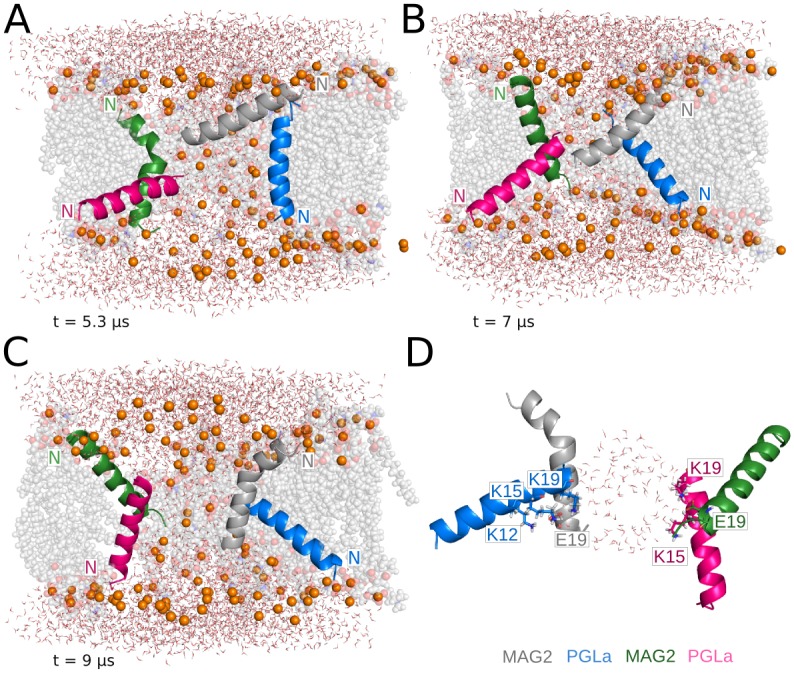
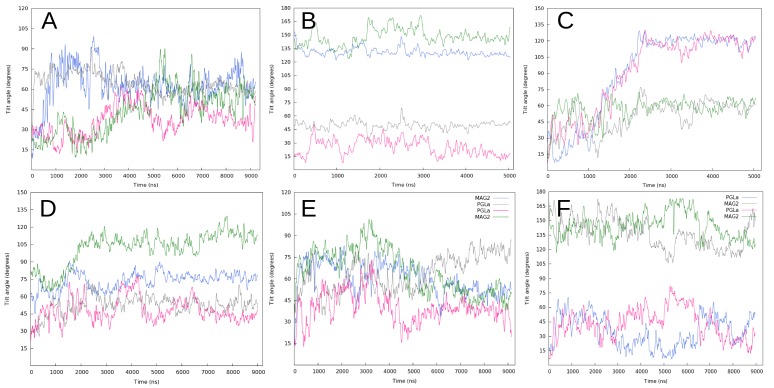
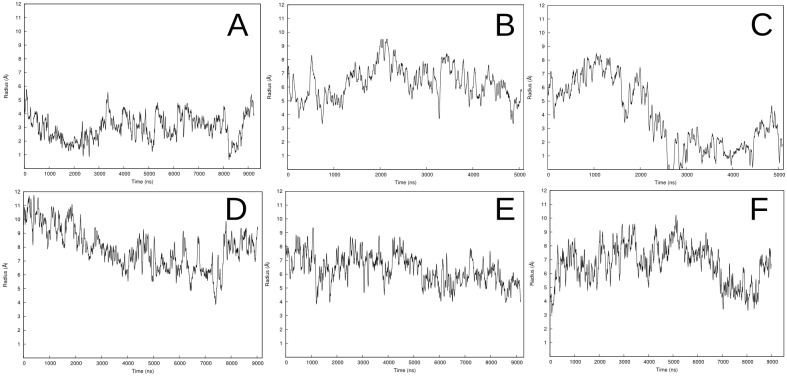
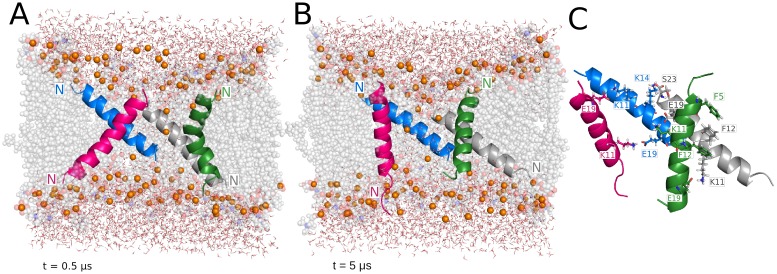
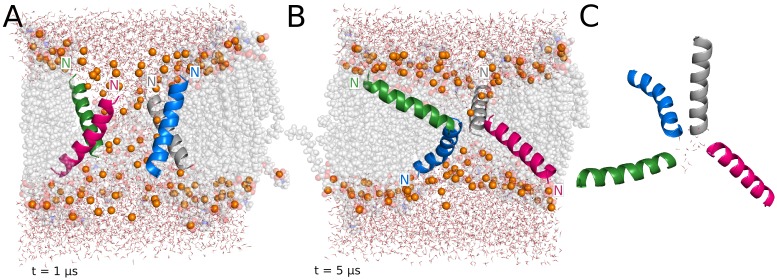
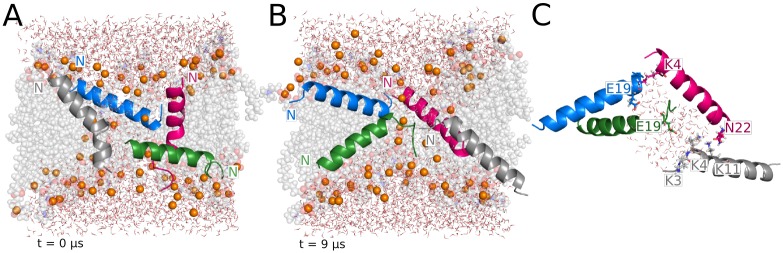
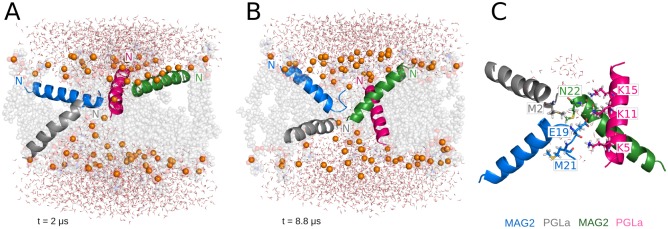
Magainin 2 and PGLa are among the best-studied cationic antimicrobial peptides. They bind preferentially to negatively charged membranes and apparently cause their disruption by the formation of transmembrane pores, whose detailed structure is still unclear. Here we report the results of 5-9 μs all-atom molecular dynamics simulations starting from tetrameric transmembrane helical bundles of these two peptides, as well as their stoichiometric mixture, and the analog MG-H2 in DMPC or 3:1 DMPC/DMPG membranes. The simulations produce pore structures that appear converged, although some effect of the starting peptide arrangement (parallel vs. antiparallel) is still observed on this timescale. The peptides remain mostly helical and adopt tilted orientations. The calculated tilt angles for PGLa are in excellent agreement with recent solid state NMR experiments. The antiparallel dimer structure in the magainin 2 simulations resembles previously determined NMR and crystal structures. More transmembrane orientations and a larger and more ordered pore are seen in the 1:1 heterotetramer with an antiparallel helix arrangement. Insights into the mechanism of synergy between these two peptides are obtained via implicit solvent modeling of homo- and heterodimers and analysis of interactions in the atomistic simulations. This analysis suggests stronger pairwise interactions in the heterodimer than in the two homodimers.
蛙皮素2(Magainin 2)和PGLa是研究最为深入的阳离子抗菌肽。它们优先结合带负电荷的膜,显然是通过形成跨膜孔来破坏膜结构,而跨膜孔的详细结构仍不清楚。在此,我们报告了从这两种肽的四聚体跨膜螺旋束、它们的化学计量混合物以及在二肉豆蔻酰磷脂酰胆碱(DMPC)或3:1的DMPC/二肉豆蔻酰磷脂酰甘油(DMPG)膜中的类似物MG-H2开始的5 - 9微秒全原子分子动力学模拟结果。模拟产生的孔结构似乎趋于一致,尽管在此时间尺度上仍能观察到起始肽排列(平行与反平行)的一些影响。这些肽大多保持螺旋结构并采取倾斜取向。PGLa计算出的倾斜角与最近的固态核磁共振实验结果高度吻合。蛙皮素2模拟中的反平行二聚体结构类似于先前确定NMR和晶体结构。在具有反平行螺旋排列的1:1异源四聚体中观察到更多的跨膜取向以及更大且更有序的孔。通过对同二聚体和异二聚体的隐式溶剂建模以及对原子模拟中相互作用的分析,深入了解了这两种肽之间的协同作用机制。该分析表明异二聚体中的成对相互作用比两个同二聚体中的更强。