Spira Daniel, Germann Thomas, Lehner Burkhard, Hemmer Stefan, Akbar Michael, Jesser Jessica, Weber Marc-André, Rehnitz Christoph
Diagnostic and Interventional Radiology, University Hospital Heidelberg, Im Neuenheimer Feld 110, 69120 Heidelberg, Germany.
Clinic for Orthopedics and Trauma Surgery, University Hospital Heidelberg, Schlierbacher Landstrasse 200a, 69118 Heidelberg, Germany.
PLoS One. 2016 Jan 4;11(1):e0146399. doi: 10.1371/journal.pone.0146399. eCollection 2016.
To search for imaging characteristics distinguishing patients with successful from those with futile microbiological pathogen detection by CT-guided biopsy in suspected spondylodiscitis.
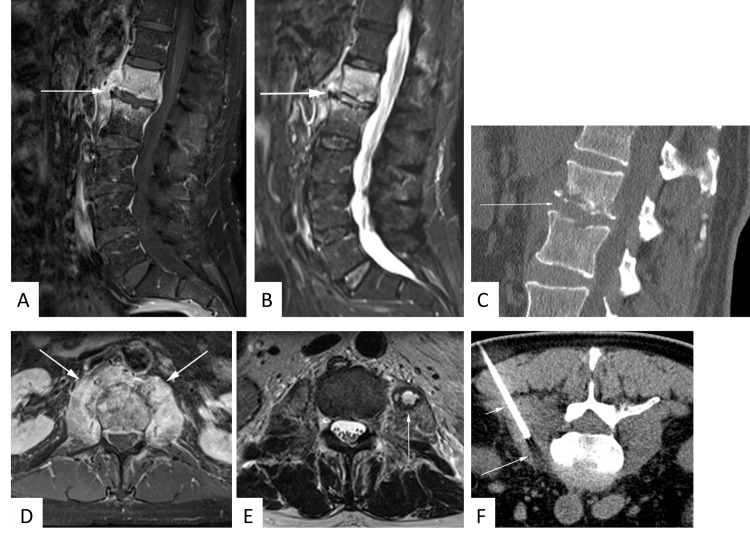
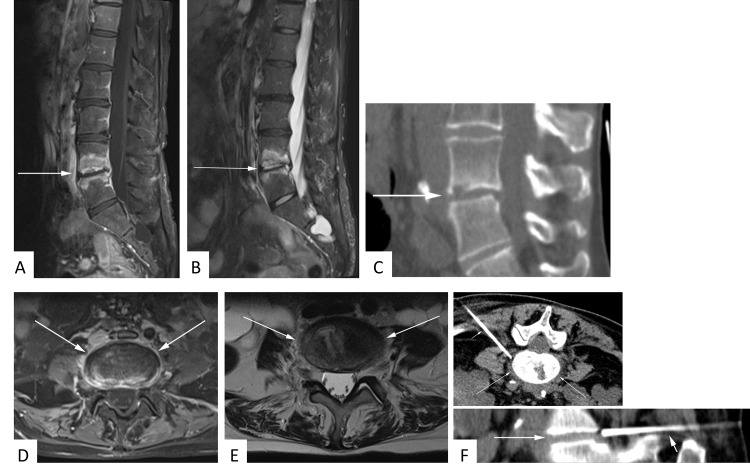
34 consecutive patients with suspected spondylodiscitis underwent CT-guided biopsy for pathogen detection. MR-images were assessed for inflammatory infiltration of disks, adjacent vertebrae, epidural and paravertebral space. CT-images were reviewed for arrosion of adjacent end plates and reduced disk height. Biopsy samples were sent for microbiological examination in 34/34 patients, and for additional histological analysis in 28/34 patients.
Paravertebral infiltration was present in all 10/10 patients with positive microbiology and occurred in only 12/24 patients with negative microbiology, resulting in a sensitivity of 100% and a specificity of 50% for pathogen detection. Despite its limited sensitivities, epidural infiltration and paravertebral abscesses showed considerably higher specificities of 83.3% and 90.9%, respectively. Paravertebral infiltration was more extensive in patients with positive as compared to negative microbiology (p = 0.002). Even though sensitivities for pathogen detection were also high in case of vertebral and disk infiltration, or end plate arrosion, specificities remained below 10%.
Inflammatory infiltration of the paravertebral space indicated successful pathogen detection by CT-guided biopsy. Specificity was increased by the additional occurrence of epidural infiltration or paravertebral abscesses.
探寻在疑似脊椎椎间盘炎中,通过CT引导下活检成功检测出微生物病原体的患者与检测失败患者之间的影像学特征差异。
34例连续的疑似脊椎椎间盘炎患者接受了CT引导下的活检以检测病原体。对磁共振成像(MR)图像评估椎间盘、相邻椎体、硬膜外和椎旁间隙的炎症浸润情况。对CT图像评估相邻终板的侵蚀和椎间盘高度降低情况。34例患者的活检样本均送去进行微生物学检查,28例患者还进行了额外的组织学分析。
10例微生物学检测呈阳性的患者均有椎旁浸润,而24例微生物学检测呈阴性的患者中只有12例有椎旁浸润,病原体检测的敏感性为100%,特异性为50%。尽管硬膜外浸润和椎旁脓肿的敏感性有限,但它们的特异性分别高达83.3%和90.9%。与微生物学检测呈阴性的患者相比,微生物学检测呈阳性的患者椎旁浸润更广泛(p = 0.002)。即使在椎体和椎间盘浸润或终板侵蚀的情况下病原体检测的敏感性也很高,但特异性仍低于10%。
椎旁间隙的炎症浸润表明CT引导下活检成功检测出病原体。硬膜外浸润或椎旁脓肿的额外出现可提高特异性。