Lee Ling, Genge Christine E, Cua Michelle, Sheng Xiaoye, Rayani Kaveh, Beg Mirza F, Sarunic Marinko V, Tibbits Glen F
Molecular Cardiac Physiology Group, Department of Biomedical Physiology and Kinesiology, Simon Fraser University, 8888 University Drive, Burnaby, BC V5A 1S6, Canada.
Child and Family Research Institute, Department of Cardiovascular Science, 950 West 28th Ave, Vancouver, BC V5Z 4H4, Canada.
PLoS One. 2016 Jan 5;11(1):e0145163. doi: 10.1371/journal.pone.0145163. eCollection 2016.
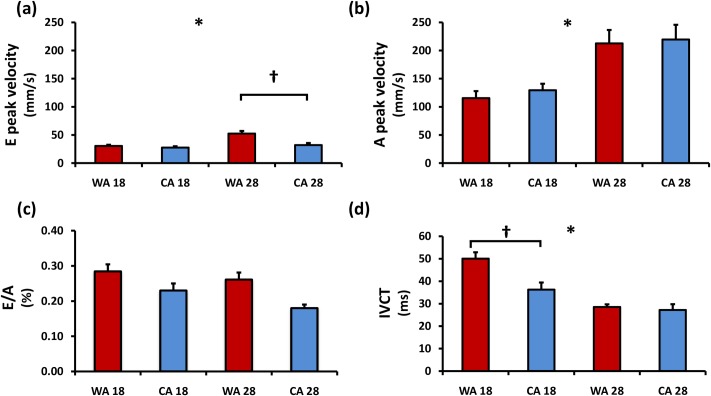
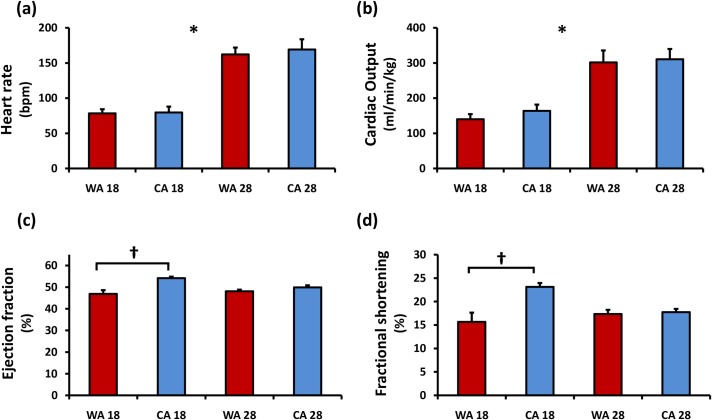
The zebrafish (Danio rerio) is an important organism as a model for understanding vertebrate cardiovascular development. However, little is known about adult ZF cardiac function and how contractile function changes to cope with fluctuations in ambient temperature. The goals of this study were to: 1) determine if high resolution echocardiography (HRE) in the presence of reduced cardiodepressant anesthetics could be used to accurately investigate the structural and functional properties of the ZF heart and 2) if the effect of ambient temperature changes both acutely and chronically could be determined non-invasively using HRE in vivo. Heart rate (HR) appears to be the critical factor in modifying cardiac output (CO) with ambient temperature fluctuation as it increases from 78 ± 5.9 bpm at 18°C to 162 ± 9.7 bpm at 28°C regardless of acclimation state (cold acclimated CA- 18°C; warm acclimated WA- 28°C). Stroke volume (SV) is highest when the ambient temperature matches the acclimation temperature, though this difference did not constitute a significant effect (CA 1.17 ± 0.15 μL at 18°C vs 1.06 ± 0.14 μl at 28°C; WA 1.10 ± 0.13 μL at 18°C vs 1.12 ± 0.12 μl at 28°C). The isovolumetric contraction time (IVCT) was significantly shorter in CA fish at 18°C. The CA group showed improved systolic function at 18°C in comparison to the WA group with significant increases in both ejection fraction and fractional shortening and decreases in IVCT. The decreased early peak (E) velocity and early peak velocity / atrial peak velocity (E/A) ratio in the CA group are likely associated with increased reliance on atrial contraction for ventricular filling.
斑马鱼(Danio rerio)是理解脊椎动物心血管发育的重要模式生物。然而,对于成年斑马鱼的心脏功能以及收缩功能如何变化以应对环境温度波动,我们了解甚少。本研究的目的是:1)确定在使用降低心脏抑制作用的麻醉剂的情况下,高分辨率超声心动图(HRE)是否可用于准确研究斑马鱼心脏的结构和功能特性;2)是否可以使用体内HRE非侵入性地确定环境温度急性和慢性变化的影响。心率(HR)似乎是随着环境温度波动改变心输出量(CO)的关键因素,因为无论适应状态如何(冷适应CA - 18°C;热适应WA - 28°C),心率都会从18°C时的78±5.9次/分钟增加到28°C时的162±9.7次/分钟。当环境温度与适应温度匹配时,每搏输出量(SV)最高,不过这种差异并不构成显著影响(CA在18°C时为1.17±0.15μL,在28°C时为1.06±0.14μl;WA在18°C时为1.10±0.13μL,在28°C时为1.12±0.12μl)。18°C时,冷适应组鱼的等容收缩时间(IVCT)显著缩短。与热适应组相比,冷适应组在18°C时收缩功能有所改善,射血分数和缩短分数均显著增加,IVCT缩短。冷适应组早期峰值(E)速度和早期峰值速度/心房峰值速度(E/A)比值降低,可能与心室充盈对心房收缩的依赖性增加有关。