
一种乳胶代谢物在根部食草动物攻击下有益于植物健康。
A Latex Metabolite Benefits Plant Fitness under Root Herbivore Attack.
作者信息
Huber Meret, Epping Janina, Schulze Gronover Christian, Fricke Julia, Aziz Zohra, Brillatz Théo, Swyers Michael, Köllner Tobias G, Vogel Heiko, Hammerbacher Almuth, Triebwasser-Freese Daniella, Robert Christelle A M, Verhoeven Koen, Preite Veronica, Gershenzon Jonathan, Erb Matthias
机构信息
Root Herbivore Interactions Group, Max-Planck Institute for Chemical Ecology, Jena, Germany.
Department of Biochemistry, Max-Planck Institute for Chemical Ecology, Jena, Germany.
出版信息
PLoS Biol. 2016 Jan 5;14(1):e1002332. doi: 10.1371/journal.pbio.1002332. eCollection 2016 Jan.
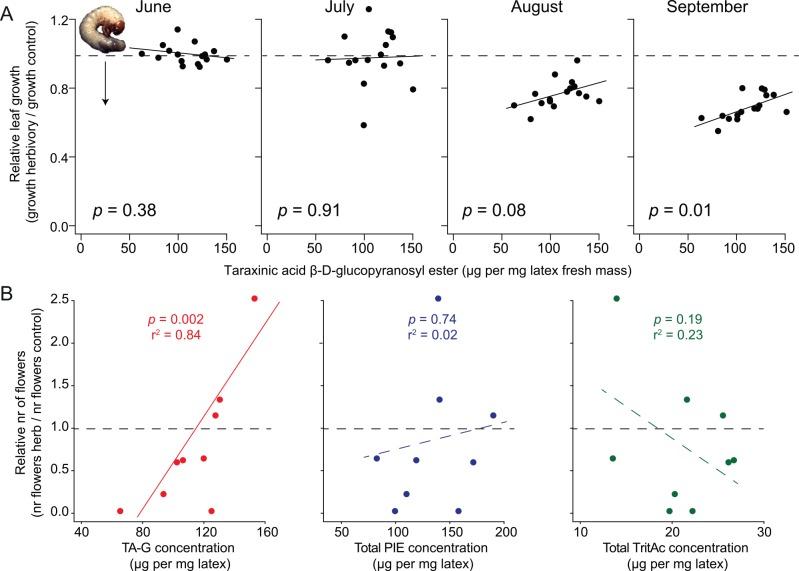
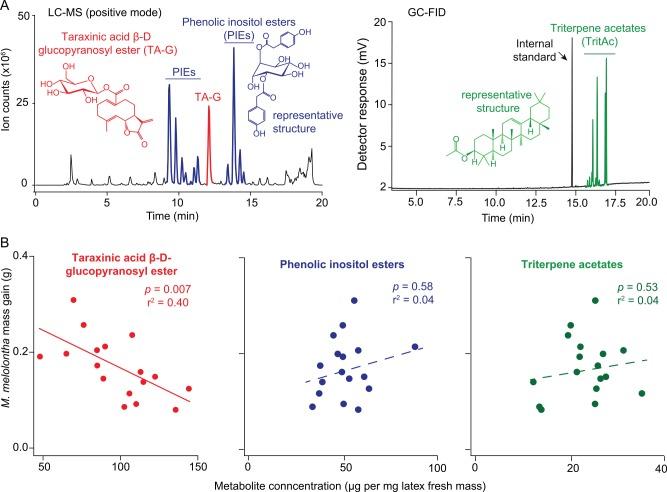
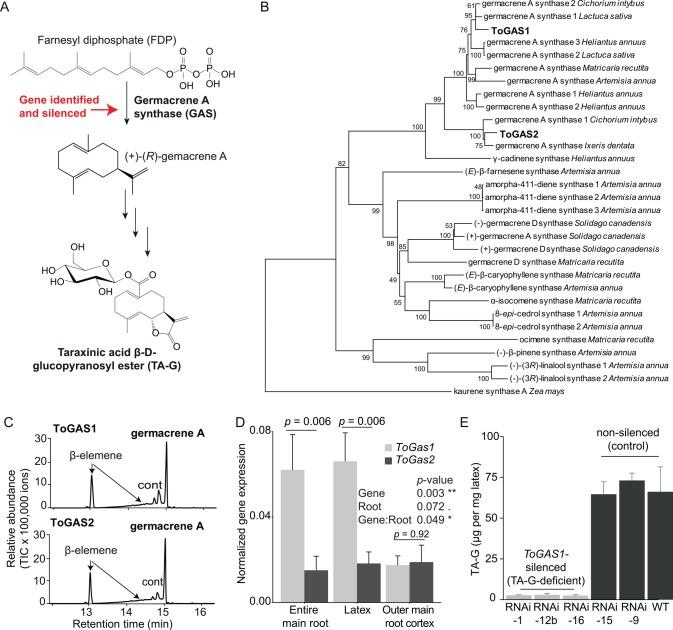
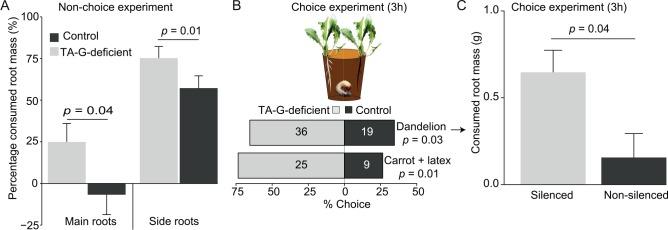
Plants produce large amounts of secondary metabolites in their shoots and roots and store them in specialized secretory structures. Although secondary metabolites and their secretory structures are commonly assumed to have a defensive function, evidence that they benefit plant fitness under herbivore attack is scarce, especially below ground. Here, we tested whether latex secondary metabolites produced by the common dandelion (Taraxacum officinale agg.) decrease the performance of its major native insect root herbivore, the larvae of the common cockchafer (Melolontha melolontha), and benefit plant vegetative and reproductive fitness under M. melolontha attack. Across 17 T. officinale genotypes screened by gas and liquid chromatography, latex concentrations of the sesquiterpene lactone taraxinic acid β-D-glucopyranosyl ester (TA-G) were negatively associated with M. melolontha larval growth. Adding purified TA-G to artificial diet at ecologically relevant concentrations reduced larval feeding. Silencing the germacrene A synthase ToGAS1, an enzyme that was identified to catalyze the first committed step of TA-G biosynthesis, resulted in a 90% reduction of TA-G levels and a pronounced increase in M. melolontha feeding. Transgenic, TA-G-deficient lines were preferred by M. melolontha and suffered three times more root biomass reduction than control lines. In a common garden experiment involving over 2,000 T. officinale individuals belonging to 17 different genotypes, high TA-G concentrations were associated with the maintenance of high vegetative and reproductive fitness under M. melolontha attack. Taken together, our study demonstrates that a latex secondary metabolite benefits plants under herbivore attack, a result that provides a mechanistic framework for root herbivore driven natural selection and evolution of plant defenses below ground.
植物在其地上部分和根部产生大量次生代谢产物,并将它们储存在专门的分泌结构中。尽管通常认为次生代谢产物及其分泌结构具有防御功能,但它们在食草动物攻击下对植物适应性有益的证据却很少,尤其是在地下部分。在这里,我们测试了普通蒲公英(Taraxacum officinale agg.)产生的乳胶次生代谢产物是否会降低其主要的本地昆虫根食草动物——普通鳃金龟(Melolontha melolontha)幼虫的性能,以及在普通鳃金龟的攻击下是否有利于植物的营养和繁殖适应性。通过气相色谱和液相色谱对17种蒲公英基因型进行筛选,倍半萜内酯蒲公英酸β-D-吡喃葡萄糖酯(TA-G)的乳胶浓度与普通鳃金龟幼虫的生长呈负相关。以生态相关浓度将纯化的TA-G添加到人工饲料中会减少幼虫的取食。沉默法呢烯A合酶ToGAS1(一种被鉴定为催化TA-G生物合成第一步的酶)会导致TA-G水平降低90%,并使普通鳃金龟的取食显著增加。普通鳃金龟更喜欢转基因的TA-G缺陷型品系,并且其根系生物量减少量是对照品系的三倍多。在一项涉及17种不同基因型的2000多个蒲公英个体的田间试验中,高TA-G浓度与在普通鳃金龟攻击下维持较高的营养和繁殖适应性相关。综上所述,我们的研究表明,一种乳胶次生代谢产物在食草动物攻击下对植物有益,这一结果为根食草动物驱动的自然选择和地下植物防御的进化提供了一个机制框架。

 Zotero 插件