Spencer Nick J
Department of Human Physiology and Centre for Neuroscience, Flinders University of South Australia Adelaide, SA, Australia.
Front Cell Neurosci. 2015 Dec 18;9:487. doi: 10.3389/fncel.2015.00487. eCollection 2015.
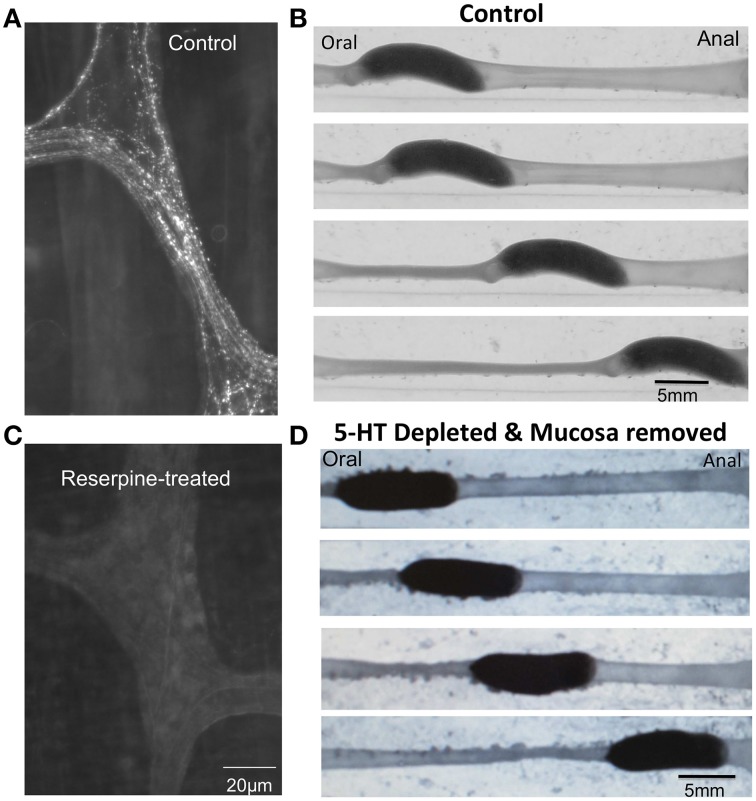
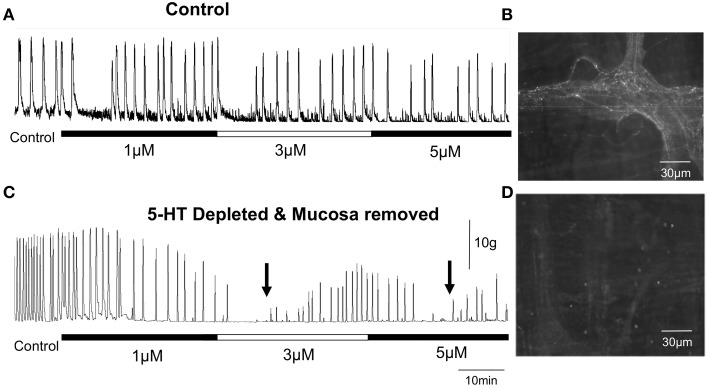
Antagonists of 5-Hydroxytryptamine (5-HT) receptors are well known to inhibit gastrointestinal (GI)-motility and transit in a variety of mammals, including humans. Originally, these observations had been interpreted by many investigators (including us) as evidence that endogenous 5-HT plays a major role in GI motility. This seemed a logical assumption. However, the story changed dramatically after recent studies revealed that 5-HT antagonists still blocked major GI motility patterns (peristalsis and colonic migrating motor complexes) in segments of intestine depleted of all 5-HT. Then, these results were further supported by Dr. Gershons' laboratory, which showed that genetic deletion of all genes that synthesizes 5-HT had minor, or no inhibitory effects on GI transit in vivo. If 5-HT was essential for GI motility patterns and transit, then one would expect major disruptions in motility and transit when 5-HT synthesis was genetically ablated. This does not occur. The inhibitory effects of 5-HT antagonists on GI motility clearly occur independently of any 5-HT in the gut. Evidence now suggests that 5-HT antagonists act on 5-HT receptors in the gut which are constitutively active, and don't require 5-HT for their activation. This would explain a long-standing mystery of how 5-HT antagonists inhibit gut motility in species like mice, rats, and humans where 5-HT is not an enteric neurotransmitter. Studies are now increasingly demonstrating that the presence of a neurochemical in enteric neurons does not mean they function as neurotransmitters. Caution should be exercised when interpreting any inhibitory effects of 5-HT antagonists on GI motility.
5-羟色胺(5-HT)受体拮抗剂能够抑制包括人类在内的多种哺乳动物的胃肠(GI)蠕动和转运,这是众所周知的。最初,许多研究者(包括我们)将这些观察结果解释为内源性5-HT在胃肠蠕动中起主要作用的证据。这似乎是一个合乎逻辑的假设。然而,最近的研究表明,在完全缺乏5-HT的肠段中,5-HT拮抗剂仍然能阻断主要的胃肠蠕动模式(蠕动和结肠移行运动复合体),情况发生了巨大变化。随后,格申斯博士的实验室进一步支持了这些结果,该实验室表明,所有合成5-HT的基因的基因缺失对体内胃肠转运的抑制作用很小或没有抑制作用。如果5-HT对胃肠蠕动模式和转运至关重要,那么当5-HT合成被基因消除时,人们会预期蠕动和转运出现重大破坏。但实际并非如此。5-HT拮抗剂对胃肠蠕动的抑制作用显然独立于肠道中的任何5-HT而发生。现在有证据表明,5-HT拮抗剂作用于肠道中组成性激活的5-HT受体,其激活不需要5-HT。这将解释一个长期存在的谜团,即5-HT拮抗剂如何在5-HT不是肠神经递质的小鼠、大鼠和人类等物种中抑制肠道蠕动。现在越来越多的研究表明,肠神经元中存在一种神经化学物质并不意味着它们起神经递质的作用。在解释5-HT拮抗剂对胃肠蠕动的任何抑制作用时应谨慎。