Hauken May Aasebø, Senneseth Mette, Dyregrov Atle, Dyregrov Kari
Center for Crisis Psychology, Bergen, Norway.
JMIR Res Protoc. 2015 Dec 30;4(4):e142. doi: 10.2196/resprot.5055.
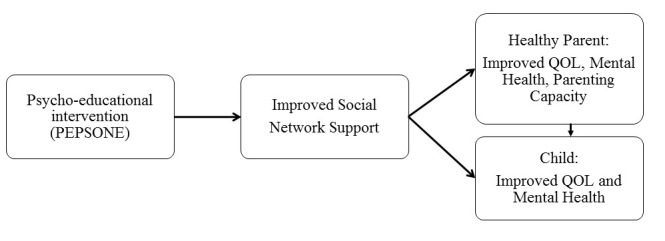
Parental cancer can have a significant impact on a family's psychosocial functioning and quality of life, whereby the children's situation is strongly related to parental coping and capacity. Such parents ask for more help in order to increase their care capacity, while the network is often insecure about how to help and thereby withdraw. They ask for guidance and training to be able to support cancer families. Based on this, the Cancer- Psycho-Educational Program for the SOcial NEtwork (PEPSONE) study was developed.
To optimize social network support through a psycho-educational program for families living with parental cancer and their network members in order to increase parental capacity and thereby secure the children's safety and quality of life.
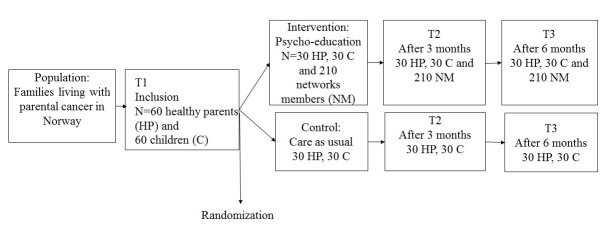
A randomized controlled trial (RCT) in which families (N=60) living with parental cancer will be randomized to either an intervention group or a control group. The intervention will last for 3 hours and includes (1) introduction, (2) psycho-education (living with cancer in the family and the importance of social network support), and (3) discussion (this family's need for social support). Primary outcomes are social support, mental health, and quality of life, and secondary outcomes are resilience and parental capacity. Data will be collected by a set of questionnaires distributed to healthy parents (N=60) living with a partner with cancer, one child in the family between 8-18 years of age (N=60), and network members (N=210) of the intervention families at inclusion, and after 3 and 6 months. Comparing differences between the intervention group (n=30) and the control group (n=30), the power analysis shows that P<.05 and a statistical power = .80 would detect effect sizes of clinical interest.
This paper presents the Cancer-PEPSON study's protocol to provide a broader understanding of the background and content of the program. The study is ongoing until August 2016 and the first results are anticipated to be finished by November 2015.
To our knowledge, this will be the first RCT study to optimize social network support through a psycho-educational program for families living with parental cancer and their network members, as well as provide an evidence basis for social network support. The results may provide important knowledge that is useful for clinical practice and further research. The trial is reported according to the CONSORT checklist.
International Standard Randomized Controlled Trial Number (ISRCTN): 15982171; http://www.controlled-trials.com/ISRCTN15982171/15982171 (Archived by WebCite at http://www.webcitation.org/6cg9zunS0).
父母患癌症会对家庭的心理社会功能和生活质量产生重大影响,儿童的情况与父母的应对方式和能力密切相关。这类父母寻求更多帮助以提高其照顾能力,而社交网络往往不确定如何提供帮助,从而选择退缩。他们需要指导和培训,以便能够支持癌症患者家庭。基于此,开展了针对社交网络的癌症心理教育项目(PEPSONE)研究。
通过为父母患癌症的家庭及其社交网络成员开展心理教育项目,优化社交网络支持,以提高父母的能力,从而保障儿童的安全和生活质量。
一项随机对照试验(RCT),将60个父母患癌症的家庭随机分为干预组或对照组。干预持续3小时,包括(1)介绍,(2)心理教育(家庭中与癌症共存及社交网络支持的重要性),以及(3)讨论(该家庭对社会支持的需求)。主要结局指标为社会支持、心理健康和生活质量,次要结局指标为心理弹性和父母能力。在纳入研究时、3个月和6个月后,通过向与患癌伴侣共同生活的健康父母(60名)、家庭中一名8至18岁的孩子(60名)以及干预组家庭的社交网络成员(210名)发放一组问卷来收集数据。比较干预组(n = 30)和对照组(n = 30)之间的差异,功效分析表明P <.05且统计功效 =.80时将检测到具有临床意义的效应大小。
本文介绍了癌症-PEPSON研究的方案,以更全面地了解该项目的背景和内容。该研究持续至2016年8月,预计首批结果将于2015年11月完成。
据我们所知,这将是第一项通过为父母患癌症的家庭及其社交网络成员开展心理教育项目来优化社交网络支持的随机对照试验研究,同时也为社交网络支持提供了证据基础。研究结果可能会提供对临床实践和进一步研究有用的重要知识。该试验按照CONSORT清单进行报告。
国际标准随机对照试验编号(ISRCTN):15982171;http://www.controlled-trials.com/ISRCTN15982171/15982171(由WebCite存档于http://www.webcitation.org/6cg9zunS0)