McNeely Marie E, Mai Marina M, Duncan Ryan P, Earhart Gammon M
Program in Physical Therapy, Washington University in St. Louis School of Medicine, St. Louis, MO, USA; Department of Neurology, Washington University in St. Louis School of Medicine, St. Louis, MO, USA.
Department of Anthropology, Washington University in St. Louis School of Medicine , St. Louis, MO , USA.
Front Aging Neurosci. 2015 Dec 21;7:239. doi: 10.3389/fnagi.2015.00239. eCollection 2015.
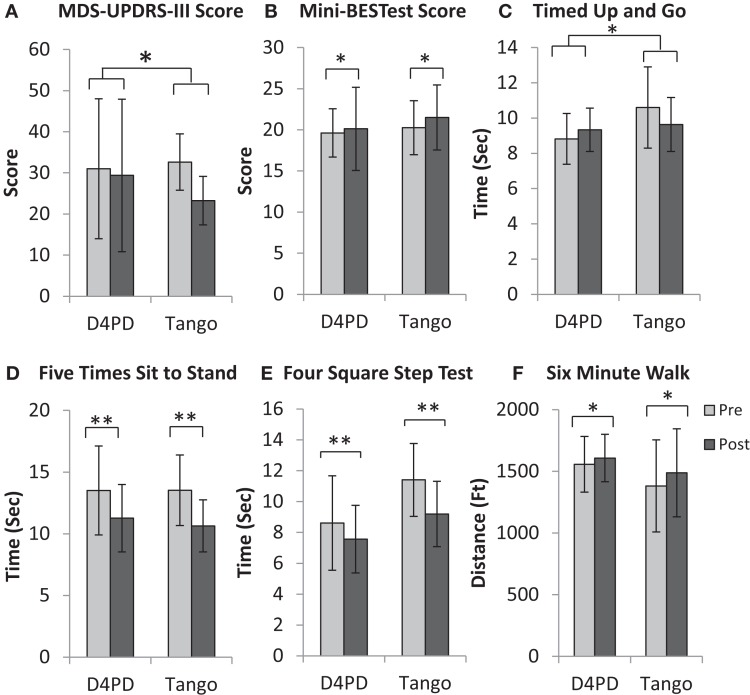
Over half of the general population does not achieve recommended daily levels of physical activity, and activity levels in people with Parkinson disease (PD) are lower than in healthy older adults. Dance can serve as an adjunct to traditional treatments to improve gait, balance, and quality of life in people with PD. This study directly compares a tango dance intervention and a dance intervention based on the Dance for PD model, which integrates multiple dance styles. Eleven people with PD participated in a community-based mixed styles dance intervention called Dance for Parkinson's (D4PD). Participants in the D4PD group were matched to participants in an ongoing community-based exercise study who participated in tango dance. The groups received 12 weeks of intervention, attending 1-h group classes twice a week. Participants were evaluated off anti-PD medication before and after intervention. Measures of balance, repeated sit-to-stand performance and endurance (mini-balance evaluation systems test, four square step test, five times sit to stand, 6-min walk time) improved from pre to post similarly in both groups. Motor sign severity (movement disorders society unified Parkinson disease rating scale motor subsection) and functional mobility (timed up and go) improved in the tango group and worsened in the D4PD group. Gait velocity was not affected by either intervention. Direct comparisons of different interventions are -critical for developing optimal exercise interventions designed to specifically target motor impairments in PD. Tango dance interventions may preferentially improve mobility and motor signs in people with PD, compared to D4PD.
超过半数的普通人群未达到推荐的每日身体活动水平,而帕金森病(PD)患者的活动水平低于健康的老年人。舞蹈可作为传统治疗的辅助手段,以改善PD患者的步态、平衡和生活质量。本研究直接比较了探戈舞蹈干预和基于帕金森病舞蹈(Dance for PD)模型的舞蹈干预,后者融合了多种舞蹈风格。11名PD患者参加了一项名为帕金森病舞蹈(D4PD)的社区混合风格舞蹈干预。D4PD组的参与者与正在进行的社区运动研究中参加探戈舞蹈的参与者进行匹配。两组接受了12周的干预,每周参加两次1小时的小组课程。在干预前后,参与者在停用抗PD药物的情况下接受评估。两组的平衡、反复坐立表现和耐力(迷你平衡评估系统测试、四方步测试、五次坐立、6分钟步行时间)测量指标从干预前到干预后均有类似改善。运动症状严重程度(运动障碍协会统一帕金森病评定量表运动部分)和功能性活动能力(计时起立行走测试)在探戈组有所改善,而在D4PD组则有所恶化。步态速度不受任何一种干预的影响。对不同干预措施进行直接比较对于制定旨在专门针对PD运动障碍的最佳运动干预措施至关重要。与D4PD相比,探戈舞蹈干预可能会优先改善PD患者的活动能力和运动症状。