Raikwar Shailendra, Srivastava Vineet K, Gill Sarvajeet S, Tuteja Renu, Tuteja Narendra
Plant Molecular Biology Group, International Centre for Genetic Engineering and Biotechnology New Delhi, India.
Stress Physiology and Molecular Biology Lab, Centre for Biotechnology, Maharshi Dayanand University Rohtak, India.
Front Plant Sci. 2015 Dec 16;6:1094. doi: 10.3389/fpls.2015.01094. eCollection 2015.
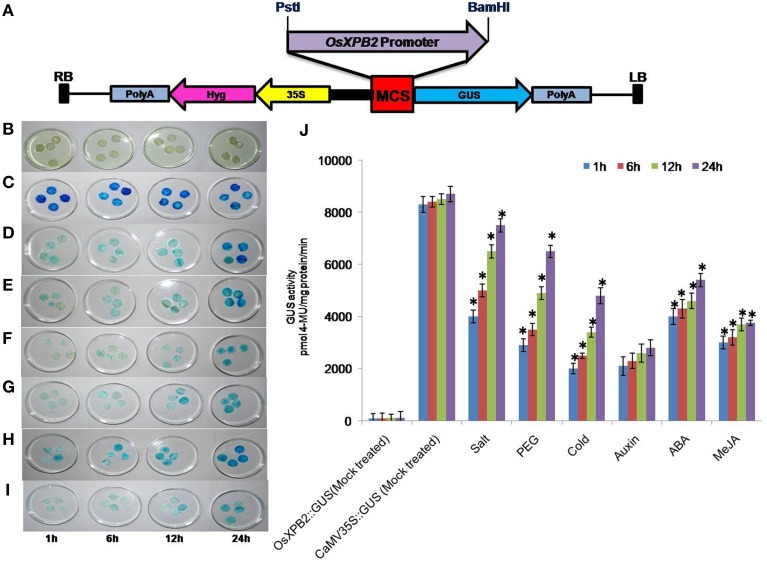
Genetic material always remains at the risk of spontaneous or induced damage which challenges the normal functioning of DNA molecule, thus, DNA repair is vital to protect the organisms against genetic damage. Helicases, the unique molecular motors, are emerged as prospective molecules to engineer stress tolerance in plants and are involved in nucleic acid metabolism including DNA repair. The repair helicase, XPB is an evolutionary conserved protein present in different organisms, including plants. Availability of few efficient promoters for gene expression in plants provoked us to study the promoter of XPB for better understanding of gene regulation under stress conditions. Here, we report the in silico analysis of novel stress inducible promoter of Oryza sativa XPB2 (OsXPB2). The in vivo validation of functionality/activity of OsXPB2 promoter under abiotic and hormonal stress conditions was performed by Agrobacterium-mediated transient assay in tobacco leaves using OsXPB2::GUS chimeric construct. The present research revealed that OsXPB2 promoter contains cis-elements accounting for various abiotic stresses (salt, dehydration, or cold) and hormone (Auxin, ABA, or MeJA) induced GUS expression/activity in the promoter-reporter assay. The promoter region of OsXPB2 contains CACG, GTAACG, CACGTG, CGTCA CCGCCGCGCT cis acting-elements which are reported to be salt, dehydration, cold, MeJA, or ABA responsive, respectively. Functional analysis was done by Agrobacterium-mediated transient assay using agroinfiltration in tobacco leaves, followed by GUS staining and fluorescence quantitative analyses. The results revealed high induction of GUS activity under multiple abiotic stresses as compared to mock treated control. The present findings suggest that OsXPB2 promoter is a multi-stress inducible promoter and has potential applications in sustainable crop production under abiotic stresses by regulating desirable pattern of gene expression.
遗传物质始终面临自发或诱导损伤的风险,这对DNA分子的正常功能构成挑战,因此,DNA修复对于保护生物体免受遗传损伤至关重要。解旋酶作为独特的分子马达,已成为在植物中构建胁迫耐受性的潜在分子,并参与包括DNA修复在内的核酸代谢。修复解旋酶XPB是一种在包括植物在内的不同生物体中都存在的进化保守蛋白。植物中用于基因表达的高效启动子较少,这促使我们研究XPB的启动子,以便更好地了解胁迫条件下的基因调控。在此,我们报告了水稻XPB2(OsXPB2)新型胁迫诱导启动子的电子分析。通过农杆菌介导的瞬时分析,利用OsXPB2::GUS嵌合构建体在烟草叶片中对OsXPB2启动子在非生物和激素胁迫条件下的功能/活性进行体内验证。本研究表明,在启动子-报告基因分析中,OsXPB2启动子含有顺式元件,这些元件导致了各种非生物胁迫(盐、脱水或冷)和激素(生长素、脱落酸或茉莉酸甲酯)诱导的GUS表达/活性。OsXPB2的启动子区域包含CACG、GTAACG、CACGTG、CGTCA CCGCCGCGCT顺式作用元件,据报道它们分别对盐、脱水、冷、茉莉酸甲酯或脱落酸有响应。通过农杆菌介导的瞬时分析,利用农杆菌浸润烟草叶片,随后进行GUS染色和荧光定量分析来进行功能分析。结果显示,与模拟处理的对照相比,在多种非生物胁迫下GUS活性有高度诱导。本研究结果表明,OsXPB2启动子是一种多胁迫诱导启动子,通过调节理想的基因表达模式,在非生物胁迫下的可持续作物生产中具有潜在应用价值。